



Home / SEO / Best Content Formats for AI Overview (Lists, FAQs, Guides)
Best Content Formats for AI Overview Key Takeaways
Choosing the Best Content Formats for AI Overview directly influences how often your material appears in AI-generated search results and featured snippets.
- Lists and comparison tables give AI clear, scannable data points that boost snippet capture rates.
- FAQs with markup answer multiple related queries, increasing the chance of appearing in multiple overview positions.
- Step-by-step guides satisfy how-to intents and often land in featured “steps” carousels.
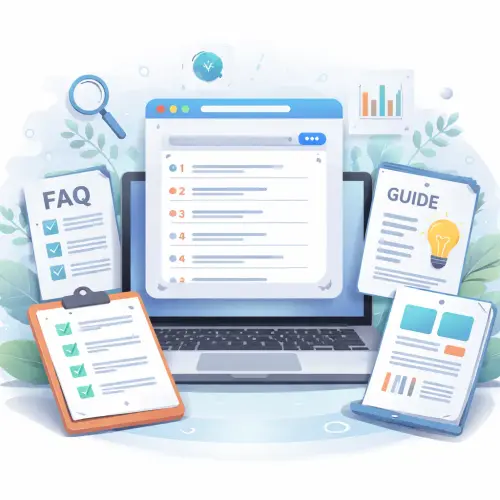
Lists work because AI models love enumerations. When you present a bulleted list or a numbered ranking, the algorithm can easily isolate each item and match it to a user’s query.
Best Practices for List-Based Content
- Start with a clear descriptor: “Top 5 tools for X” or “3 mistakes to avoid” gives AI a clean starting point.
- Use lists for AI overview naturally by placing the most important item first — AI often truncates lists to the first three entries.
- Add short explanations after each bullet (2–3 sentences) so the context is rich but not bloated.
Comparison Tables for Decision-Based Queries
When users compare products or services, a table is the Best Content Formats for AI Overview. AI extracts rows and columns directly, presenting them in the answer box. For a related guide, see How to Optimize Content for AI Overviews (Step-by-Step Guide).
| Format | Best For | Snippet Likelihood |
|---|---|---|
| Bulleted list | Quick tips, rankings, features | High |
| Numbered list | Step counts, top N items | High |
| Comparison table | Product vs product, category vs category | Very High |
Example: If you run a tech review site, a table comparing battery life, price, and weight across five smartphones will often appear in the AI Overview for “best budget phone 2025.”
FAQs: The Underrated Best Content Formats for AI Overview for Long-Tail Wins
FAQs serve a dual purpose: they answer multiple user questions in one place, and they naturally map to People Also Ask boxes and AI Overview panels. However, not all FAQ sections perform equally.
How to Structure an AI-Friendly FAQ
- Use exact question phrasing that real users search for (e.g., “How do I fix error code 404?”).
- Keep answers concise: 40–60 words per answer works best for snippet inclusion.
- Wrap the section in FAQ schema markup (JSON-LD) so search engines recognize it immediately.
For FAQs for AI overview, include a mix of primary questions (broad) and secondary questions (specific). For example, a recipe site might ask both “How do I make sourdough starter?” and “Can I use whole wheat flour instead of all-purpose?”.
Common FAQ Mistakes
- Writing answers that are too long — AI truncates after ~300 characters.
- Using vague questions that no one actually searches.
- Not including the focus keyword in at least three questions.
Guides and How-To Content: The Best Content Formats for AI Overview for Step-by-Step Queries
Google’s AI Overview increasingly features step-by-step instructions, especially for tasks that require sequence. If your content follows a logical order with clear headings, it can be pulled into a multi-step answer box. For a related guide, see AI Overview SEO Strategy: How to Stay Visible.
Anatomy of a Guide That Gets Featured
- Numbered steps with H3 headings (e.g.,
Step 1: Gather Your Ingredients
). - One step per heading — never combine two steps under one H3.
- Visual instructions — include images at each step (or placeholder for the main image).
- Estimated time and difficulty near the top of the guide.
For guides for AI overview, keep each step between 50–100 words. That brevity allows AI to extract the full step without cutting off context.
Example: How to Optimize a Blog Post (Quick Guide)
- Choose one focus keyword (like Best Content Formats for AI Overview) and place it in the first H2.
- Write a 2-sentence summary that answers the user’s core question.
- Add three to five subheadings that each address a specific angle.
- Include a FAQ section with schema markup.
- Publish, monitor, and refine based on snippet appearance.
Practical Implementation Tips for All Three Formats
No matter which format you choose, follow these universal rules to increase your chances of being featured in an AI Overview.
- Front-load your content: Put the most important point in the first 100 words.
- Use clear, descriptive headings that include the focus keyword or a direct variation.
- Add internal links to related articles to help AI understand your site’s topical authority.
- Test each format with a live query: Search for your target phrase and see which result structure appears. Model yours after that.
Keep in mind that the Best Content Formats for AI Overview evolve as search algorithms update. What works today may shift in six months, so revisit your top-performing pages quarterly and adjust the structure if needed.
Useful Resources
Frequently Asked Questions About Best Content Formats for AI Overview
What are the Best Content Formats for AI Overview ?
The top three formats are lists (bulleted and numbered), FAQs with structured data, and step-by-step guides. These formats give AI clear, extractable answers.
Why do lists work well for AI Overviews?
Lists let AI isolate individual items and match them to user queries. They are one of the most scannable AI Overview content formats.
Do FAQs help with featured snippets?
Yes, especially when you add FAQ schema markup. FAQs are one of the proven content formats for featured snippets.
How long should a FAQ answer be for AI Overview?
Keep answers between 40–60 words. Longer answers risk being truncated in the AI Overview box.
Can I use comparison tables for AI Overview?
Absolutely. Tables with clear rows and columns are among the best content formats for AI Overview because AI extracts them directly.
What is the best heading structure for a guide?
Use H2 for the main section and H3 for each step. Number the steps so AI can display them in order.
How do I choose between a list and a guide?
Choose a list when users want a quick answer (e.g., “top tools”). Choose a guide when they need sequential instructions (e.g., “how to set up”).
Do I need a specific keyword density for AI Overview?
No, but you should use the focus keyword naturally in headings and the first paragraph. Keyword stuffing hurts readability and rankings.
Can I mix formats in one article?
Yes, combining a list with a FAQ section often works well. Just make sure each format is clearly separated with its own heading.
What is the lists for AI overview best practice?
Always start a list with a descriptive sentence, then use bullet points. Place the strongest item first.
How often should I update my content for AI Overview?
Review your top pages every 3–6 months. Update statistics, add new items, and adjust structure if the SERP layout changes.
Do images affect AI Overview inclusion?
Yes, images with proper alt text can help context. But the text structure remains the primary factor.
What is the best way to test if my content is AI-Overview-friendly?
Search for your target query on Google and see which result appears in the overview. Then copy that structure in your own content. For a related guide, see How AI Overview Affects SEO Rankings in 2026.
Can I use JSON-LD schema for FAQs?
Yes, Google recommends JSON-LD for FAQ schema. It helps AI understand the question-answer pairs.
Are numbered lists better than bulleted lists for AI Overview ?
Numbered lists are better for rankings and sequences. Bulleted lists work well for features or attributes.
What is the ideal article length for AI Overview visibility?
Most articles that appear in AI Overviews are between 800 and 1,200 words. That gives enough depth without being too long.
Should I write for AI or for human readers first?
Write for humans first, but structure for AI. Clear headings, short paragraphs, and scannable lists benefit both.
Can eCommerce product pages use lists for AI Overview ?
Yes, product pages with feature bullet lists and comparison tables often get snippet placements. Use lists for AI overview to highlight specs.
What is the single most important factor for AI Overview inclusion?
Structure. No matter the format, if your content is not divided into clear, logical sections, AI will struggle to extract an answer.
Do I need to use the exact focus keyword in every H2?
No, but it should appear in at least two H2 headings. LSI keywords and variations are fine for the rest.