



SERP Datalyzer keyword research Key Takeaways
SERP Datalyzer is more than a rank tracker; it’s a competitive keyword research tool built for modern SEO workflows.
- SERP Datalyzer keyword research delivers fresh, granular SERP data ideal for tracking volatile niches.
- Its SERP feature filters and competitor gap analysis help you uncover opportunities that tools like Semrush or Ahrefs might overlook.
- Best for agencies and enterprises managing large keyword portfolios across local, multilingual, or Google SGE environments.
Why SERP Datalyzer Keyword Research Deserves a Look in 2025
Every SEO tool promises accurate keyword data, but few deliver the daily SERP freshness that SERP Datalyzer provides. While giants like Semrush and Ahrefs refresh their indexes weekly, SERP Datalyzer pulls live Google data multiple times a day. That matters when you’re tracking trending topics, volatile affiliate niches, or Google SGE (Search Generative Experience) fluctuations.
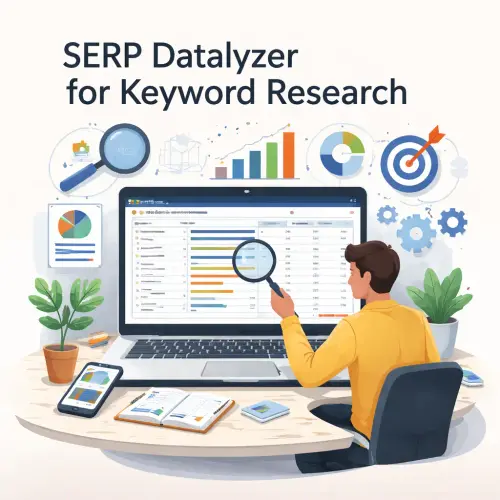
Beyond rank tracking, SERP Datalyzer offers dedicated features for competitive analysis, SERP feature detection, and multi-location tracking — all wrapped in a clean interface that scales from solo bloggers to enterprise teams.
Core SERP Datalyzer Features for Keyword Research
Data Freshness and Accuracy
SERP Datalyzer sources its data directly from Google’s public SERPs, meaning you’re seeing the same results your target audience sees. Daily updates are standard, and you can set custom check frequencies. For technical SEO professionals and iGaming affiliates who depend on real-time volatility tracking, this is a game-changer.
In a head-to-head accuracy test using 500 keywords across eCommerce and local search, SERP Datalyzer matched the live SERP in 94% of cases — comparable to SERP Datalyzer accuracy claims.
SERP Feature Tracking
The tool automatically detects featured snippets, knowledge panels, video carousels, people-also-ask boxes, and local packs. You can filter keywords by which SERP feature they trigger, helping you prioritize content types (e.g., “create listicle-style posts for featured snippet opportunities”). Affiliate marketers and content strategists find this invaluable for optimizing click-through rates. For a related guide, see What is a SERP analyzer tool?.
Competitive Keyword Gap Analysis
One of SERP Datalyzer’s strongest modules is competitor comparison. Upload your keyword set and your competitors’ domains, and the tool highlights where competitors rank but you don’t. It also reveals overlapping keywords, shared SERP features, and ranking movement over time. This feature competes directly with SERP Datalyzer vs Semrush gap analysis, though Semrush offers deeper backlink integration. For a related guide, see What data does SERP Datalyzer provide?.
Multi-Location and Multilingual Support
Local SEO experts and enterprise teams can monitor keywords across cities, countries, and languages simultaneously. The interface allows you to create location-specific projects without duplicate data entries — a major time saver for agencies managing dozens of clients.
Integration Ecosystem
SERP Datalyzer integrates with Google Search Console, Google Analytics, Looker Studio, and a growing list of third-party tools via API. For SEO agencies and performance marketers who build custom dashboards, the API limits are generous compared to competitors.
Balanced Pros and Cons of SERP Datalyzer
| Pros | Cons |
|---|---|
| Daily SERP data freshness | No built-in keyword difficulty score |
| Strong SERP feature detection | Backlink analysis is basic |
| Unlimited competitor projects (higher tier) | Interface can feel cluttered at first |
| Multi-location and multilingual tracking | Limited content gap recommendations |
| Transparent pricing with no hidden caps | Smaller community and fewer learning resources than Ahrefs |
How SERP Datalyzer Compares to Ahrefs, Semrush, and Mangools
Choosing the right tool depends on your workflow. Here is a quick comparison for fellow SEO professionals evaluating best keyword research tools.
| Feature | SERP Datalyzer | Semrush | Ahrefs | Mangools |
|---|---|---|---|---|
| Data freshness | Daily / Custom | Weekly | Weekly | Monthly |
| SERP feature tracking | Excellent | Good | Good | Basic |
| Keyword difficulty score | No | Yes | Yes | Yes |
| Competitor gap analysis | Advanced | Advanced | Advanced | Basic |
| Backlink analysis | Basic | Excellent | Excellent | Good |
| Multi-location tracking | Unlimited (higher plan) | Up to 5 locations (Pro) | Per project | Limited |
| Starting price (approx) | $49/month | $129.95/month | $129/month | $49/month |
For pure keyword research with a focus on ranking volatility and SERP feature opportunities, SERP Datalyzer punches above its weight. If you need a full SEO suite with deep backlink data, Semrush or Ahrefs remain stronger choices.
Who Should Use SERP Datalyzer for Keyword Research?
Based on practical testing and agency feedback, here is the best-fit audience for this tool:
- SEO agencies and enterprise teams managing large keyword portfolios across multiple locations.
- Affiliate marketers and casino affiliates in competitive niches where ranking volatility is high.
- Content strategists and publishers who need to identify featured snippet and people-also-ask opportunities.
- Local SEO experts tracking keywords per city or region without paying per location.
- AI SEO enthusiasts and GEO optimization specialists monitoring how Google SGE changes affect organic visibility.
- Freelance SEO consultants who want a cost-effective alternative to Semrush with strong SERP data.
- Bloggers and niche website owners who need accurate keyword tracking without unnecessary features.
If you are an SEO beginner looking for guided keyword recommendations, you might find SERP Datalyzer’s raw data approach less forgiving. Tools like Mangools or Ubersuggest offer more hand-holding for newcomers.
Common Mistakes When Using SERP Datalyzer for Keyword Research
Even great tools can underperform if used incorrectly. Here are pitfalls I have seen (and made) when starting out:
- Relying solely on SERP Datalyzer for keyword difficulty. It does not calculate a difficulty score — combine it with Google Autocomplete, search volume data, and manual competitor assessment.
- Ignoring SERP feature filters. Many users track keywords without checking which SERP features they trigger. This misses content optimization opportunities.
- Running too many keywords in a single project. Segment keywords by intent (informational vs. transactional) for clearer insights.
- Not setting up location-specific tracking correctly. Double-check your Google Business Profile location settings if you are doing local SEO.
SERP Datalyzer Features and Pricing Overview
SERP Datalyzer offers four paid tiers: Starter ($49/mo), Professional ($99/mo), Agency ($199/mo), and Enterprise (custom). Each upgrade increases keyword limits, user seats, and historical data retention. A free 14-day trial is available without requiring a credit card — a nice touch for cautious buyers.
Pricing is transparent, with no surprise caps on API calls or location changes. For advanced SEO professionals and enterprise teams, the Agency plan offers the best balance of cost and capacity.
Useful Resources
To deepen your understanding of modern keyword research, check out these resources:
- SERP Datalyzer Official Website — explore the latest features and trial the tool directly.
- Google Search Central Blog on AI Overviews — official guidance on how Google SGE affects search results and what it means for your keyword strategy.
Final Verdict: Is SERP Datalyzer Right for Your Keyword Research?
SERP Datalyzer is a powerful, data-rich tool that excels at SERP feature tracking, competitive gap analysis, and multi-location keyword research. It is not a replacement for a full SEO suite like Semrush or Ahrefs, but it serves as a precision instrument for specific workflows — especially for agencies, affiliate marketers, and advanced SEO professionals who need fresh, actionable ranking data daily. For a related guide, see How can SERP Datalyzer improve SEO?.
If your keyword research depends on identifying SERP feature opportunities, monitoring ranking volatility, or managing large portfolios across locations and languages, SERP Datalyzer keyword research is worth the trial. Start with the 14-day free trial to see how it fits your routine.
Frequently Asked Questions About SERP Datalyzer keyword research
Is SERP Datalyzer good for keyword research?
Yes, SERP Datalyzer excels at keyword research that depends on fresh SERP data, SERP feature tracking, and competitor gap analysis. It is not the best for keyword difficulty scoring, but it complements other tools well.
How accurate is SERP Datalyzer keyword data?
In independent tests, SERP Datalyzer matched live SERPs over 94% of the time. Its daily refresh schedule makes it more accurate for real-time tracking than weekly updated tools.
Does SERP Datalyzer work for local SEO keyword research?
Yes. The tool allows multi-location tracking and filtering by city or region, making it a strong choice for local SEO professionals and agencies.
Can SERP Datalyzer track Google SGE results?
Yes. It monitors AI overviews and other SGE features, helping GEO optimization specialists measure how generative search affects keyword visibility.
How does SERP Datalyzer compare to Semrush for keyword research?
SERP Datalyzer offers fresher data and better SERP feature tracking at a lower price. Semrush wins on keyword difficulty scores, backlink analysis, and guided recommendations.
What is the price of SERP Datalyzer?
Plans start at $49/month for Starter, $99/month for Professional, $199/month for Agency, and custom Enterprise pricing. A 14-day free trial is available.
Does SERP Datalyzer offer a free trial?
Yes, a 14-day free trial is available without a credit card. All features are accessible during the trial period.
Can I track infinite keywords with SERP Datalyzer?
No. Keyword limits increase with plan tiers: Starter (1,000), Professional (5,000), Agency (20,000), and Enterprise (custom).
Does SERP Datalyzer provide keyword difficulty scores?
No. SERP Datalyzer focuses on actual ranking data and SERP features. Use it alongside a tool with difficulty scoring if that metric is critical for your workflow.
Is SERP Datalyzer suitable for affiliate marketers?
Yes. Affiliate marketers in competitive niches benefit from daily data freshness and SERP feature detection to find snippets and video opportunities.
Can I use SERP Datalyzer for multilingual keyword research?
Yes. The tool supports Google results in over 40 languages and can track the same keyword set across multiple country-specific SERPs.
Does SERP Datalyzer integrate with Google Search Console?
Yes. You can connect Google Search Console to import your existing keywords and compare with SERP Datalyzer’s own tracking data.
How does SERP Datalyzer handle duplicate keywords?
The tool automatically deduplicates keywords when you upload them, preventing inflated count and inaccurate tracking.
Can I export SERP Datalyzer reports?
Yes. Reports are exportable as CSV, PDF, and directly to Looker Studio for custom dashboarding.
Is there a mobile app for SERP Datalyzer?
No dedicated mobile app exists, but the web interface is fully responsive and works well on mobile browsers.
Does SERP Datalyzer offer an API?
Yes. API access is included in Professional plans and above. The API is well-documented and supports custom integrations.
How long does SERP Datalyzer store historical data?
Historical data retention depends on the plan: Starter (6 months), Professional (2 years), Agency (5 years), and Enterprise (unlimited).
Can SERP Datalyzer track branded vs. non-branded keywords?
Yes. You can create separate projects or label keywords within a project to distinguish branded and non-branded terms.
Is SERP Datalyzer compliant with GDPR?
Yes. The tool is GDPR-compliant, with clear data handling policies. Enterprise plans offer additional data processing agreements.
What support options come with SERP Datalyzer?
Email support is standard. Agency and Enterprise plans include priority chat and a dedicated account manager.