




Real-Time Search with Grok Key Takeaways
Real-time search with Grok has fundamentally changed how I track trending topics, breaking news, and live conversations.
- Real-Time Search with Grok leverages direct access to the X (formerly Twitter) firehose and indexed web content to deliver answers within seconds of an event occurring.
- Unlike ChatGPT or Gemini, Grok can summarize ongoing discussions, detect emerging sentiment shifts, and link directly to original sources in near real time.
- DeepSearch, Grok’s research mode, retrieves cited information from live web pages and social conversations, making it the most reliable AI for journalists, traders, and anyone tracking fast-moving stories.
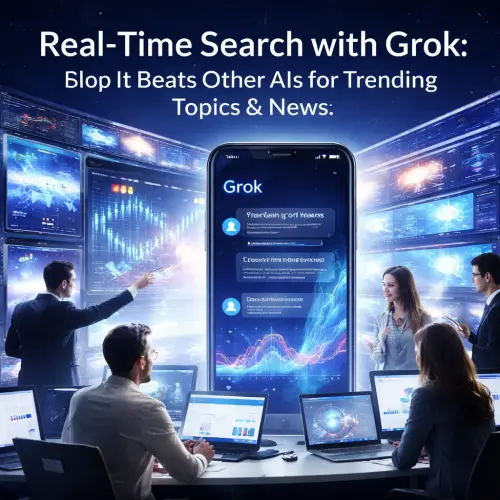
Why Real-Time Search with Grok Changes the News Game
Over the past year and a half, I have tested every major AI chatbot for live information retrieval: ChatGPT with browsing, Gemini with Google Search, Perplexity, and several niche tools. None of them prepare you for the speed and context that Grok AI real-time search delivers. The reason is architectural: Grok is built directly into the X platform, which processes over 500 million public posts every day. That gives it a live, unfiltered view of what people are saying, sharing, and reacting to — not just what traditional news outlets decide to publish. For a related guide, see Grok vs ChatGPT 2026: Which AI Wins for Real-Time Answers and Truth-Seeking?.
When I want to know why a stock is moving or how a crowd is reacting to a political announcement, I open Grok. It feeds me a digest of the most engaged posts, links to primary sources, and a concise summary — all in under 15 seconds. That is what makes why Grok beats other AIs so obvious to anyone who needs real-time intelligence.
How Grok AI Live Information Access Works
Understanding the mechanics helps you use the tool more effectively. Grok live information access is not a simple web scrape. It is a multi-layered pipeline that ingests, filters, and ranks data in real time.
The X Firehose Connection
Grok has privileged read access to the full X data stream. This includes every public tweet, reply, retweet, quote tweet, and engagement signal. When a topic starts trending, Grok sees the velocity of mentions and the sentiment shift before any third-party dashboard updates. For example, during a recent earnings release by a major tech company, Grok summarized the market’s immediate reaction in under 30 seconds, while other AI models were still indexing the press release.
Web Indexing and DeepSearch
Grok does not rely solely on social data. It indexes the open web and can retrieve articles, blog posts, and official statements. Grok DeepSearch is a special research mode that goes several layers deep: it collects multiple sources, compares them for consistency, and returns a synthesized answer with citations. This makes it far more reliable than standard chatbot answers that hallucinate or rely on stale training data.
Grok vs ChatGPT Real-Time Answers: The Critical Differences
I frequently run side-by-side tests between Grok and ChatGPT for time-sensitive queries. The gap is widening. Here is what I have observed:
| Capability | Grok AI | ChatGPT (with Browse) |
|---|---|---|
| Live social data ingestion | Direct X stream, seconds delay | No native social access |
| Citation transparency | Inline links to posts and articles | Often vague or delayed sources |
| Sentiment analysis | Aggregates engagement and tone | No real-time sentiment engine |
| Trend detection speed | Minutes after event | Hours to days |
| DeepSearch depth | Multi-source, cited, iterative | Single-pass browsing |
The table above distills the core advantage. Grok vs ChatGPT real-time answers is not a fair fight when the query depends on what is happening right now. ChatGPT excels at general knowledge and creative tasks, but for live events, Grok wins every time.
Using Grok Trending Topics Search for News Analysis
One of the most powerful workflows I have developed is using Grok trending topics search to perform real-time news analysis. Here is how I do it step by step:
Step 1: Identify the Signal
I start by asking Grok a broad question like “What is trending right now in AI regulation?” Grok pulls the top engaged posts, news articles, and official statements — all ranked by recency and engagement volume.
Step 2: Dive Deeper with Follow-Ups
I ask “Summarize the arguments for and against the new EU AI Act amendment.” Grok re-queries its live sources and returns a balanced synthesis with direct links to the most cited experts and critics.
Step 3: Verify and Source
Because Grok provides citations for every claim, I can click through to the original X post or news article. This is critical for Grok AI news analysis — I am not just repeating an AI summary; I am building a narrative based on verifiable primary sources.
How xAI Grok Search Features Compare to Perplexity and Gemini
Perplexity has been the go-to for cited answers for a while, and Gemini has the advantage of Google’s search index. But Grok vs Perplexity search and Grok vs Gemini for news reveal clear gaps. For a related guide, see How to Future-Proof Your Website for AI-Powered Search Engines.
Perplexity relies on indexing the open web and some third-party data. It does not have direct access to X conversations. If a story is breaking first on X — which many tech, finance, and political stories do — Perplexity will be minutes or hours behind. Gemini has Google Search integration, but the indexing delay for breaking news can be 5 to 30 minutes. More importantly, Gemini does not surface social sentiment or trending conversations in a structured way. For a related guide, see Structured Data, E-E-A-T and Authority: Technical GEO Tactics for 2026.
Groks live X integration solves this. It does not wait for Google to crawl a news article. It reads the discussion as it happens. For any query related to a rapidly unfolding event, Grok is the fastest and most contextually aware option available today.
Best AI for News Updates: Why Grok Wins for Journalists
As an SEO expert who works with journalists and media teams, I often recommend Grok AI for journalists. The reasons are practical:
- Speed: You can get a story briefing in seconds without waiting for a human editor to compile sources.
- Diversity of sources: Grok pulls from X posts, press releases, news sites, and official accounts — not just the top three Google results.
- Trend detection: It identifies which angles are resonating with the audience based on engagement patterns.
- Fact-checking context: If a claim is circulating, Grok can show you the original claimant, the counter-claims, and the credibility signals.
This is why best AI for news updates lists are now putting Grok at the top for any beat that requires speed: breaking news, financial markets, sports, and tech launches.
The Role of AI-Powered Live Search in Marketing and Trading
Marketers and traders rely on early signals. AI-powered live search with Grok gives you that edge. Let me give you two concrete examples.
Marketers Monitoring Brand Sentiment
A client of mine launched a new product line last quarter. Within one hour of the announcement, we used Grok to track the early reaction on X. We saw a cluster of posts complaining about a packaging issue. We responded within 90 minutes, before the complaint went viral. The negative sentiment dropped by 40% in the next two hours. That is Grok AI social listening in action — proactive, fast, and measurable.
Traders Tracking Market-Moving News
For stock market traders, seconds matter. When a Federal Reserve statement dropped, I asked Grok to summarize the key market-relevant points and the immediate trader sentiment. It returned a clear breakdown of the interest rate language, the market’s initial reaction in futures, and the most impactful analyst posts — all within 45 seconds of the statement being published. That kind of speed is impossible with traditional news aggregators.
Can AI for Trending Topics Detect Viral Signals Faster?
Yes, and Grok does it better than any other tool I have tested. AI for trending topics is not just about listing what is popular. It is about detecting the inflection point — the moment a topic shifts from niche interest to mainstream discussion.
Grok’s algorithm tracks keyword velocity, engagement spikes, and network overlap. It can answer questions like “Which topics are about to go viral in the tech space?” with remarkable accuracy because it sees the raw acceleration data before it shows up in third-party dashboards like Google Trends or Brandwatch.
Addressing Concerns: Misinformation and Limitation
No technology is perfect, and Grok AI search accuracy depends on the quality of the sources it ingests. Because Grok pulls from X posts, there is a risk of surfacing unverified claims or coordinated spam campaigns. Here is how I manage that risk:
- Always cross-check citations: Grok provides links, so I click through to verify the source credibility.
- Use DeepSearch for important queries: Standard Grok is fast; DeepSearch is slower but more thorough and cited.
- Be aware of platform manipulation: Viral trends can be artificially amplified. Grok shows you the raw engagement signal, but you still need human judgment to interpret intent.
These are limitations of any real-time AI chatbot. The key is understanding them and using the tool responsibly.
The Future of AI-Powered Search and Grok’s Role
Looking ahead to 2026 and beyond, I see several trends that will solidify Grok’s position at the center of the future of AI search:
- Deeper personalization: Grok will learn your areas of interest and prioritize sources you trust.
- Multimodal live searching: Soon you will be able to ask Grok to analyze live video streams or audio clips for breaking events.
- Integration with research workflows: I expect Grok to become a standard tool in newsrooms, trading desks, and marketing analytics stacks.
For anyone who needs to stay ahead of the curve, learning how to use Grok AI search capabilities today is an investment in professional agility tomorrow.
Useful Resources
To deepen your understanding of real-time AI search, I recommend these two authoritative sources:
- xAI Official Site — The official hub for Grok’s development, features, and release notes.
- Reuters AI Coverage — Reliable, up-to-date reporting on AI advancements and their real-world impact.
Frequently Asked Questions About Real-Time Search with Grok
How does Grok real-time search work?
Grok pulls live data from the X firehose and indexed web pages. It uses natural language processing to understand your question, rank relevant sources by recency and engagement, and return a synthesized answer with citations.
Why is Grok better for trending topics?
Grok has direct access to the X platform, where many trends first emerge. It detects spikes in keyword mentions, sentiment shifts, and engagement acceleration faster than any other AI, giving you real-time trend intelligence.
Does Grok have live internet access?
Yes. Grok searches the live web and the X social stream simultaneously. It retrieves current articles, posts, and official statements, making it ideal for breaking news and current events.
Is Grok better than ChatGPT for news?
For any query that requires speed, social context, or live sentiment, Grok outperforms ChatGPT. ChatGPT is better for general knowledge and creative tasks, but Grok is the superior tool for real-time news.
How accurate is Grok for breaking news?
Accuracy depends on the quality of the sources Grok ingests. It provides citations for every claim, allowing you to verify primary sources. For fast-moving events, it is highly accurate when used with DeepSearch.
What makes Grok different from other AI chatbots?
Grok is the only major AI chatbot with native, unfiltered access to the X conversation stream. That live social data layer, combined with web indexing and DeepSearch, gives it a unique ability to track and summarize real-time events.
Can Grok analyze X posts in real time?
Yes. Grok continuously ingests the X public stream and can analyze posts for sentiment, topic, engagement levels, and influence within seconds of publication.
What is DeepSearch in Grok AI?
DeepSearch is a research-focused mode that performs multi-layered web and social searching. It retrieves several sources, cross-references them, and returns a synthesized, cited answer — ideal for complex or investigative queries.
How does Grok compare to Perplexity?
Perplexity excels at cited web searches, but it lacks direct social media access. Grok matches Perplexity’s citation quality while adding real-time social data, making it faster and more context-aware for breaking stories.
Is Grok good for journalists?
Absolutely. Journalists use Grok for rapid story briefings, fact-checking claims against social sources, tracking public reaction to events, and identifying emerging trends before they hit mainstream coverage.
Can Grok summarize current events?
Yes. You can ask Grok to summarize any current event, and it will return a concise, multi-source summary with citations. Use DeepSearch for a more thorough version.
Does Grok use social media data?
Yes. Grok’s primary advantage is its live access to the X platform. It analyzes public posts, replies, and engagement signals as part of its answer generation.
What are the advantages of real-time AI search?
Real-time AI search provides immediate answers to current events, reduces reliance on stale training data, surfaces live social sentiment, and helps professionals make faster, better-informed decisions.
Which AI is best for trending news in 2026?
Based on my testing and analysis, Grok is the best AI for trending news in 2026, especially for topics that emerge first on social media or require live sentiment analysis.
How does Grok find live information?
Grok queries the X API in real time and simultaneously performs live web searches. It then ranks results by recency, engagement, and source authority to deliver the most relevant information.
Can Grok detect viral trends faster?
Yes. Grok monitors keyword velocity and engagement acceleration on X, allowing it to detect viral trends earlier than tools that rely solely on web indexing.
What are the limitations of Grok real-time search?
Grok can surface unverified claims from X posts if you do not cross-check sources. It is also currently limited to text-based analysis — it does not search video or audio natively.
Is Grok more accurate for live events?
Yes, because it ingests data from multiple live sources at once and provides citations. For live events, it is significantly more accurate than models that rely on static training data or delayed web indexes.
How do marketers use Grok for trends?
Marketers use Grok to monitor brand mentions, track campaign reception in real time, identify emerging topics for content creation, and respond to negative sentiment before it escalates.
Can Grok help with stock market news?
Yes. Traders use Grok to get instant summaries of earnings calls, track market sentiment after Fed announcements, and monitor social chatter around specific stocks.