Jin Grey | Senior SEO Consultant & Author. 18+ years of building technical growth systems and strategic roadmaps. Direct access, no junior staff, and 50+ eBooks for self-paced mastery. Strategy first.
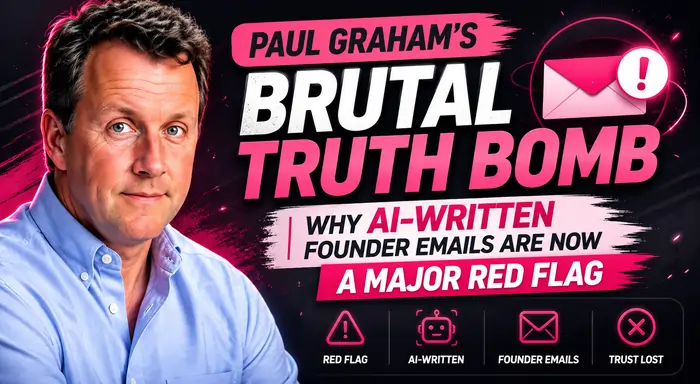
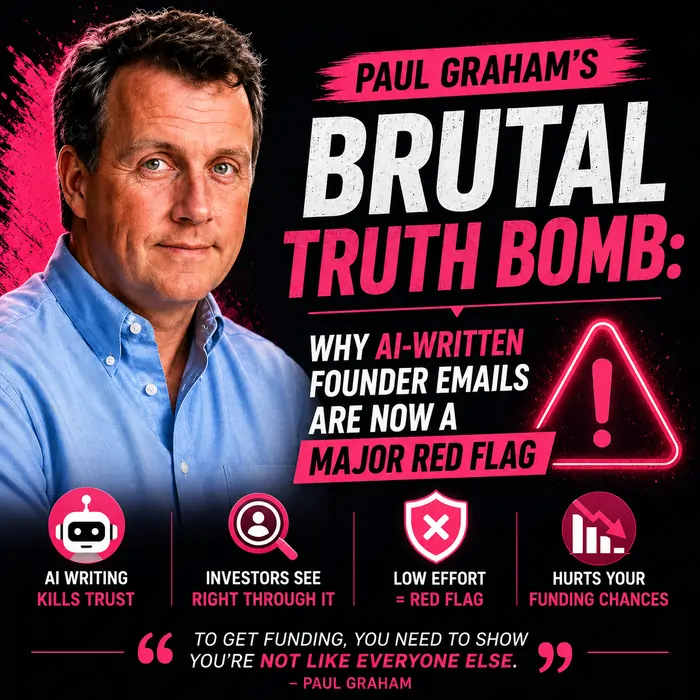
Paul Graham, co-founder of Y Combinator, has issued a stark warning to startup founders: AI-written emails to investors are now a significant red flag in venture capital fundraising. Graham’s statement reflects growing concern that generative AI in founder communication signals poor judgment, lack of authentic passion, and questionable leadership qualities. As AI detection becomes standard in investor due diligence, founders who rely on ChatGPT, Claude, or Gemini to draft investor outreach risk immediate rejection.
This analysis explores why AI-generated communication undermines founder credibility, how VCs identify machine-written emails, and what authentic fundraising outreach looks like in 2026.
Introduction: The Bombshell Statement That Shook Startup Twitter
The startup world moves fast, but certain voices carry weight that transcends the usual noise of venture capital Twitter. When Paul Graham speaks, founders listen. His track record as co-founder of Y Combinator—the accelerator behind Airbnb, Dropbox, Stripe, and Reddit—gives his words the force of institutional authority. So when Graham recently dropped a brutal truth bomb about AI-written founder emails, the reverberations spread through the startup ecosystem within hours.
His message was characteristically direct: founders who use AI to write their outreach emails to investors are displaying a fundamental misunderstanding of what fundraising actually requires. More damningly, he suggested that such emails now serve as an immediate red flag—a signal to investors that something is already wrong with the founder’s judgment, authenticity, or commitment.
This wasn’t just another hot take about generative AI disrupting another industry. This was Paul Graham, one of the most respected figures in early-stage investing, drawing a line in the sand. And when Graham draws lines, the startup world pays attention.
The implications ripple outward far beyond a single tweetstorm. Graham’s statement crystallizes a growing tension at the heart of the AI revolution: as large language models like ChatGPT, Claude, Gemini, and Perplexity become more capable and accessible, the boundaries between appropriate AI assistance and damaging AI dependence grow increasingly critical to define.
Nowhere are the stakes higher than in startup fundraising, where a single email can determine whether a founder gets a meeting that changes their company’s trajectory—or gets quietly rejected without ever knowing why.
Who Is Paul Graham and Why His Words Carry Weight
For those outside the startup ecosystem, understanding why Graham’s opinion matters requires context. Paul Graham is not merely a commentator on startups; he is one of the principal architects of the modern venture capital landscape. After selling his company Viaweb to Yahoo in 1998, he co-founded Y Combinator in 2005, pioneering the accelerator model that has since been replicated globally.
Y Combinator has funded over 4,000 startups with a combined valuation exceeding $600 billion. The organization’s alumni include some of the most transformative technology companies of the past two decades. Graham’s essays on startups, technology, and business—published on his personal website—have become foundational texts for aspiring entrepreneurs worldwide. H
is ability to identify patterns across thousands of founder interactions gives him a perspective that few others in the investment world can match.
When Graham identifies a pattern as a red flag, he is not speaking from theory. He is speaking from having reviewed tens of thousands of applications, conducted countless founder interviews, and observed which signals correlate with success and which with failure. His pattern recognition abilities, honed over decades of high-volume founder evaluation, are precisely what make his warning about AI-written emails so significant. He has seen enough to know what authentic founder communication looks like—and what it does not.
The Exact Statement: What Paul Graham Said About AI-Written Emails
Graham’s warning, shared across his social media presence and discussed in startup circles, was characteristically blunt. While the exact phrasing has been shared and reshared across platforms, the core message was unmistakable: founders who use AI to write their emails to investors are signaling that they either do not understand what investors are looking for, or worse, that they lack the authentic qualities that investors seek.
The statement cuts to the heart of what venture capital investment actually requires. Fundraising is not a bureaucratic exercise where polished prose wins the day. It is a human relationship-building process where trust, authenticity, and genuine connection matter more than grammatical perfection. An email that reads like it was generated by ChatGPT or Claude—however grammatically flawless—fundamentally fails at the actual task: beginning a human relationship that could last a decade or more.
Graham’s point was not that AI is inherently bad for all business communication. It was specifically about the context of founder-investor outreach, where the medium is very much part of the message. An AI-generated email communicates, paradoxically, that the founder was not willing to invest their own time and thought into the communication. If a founder cannot be bothered to write their own introductory email, what does that suggest about their willingness to do the genuinely hard work of building a company?
Why Founders Are Turning to AI for Investor Communications
To understand Graham’s warning fully, it is worth examining why founders are tempted to use generative AI for investor outreach in the first place. The reasons are not mysterious, and they reflect broader pressures in the startup ecosystem.
Time Pressure and Resource Constraints
Early-stage founders are chronically overwhelmed. They are simultaneously building product, recruiting early team members, managing customer relationships, and attempting to raise capital. The temptation to offload any task that can be delegated—including email composition—is powerful and understandable. AI tools promise to save hours that could theoretically be spent on more “important” work.
Perceived Quality Improvement
Many founders, particularly those from technical backgrounds, lack confidence in their writing abilities. They worry that imperfect prose will make them look unprofessional or unsophisticated. AI writing tools offer the seductive promise of polished, grammatically flawless communication that seems, on its surface, more impressive than what the founder might produce on their own.
Scalability Demands
Fundraising often requires reaching out to dozens or even hundreds of potential investors. The temptation to use AI to generate personalized-seeming emails at scale is intense. Founders tell themselves that they are simply being efficient, that the AI-generated email captures their ideas accurately, that investors will not notice or care.
Normalization of AI in Other Contexts
As ChatGPT, Claude, Gemini, and Copilot become integrated into daily workflows across industries, the line between acceptable and unacceptable AI use blurs. If AI is acceptable for internal memos, marketing copy, and customer support responses, why not for investor emails? Graham’s answer, implicitly, is that investor communications belong to a fundamentally different category of human interaction.
What Makes AI-Written Emails Instantly Detectable
Experienced investors develop pattern recognition skills that make AI-generated text surprisingly easy to identify. Understanding these tells helps explain why Graham and other VCs view AI-written emails as such a significant negative signal.
The Pattern Recognition Skills VCs Develop Over Decades
Venture capitalists, particularly those at firms like Y Combinator, review an enormous volume of founder communications. Over years and decades, they develop an intuitive sense for what authentic founder writing sounds like. This pattern recognition operates partly below conscious awareness—something feels “off” about an email before the reader can articulate exactly why.
Generic Language and Missing Personal Context
AI-generated emails tend toward generic phrasing that could apply to any investor and any startup. They lack the specific, granular details that signal genuine research and personal connection. An authentic founder email might reference a specific investment the VC made, a particular blog post they wrote, or a shared connection. AI-generated emails typically offer vague praise and generic fit statements.
Overly Polished Prose: When Perfect Grammar Becomes Suspicious
Paradoxically, grammatically perfect writing can itself be a red flag. Most founders, particularly technical founders operating under extreme time pressure, do not write with the polished perfection of a large language model. Their emails contain idiosyncrasies, informal constructions, and minor imperfections that signal human authorship. An email that reads like it was copy-edited by a professional raises questions.
Absence of Founder Voice: The Intangible Quality AI Cannot Replicate
The most important tell is also the most difficult to articulate. Every founder has a distinctive voice—a particular way of thinking about their problem space, expressing their vision, and communicating their passion. This voice emerges from deep domain expertise and genuine obsession with the problem they are solving. AI, regardless of how well-prompted, cannot replicate this authentic founder voice because it lacks the specific lived experience and emotional investment that produces it.
The Deeper Problem: What AI-Written Emails Signal About a Founder
Graham’s warning is not primarily about the aesthetic qualities of prose. It is about what the decision to use AI reveals about the founder making that decision.
Lack of Genuine Passion and Domain Expertise
The most successful founders are typically obsessed with their problem space. They think about it constantly. They have insights that come from deep immersion. This obsession naturally produces authentic, passionate communication. A founder who reaches for ChatGPT or Claude to express their vision may simply lack the authentic passion that produces the most compelling founder-investor connections.
Questionable Judgment and Self-Awareness Deficits
Using AI to write investor emails suggests a fundamental misreading of what the fundraising process requires. It indicates that the founder views investor communication as a bureaucratic hurdle to clear rather than a relationship-building opportunity. This lack of judgment extends beyond email—investors reasonably wonder what other important human interactions the founder might attempt to automate.
The Trust Deficit Created Before the First Meeting
Perhaps most damagingly, AI-generated emails create a trust deficit before the relationship even begins. If the first communication from a founder is discovered to be machine-generated, the investor immediately questions what else might be inauthentic. Trust, once broken, is extraordinarily difficult to rebuild, and an AI-written introduction email may prevent trust from ever forming in the first place.
When Is It Acceptable to Use AI in Fundraising Communications?
Graham’s warning is not a blanket condemnation of all AI use in business communication. The nuance matters, and understanding appropriate boundaries helps founders navigate the AI era effectively.
Appropriate AI Assistance: Grammar Checking and Structure Suggestions
Using AI tools to review grammar, suggest clearer phrasing, or help structure arguments is fundamentally different from having AI generate the entire communication. These applications enhance the founder’s authentic voice rather than replacing it. The key distinction is whether the AIis refining the founder’s thinking or substituting for it.
Where AI Crosses the Line: Complete Draft Generation
The red flag Graham identifies is specifically about using AI to generate the substantive content of investor communications. When a founder prompts an AI to “write an email introducing my startup to an investor,” they have crossed the line from assistance to replacement. The investor is being asked to connect with a machine’s output, not a founder’s authentic expression.
The Gray Area: AI-Assisted Brainstorming vs. AI-Generated Content
Between these clear cases lies a gray area. Using AI to brainstorm potential angles, explore different ways of framing a value proposition, or overcome writer’s block may be acceptable if the final output is genuinely the founder’s own. The test is simple: does the communication represent what the founder actually thinks and how they actually express themselves? If the answer is yes, AI may have played a helpful role. If the answer is no, the founder has a problem.
How VCs and Accelerators Are Adapting Their Evaluation Processes
Graham’s statement reflects a broader shift in how investment organizations approach founder evaluation in the AI era.
AI Detection Tools Being Deployed by Investment Teams
Investment firms are increasingly deploying AI detection software to screen written communications. These tools analyze text for patterns characteristic of large language modeloutput. While detection is not perfect, it adds another layer of scrutiny to founder communications and raises the stakes for those tempted to use AI inappropriately.
New Due Diligence Questions Emerging in 2026
Beyond technical detection, investors are adding new questions to their due diligence processes. Founders may be asked directly about their use of AI tools in communications. References checks now sometimes include inquiries about communication authenticity. The pattern is clear: investors are actively building AI awareness into their evaluation frameworks.
Pattern-Based Screening: What YC Partners Look For
Y Combinator partners, like Graham, have developed sophisticated pattern recognition for identifying authentic founder communication. They look for specific, non-obvious insights that demonstrate deep domain understanding. They notice when language feels generic or could apply to any company in the same sector. They pay attention to whether the founder seems to be expressing genuine thinking or reciting polished talking points.
Practical Guide: How to Write Authentic Founder Emails Without AI
For founders concerned about Graham’s warning, practical guidance on authentic communication is essential.
Start With Genuine Research and Personal Connection
Before writing, invest time in understanding the specific investor you are approaching. Read their blog posts, listen to their podcast appearances, understand their investment thesis. Reference something specific that demonstrates you have done your homework. This personalization cannot be faked by AI and immediately signals authenticity.
Write Like You Speak: Embracing Imperfection
Your email should sound like you, not like a corporate communications department. Use the vocabulary you naturally use. Include the analogies that make sense to you. Do not worry about grammatical perfection—authentic voice matters more than flawless prose. Investors are evaluating you, not your writing skills.
The Editing Process: Human Refinement Without AI Crutches
Edit your own writing or get feedback from human colleagues who know you well. The goal is to refine your authentic expression, not to replace it with something more polished but less genuine. If you struggle with writing, consider dictating your thoughts and then editing the transcription yourself.
Broader Implications for AI in Professional Communication
Graham’s warning extends beyond startup fundraising to raise broader questions about AI in professional communication.
The core tension is between efficiency and authenticity. AI tools undeniably increase productivity across many dimensions of business communication. But some communications carry weight that transcends efficiency considerations. Communications that establish human relationships, convey authentic passion, or represent personal commitment fall into this category.
The challenge for professionals across industries is developing nuanced judgment about where AIbelongs and where it does not. This judgment cannot be reduced to a simple rule. It requires understanding context, relationship stage, and what is actually at stake in a given communication.
Where AI Belongs in Business and Where It Absolutely Does Not
AI is well-suited for internal documentation, routine status updates, first drafts of marketing copy that will be heavily revised by humans, and communications where efficiency is the primary value. AI is poorly suited for communications that establish trust, convey authentic emotion, represent personal commitment, or initiate relationships that will depend on human connection.
Conclusion: Authenticity as a Competitive Advantage in the AI Era
Paul Graham’s warning about AI-written founder emails points toward a larger truth about the AI era: as machine-generated content becomes ubiquitous, authentic human communication becomes increasingly valuable and increasingly rare.
Founders who resist the temptation to automate their most important human interactions will stand out. Their communications will feel different to investors—more specific, more passionate, more genuine. In an environment where investors receive hundreds of emails that all sound vaguely similar, the founder who writes something unmistakably human has an immediate advantage.
Graham’s brutal truth is ultimately optimistic: authenticity cannot be automated. The qualities that make founders compelling to investors—genuine insight, authentic passion, unique perspective—remain exclusively human. AI can imitate the form of these qualities but cannot replicate their substance. For founders willing to do the genuinely human work of authentic communication, the AI era offers not a threat but an opportunity to stand out.
The question for founders is simple: when you reach out to an investor, are you demonstrating the authentic qualities that would make someone want to work with you for the next decade? Or are you demonstrating that you took the easiest possible path to get the email sent?
In Paul Graham’s world—and increasingly, in the broader world of early-stage investing—the answer to that question may determine whether you get a meeting or get ignored.
FAQ Questions with Answers
1. What did Paul Graham say about AI-written founder emails?
Paul Graham, co-founder of Y Combinator, stated that AI-written founder emails to investors are now a major red flag. He warned that using AI tools like ChatGPT or Claude to draft investor communications signals poor judgment, lack of authentic passion, and a fundamental misunderstanding of what fundraising requires. His statement reflects decades of experience evaluating thousands of founders and recognizing patterns that correlate with startup success or failure.
2. Why are AI-written emails considered a red flag by investors?
AI-written emails are considered a red flag because they signal that a founder either lacks genuine passion for their venture, has poor judgment about important human interactions, or is attempting to take shortcuts in relationship-building processes that require authentic human connection. Experienced investors view the decision to use AI for personal outreach as indicative of broader character and judgment issues.
3. Can investors actually detect AI-written emails?
Yes, experienced investors and Y Combinator partners develop sophisticated pattern recognition over decades of reviewing founder communications. AI-generated text tends to use generic phrasing, lack specific personal details, display overly polished grammar, and most importantly, miss the authentic founder voice that comes from genuine domain expertise and passion. Many investment firms are also deploying AI detection tools.
4. Is it ever acceptable to use AI for fundraising communications?
Limited AI assistance, such as grammar checking or suggesting structural improvements, may be acceptable if the substantive content remains genuinely the founder’s own expression. The key distinction is whether AI is refining the founder’s authentic voice or replacing it entirely. Complete draft generation crosses the line into problematic territory.
5. What should founders do instead of using AI for investor emails?
Founders should invest time in researching specific investors, write in their natural voice without worrying about grammatical perfection, focus on conveying genuine passion and domain expertise, and have human colleagues review drafts rather than relying on AI generation. The goal is authentic communication that reflects the founder’s actual thinking and personality.
6. Does Y Combinator have a policy against AI-written applications?
While Y Combinator has not published a formal policy specifically banning AI-written applications, Paul Graham’s public statements make clear that AI-generated content is viewed negatively in the evaluation process. The organization’s emphasis on authentic founder voice and genuine insight means that AI-written materials are likely to harm rather than help an application.
7. What are the most common signs an email was written by AI?
Common signs include generic language that could apply to any investor or startup, lack of specific personal details demonstrating genuine research, overly polished and grammatically perfect prose, absence of individual voice or idiosyncratic expression, and content that feels comprehensive but lacks genuine insight or unique perspective.
8. How does AI-written communication affect founder credibility?
AI-written communication damages founder credibility by creating an immediate trust deficit. If the first interaction with an investor is discovered to be machine-generated, the investor questions what else might be inauthentic about the founder’s presentation. This trust deficit is extremely difficult to overcome and may prevent a relationship from ever forming.
9. Are there industries where AI-written communication is more acceptable?
AI assistance is generally more acceptable for internal communications, routine status updates, marketing copy that will be heavily revised, and communications where efficiency rather than relationship-building is the primary value. It is least acceptable for communications that establish trust, convey authentic emotion, or initiate long-term human relationships.
10. What does Paul Graham’s warning mean for the future of AI in business?
Graham’s warning highlights the growing importance of understanding boundaries in AI usage. As AI becomes more capable, the value of authentic human communication increases. The ability to distinguish between situations where AI enhances human capability and situations where AI undermines human connection will become a critical professional skill.
11. How are venture capital firms adapting their processes for the AI era?
VC firms are increasingly deploying AI detection tools, adding new due diligence questions about communication authenticity, and training partners to identify AI-generated content. The industry is actively developing frameworks for evaluating founder authenticity in an environment where AI-generated text is increasingly common.
12. Can AI ever replicate authentic founder voice?
Current AI technology cannot replicate authentic founder voice because that voice emerges from specific lived experience, genuine emotional investment, and deep domain expertise that the AI does not possess. AI can imitate stylistic patterns but cannot generate the unique insights and authentic passion that characterize genuine founder communication.
13. What is the relationship between authentic communication and fundraising success?
Authentic communication is strongly correlated with fundraising success because early-stage investment is fundamentally about human relationships. Investors commit to working with founders for years or decades. Communication that demonstrates genuine thinking, authentic passion, and personal commitment builds the trust necessary for these long-term relationships to form.
14. How should founders balance efficiency and authenticity in communication?
Founders should identify which communications are primarily transactional and which are primarily relational. Transactional communications may benefit from AI assistance. Relational communications—including investor outreach, key hire recruitment, and important partnership discussions—should prioritize authenticity over efficiency. The time saved by AI-generating an investor email is meaningless if the email fails to accomplish its purpose.
15. What is the single most important thing founders should remember about investor communication?
The most important principle is that investor communication is a human relationship-building activity, not a bureaucratic hurdle. Every communication should demonstrate the qualities that would make someone want to work with you for the next decade: genuine insight, authentic passion, sound judgment, and personal integrity. AI cannot replicate these qualities, and attempting to substitute AI for authentic communication signals their absence.
16. Does Paul Graham’s warning apply to other professional contexts beyond fundraising?
While Graham’s statement specifically addresses founder-investor communication, the underlying principle extends broadly. Any professional communication that establishes trust, conveys authentic commitment, or initiates long-term human relationships should prioritize authenticity over AI-generated efficiency. This applies to job applications, partnership proposals, key client relationships, and other high-stakes human interactions.
17. What resources can help founders improve their authentic writing skills?
Founders can improve authentic writing by reading Paul Graham’s essays on startups and communication, practicing regular writing about their domain, seeking feedback from human mentors rather than AI tools, and studying examples of effective founder-investor communications. The goal is developing comfort with expressing genuine thinking in written form.