Jin Grey | Senior SEO Consultant & Author. 18+ years of building technical growth systems and strategic roadmaps. Direct access, no junior staff, and 50+ eBooks for self-paced mastery. Strategy first.
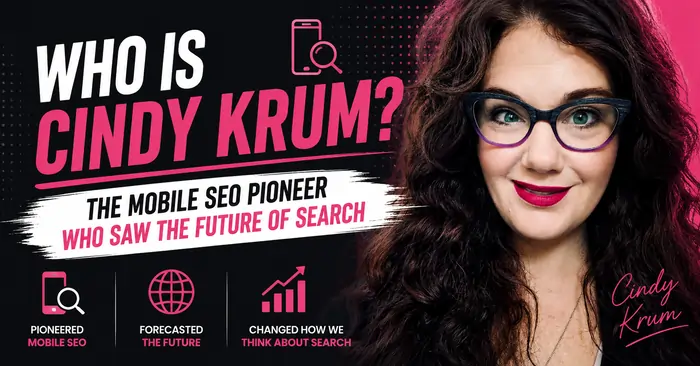
Cindy Krum is the CEO and founder of MobileMoxie, a leading mobile SEO and digital marketingconsultancy. She is a recognized thought leader, international speaker, and the author of Mobile Marketing: An Hour a Day. Krum is widely known for her forward-thinking concepts including Entity-First Indexing, Journey Optimization, and the Fraggles framework for understanding SERP features. Her work bridges the gap between traditional SEO, mobile search, and the emerging landscape of AI-driven search and Google Discover, making her one of the most influential voices in modern search strategy.
Introduction: The Woman Who Saw Mobile Coming
When the history of modern search marketing is written, certain names will stand out as having seen the future before it arrived. Cindy Krum is one of those names. Long before “mobile-first indexing” became a Google mandate, long before entities and knowledge graphs dominated SEO conference agendas, and long before AI threw the entire search industry into transformation, Krum was on stage, in boardrooms, and in her writing, telling anyone who would listen that the way people search was about to fundamentally change—and that marketers needed to change with it.
Today, Krum is the CEO and founder of MobileMoxie, a consultancy that has become synonymous with cutting-edge mobile and technical SEO strategy. She is an international keynote speaker who has presented on every continent, an author whose book became required reading for digital marketers, and a thinker whose concepts—Entity-First Indexing, Fraggles, Journey Optimization—have shaped how an entire industry thinks about search.
For those who know her work, Krum occupies a rare position in the SEO world: she is simultaneously a deeply technical practitioner who understands the inner workings of search engines and a big-picture visionary who can explain where the entire industry is heading. In an era of AI disruption, her insights have never been more relevant.
The Early Years: From Curious Mind to Digital Pioneer
A Foundation in Understanding How Things Work
Before she became one of the most recognizable faces in digital marketing, Cindy Krum was simply someone who wanted to understand how things worked. Her early career path did not follow a straight line into SEO—there was no such path when she started. Instead, she brought a natural curiosity about systems, technology, and human behavior that would later prove essential to her work in search.
Krum entered the digital marketing world during a period of rapid change. The iPhone had just been released. Mobile browsing was still a novelty that most marketers ignored. The dominant assumption was that desktop search would remain the primary way people found information, and mobile was a secondary consideration at best. Krum looked at the data, looked at user behavior, and reached a different conclusion entirely.
The Mobile Epiphany
What set Krum apart from her contemporaries was her early recognition that mobile was not just another channel—it was a fundamental shift in how humans would interact with information. While other marketers were optimizing for desktop screens and treating mobile as an afterthought, Krum understood that the future of search would be personal, portable, and always available. This insight would become the foundation of her entire career.
She began speaking about mobile SEO at conferences when the topic was still considered niche. She wrote about it when few publications cared. She built her consultancy around it when most agencies were still selling traditional desktop SEO services. In retrospect, this looks like prescience. At the time, it looked like risk. But Krum’s willingness to bet on her convictions—and her ability to explain complex technical concepts in ways that business leaders could understand—set her on a path that would make her one of the most respected voices in search.
MobileMoxie: Building a Company on a Vision
The Founding of a Specialized Consultancy
MobileMoxie was born from Krum’s conviction that mobile search deserved dedicated expertise, not just a checkbox on an SEO audit. The company she built offers a comprehensive suite of services including mobile SEO strategy, app store optimization, mobile conversion rate optimization, and technical consulting for enterprise clients navigating the complexities of mobile-first indexing.
What distinguishes MobileMoxie from generalist digital agencies is its depth of specialization. Under Krum’s leadership, the consultancy does not just help clients adapt their existing desktop strategies for mobile. It fundamentally rethinks how content, user experience, and technical architecture should work in a mobile-first world.
The Tools That Define MobileMoxie
Beyond consulting, MobileMoxie developed practical tools that have become essential for serious SEO professionals. The SERPerator tool, which allows marketers to view search engine results pages as they appear on different devices and in different locations, solved a critical problem: how do you understand what your users actually see when you cannot physically be in every market on every device?
Page-oscope, another MobileMoxie tool, enables technical SEOs to examine how Googlebot renders pages, revealing issues that traditional crawling tools miss. These tools reflect Krum’s philosophy: effective search strategy requires understanding not just what search engines say they do, but what they actually do. Empirical observation, not assumption, drives her approach.
The Author: Mobile Marketing: An Hour a Day
A Book That Became Required Reading
In 2012, Krum published Mobile Marketing: An Hour a Day, a comprehensive guide that translated complex mobile marketing concepts into practical, actionable strategies. The book’s structure—designed to be consumed in manageable daily segments—reflected Krum’s understanding of how busy professionals actually learn. It was not a theoretical treatise; it was a field manual.
The book covered the full spectrum of mobile marketing: mobile SEO, mobile advertising, app marketing, location-based services, mobile analytics, and the emerging world of mobile commerce. For many marketers, it was their first serious introduction to the idea that mobile required its own strategy, its own metrics, and its own expertise—not just a shrunken version of desktop marketing.
More than a decade after its publication, many of the principles Krum articulated in that book have moved from cutting-edge to foundational. The idea that mobile user experience directly impacts search rankings? She was writing about that years before Google made it official. The importance of page speed, responsive design, and mobile-friendly content? Krum was teaching it before it became industry standard.
The Book’s Lasting Influence
What makes Mobile Marketing: An Hour a Day more than a historical artifact is the framework it provided for thinking about digital marketing as an integrated system, not a collection of disconnected tactics. Krum’s approach emphasized understanding user journeys across devices, measuring what actually matters rather than what is easy to measure, and building strategies that adapt as technology evolves. These principles remain relevant even as the specific platforms and tactics have changed.
The Thought Leader: Concepts That Shaped the Industry
Entity-First Indexing: Seeing Search as Google Sees It
Perhaps Krum’s most influential contribution to SEO thinking is her articulation of Entity-First Indexing. While many SEOs were still fixated on keywords and backlinks, Krum recognized that Google was fundamentally reorganizing its understanding of the web around entities—people, places, things, and concepts—rather than strings of text.
This insight had profound implications. If Google was building a knowledge graph that understood relationships between entities, then traditional keyword-focused SEO was optimizing for the old paradigm. Krum argued that the future belonged to marketers who understood how to communicate entity relationships clearly, how to structure content so machines could parse it, and how to optimize for meaning rather than just matching words.
Her talks on entity-first indexing have become legendary in the SEO community. She has a gift for making complex technical concepts accessible, often using analogies and visual explanations that help audiences understand what Google is actually doing under the hood. In a field where many speakers recycle the same ideas, Krum consistently offers genuinely original thinking.
Fraggles: Understanding the Fragmented SERP
Krum coined the term “Fraggles” to describe the fragmented elements that appear in modern search engine results pages—featured snippets, knowledge panels, people-also-ask boxes, image carousels, video results, and the dozens of other SERP features that have transformed search from a simple list of blue links into a rich, interactive information experience.
This framework was important because it helped marketers understand that SEO was no longer just about ranking in the top ten organic results. The modern SERP contains dozens of elements, many of which appear above traditional organic listings. Understanding how these elements work, where they draw their data from, and how to optimize content to appear in them became a new frontier of search marketing. Krum provided the vocabulary and the conceptual framework for thinking about this fragmented landscape.
Journey Optimization: Thinking Beyond the Click
Building on her entity and Fraggle frameworks, Krum developed the concept of Journey Optimization—the idea that modern search strategy must consider the entire user journey, not just the moment of the search query. This was a significant evolution beyond traditional SEO thinking, which often focused narrowly on getting the click.
Journey Optimization recognizes that users interact with search engines across multiple sessions, devices, and contexts. A user might research a topic on their phone during a commute, revisit it on a desktop during work hours, and make a final decision on a tablet in the evening. Each touchpoint is part of a larger journey, and effective search strategy must account for the entire path, not just individual moments.
This framework connects Krum’s early mobile expertise with her later work on entities and SERP features. Mobile made search personal and contextual. Entities made search semantic and relational. Journey Optimization brings these threads together into a coherent strategy for the modern search landscape
The Speaker: Taking the Message Global
International Keynote Presence
Krum has established herself as one of the most sought-after speakers in the digital marketing conference circuit. She has presented on every continent, delivering keynotes and workshops at major industry events including MozCon, SMX, Pubcon, SearchLove, and countless others. Her speaking style—technical enough for experienced practitioners but accessible enough for business decision-makers—has made her equally popular with both audiences.
What makes Krum’s presentations distinctive is their combination of deep technical insight with practical applicability. She does not just explain how search engines work; she explains what marketers should do differently because of how search engines work. Her talks typically leave audiences with both a clearer understanding of the landscape and specific actions they can take immediately.
Educating the Next Generation
Beyond conference speaking, Krum has invested significantly in education. She teaches workshops, contributes to industry publications, and shares insights through the MobileMoxie blog and her appearances on industry podcasts. Her commitment to education reflects a belief that the SEO industry advances when knowledge is shared openly, not hoarded as competitive advantage.
This educational orientation has made her a particularly influential figure among younger SEOs and those transitioning into the field from adjacent disciplines. Many practitioners cite Krum’s talks or writings as pivotal moments in their professional development—the point at which search strategy clicked from a collection of tactics into a coherent philosophy.
The Visionary: Why Cindy Krum Matters Now More Than Ever
AI and the Next Transformation of Search
The emergence of AI-driven search, generative AI answers, and Google’s Search Generative Experience represents the latest chapter in the transformation Krum has been tracking for her entire career. Her frameworks for understanding entities, fragmented SERPs, and user journeys provide essential intellectual scaffolding for making sense of AI’s impact on search.
In recent years, Krum has been speaking and writing about how AI fits into the entity-first model she has been advocating for more than a decade. Large language models, she argues, are essentially entity prediction engines. They work by understanding relationships between concepts and generating probable sequences. This is not fundamentally different from what Google has been doing with the Knowledge Graph—it is simply more advanced and more visible to end users.
Google Discover and the Next Frontier
Krum has also been at the forefront of understanding Google Discover as a search-adjacent channel that many marketers overlook. Her analysis of how Discover surfaces content, what signals influence visibility, and how it relates to traditional search provides practical guidance for marketers navigating an increasingly complex digital landscape.
Her work on Discover reflects a consistent theme across her career: paying attention to the things other marketers ignore. Mobile was ignored until it was impossible to ignore. Entities were ignored until they became the foundation of modern search. Discover may follow the same pattern, and Krum is already there, doing the research and sharing the insights.
The Influence: How Cindy Krum Shaped Modern SEO
A Different Kind of SEO Leader
The SEO industry has no shortage of loud voices, hot takes, and self-proclaimed gurus. What sets Krum apart is the substance behind her ideas. She does not offer quick hacks or gaming-the-system tactics. Instead, she provides frameworks for understanding the fundamental principles that drive search, principles that remain relevant even as algorithms change.
This approach has earned her respect across the industry, including from other influential voices. Her work is cited by fellow speakers, referenced in industry publications, and taught in digital marketing courses. When serious SEOs want to understand where search is heading, they pay attention to what Cindy Krum is saying.
Mentorship and Community
Beyond her public work, Krum has been an important mentor and community builder within the SEO industry. She has been particularly visible as a voice encouraging women to enter and advance in the technical SEO space, an area where female representation has historically been low. Her visibility as a female CEO and technical expert provides representation that matters for the industry’s future.
She has also been generous in supporting the broader SEO community, participating in forums, responding to questions on social media, and making herself accessible in ways that many consultants at her level do not. This accessibility has built a loyal following of practitioners who see her not just as an expert to learn from but as a genuine member of the community.
Conclusion: The Constant Evolution
Cindy Krum’s career can be understood as a sustained exercise in looking ahead. From her early bet on mobile when the industry was skeptical, through her articulation of entity-first indexing when most SEOs were still thinking in keywords, to her current work on AI and Discover, she has consistently identified the next important shift before it became obvious.
What makes her influence enduring is not just the accuracy of her predictions but the quality of her explanations. She does not just tell the industry what is happening; she provides the conceptual frameworks that help practitioners understand why it is happening and what to do about it. Entity-First Indexing, Fraggles, Journey Optimization—these are not just terms but tools for thinking about search more clearly.
For marketers navigating the AI transformation of search, Krum’s work provides both practical guidance and intellectual grounding. Her career reminds us that the specific technologies change—from desktop to mobile, from keywords to entities, from traditional search to AI-generated answers—but the fundamental principles of understanding user behavior, communicating clearly with machines, and building strategies that adapt to change remain constant.
The SEO industry is fortunate to have thinkers like Cindy Krum—people who combine technical depth with conceptual clarity, who share their knowledge generously, and who consistently point toward the future rather than protecting the past. As search continues its rapid evolution, her voice will remain essential listening for anyone serious about understanding where we are heading.
Frequently Asked Questions About Cindy Krum
1. Who is Cindy Krum?
Cindy Krum is the CEO and founder of MobileMoxie, a leading mobile SEO and digital marketing consultancy. She is an international keynote speaker, author of Mobile Marketing: An Hour a Day, and a recognized thought leader in mobile search, entity-first indexing, and modern SEO strategy.
2. What is MobileMoxie?
MobileMoxie is a specialized digital marketing consultancy founded by Cindy Krum, focusing on mobile SEO, app store optimization, mobile conversion rate optimization, and technical SEO strategy. The company also develops SEO tools including SERPerator and Page-oscope.
3. What is Entity-First Indexing?
Entity-First Indexing is a concept articulated by Cindy Krum that describes how Google has reorganized its index around entities—people, places, things, and concepts—rather than keywords. This framework helps marketers understand how to optimize content for semantic search and knowledge graph visibility.
4. What are Fraggles in SEO?
Fraggles is a term coined by Cindy Krum to describe the fragmented elements in modern search engine results pages, including featured snippets, knowledge panels, people-also-ask boxes, and other SERP features that appear beyond traditional organic listings.
5. What book did Cindy Krum write?
Cindy Krum is the author of Mobile Marketing: An Hour a Day, published in 2012. The book provides a comprehensive guide to mobile marketing strategy and remains an influential text in digital marketing education.
6. What is Journey Optimization?
Journey Optimization is a concept developed by Cindy Krum that emphasizes optimizing the entire user journey across devices and touchpoints, rather than focusing narrowly on individual search queries or clicks.
7. Where does Cindy Krum speak?
Cindy Krum has presented keynotes and workshops at major digital marketing conferences worldwide including MozCon, SMX, Pubcon, SearchLove, and numerous other industry events across every continent.
8. What tools does MobileMoxie offer?
MobileMoxie offers the SERPerator tool for viewing search results on different devices and locations, and Page-oscope for understanding how Googlebot renders pages. Both tools are widely used by professional SEOs for technical analysis.
9. What is Cindy Krum’s view on AI and search?
Cindy Krum has positioned large language models and AI as extensions of the entity-first search paradigm. She argues that AI prediction engines function similarly to Google’s Knowledge Graph, understanding relationships between concepts to generate probable outputs.
10. Why is Cindy Krum important to SEO?
Cindy Krum is important to SEO because she consistently identifies major industry shifts—mobile-first indexing, entity search, fragmented SERPs—before they become mainstream. Her frameworks help practitioners understand fundamental principles rather than chase temporary tactics.