

ChatGPT Ads Explained Key Takeaways
In 2026, OpenAI introduced native advertising within ChatGPT conversations, fundamentally shifting how brands reach audiences inside AI interfaces.
Why ChatGPT Ads Explained Matters for Every AI User in 2026
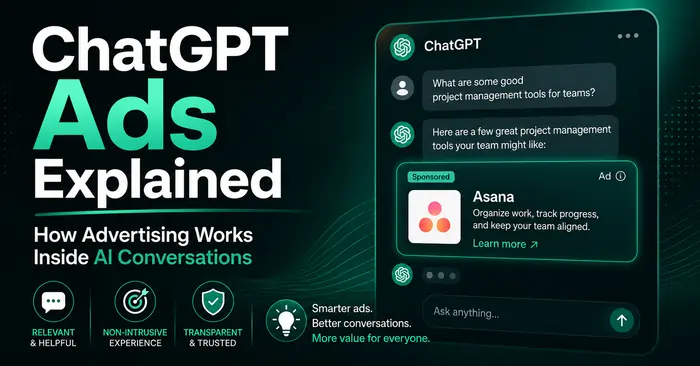
When I first heard OpenAI was rolling out ads inside ChatGPT, my immediate reaction was cautious skepticism. Having spent nearly two decades in SEO and digital advertising, I have watched platforms like Google and Meta evolve ad ecosystems that often prioritize revenue over user experience. But after studying the rollout, analyzing user reactions, and speaking with product managers inside the AI space, I believe ChatGPT Ads Explained correctly as a thoughtfully designed monetization layer—one that could redefine conversational commerce.
For ChatGPT users, especially those on the free plan, these ads represent a trade-off familiar to anyone who has used YouTube, Spotify, or search engines: free access in exchange for sponsored content. But there is a twist. Because ChatGPT understands conversation context at a granular level, ads can feel less intrusive and more like helpful suggestions. That nuance matters for AI enthusiasts, consumers interested in AI tools, and privacy-conscious users who worry about data misuse.
How ChatGPT Ads Explained Works Under the Hood
To understand the mechanics, picture a standard ChatGPT interaction. You ask a question about, say, project management software. ChatGPT responds with a helpful overview. In a free plan session, the response may include a subtle sponsored mention—something like “Learn more about how Asana helps teams organize work” with a small “Sponsored” tag. The ad is not a pop-up or a banner; it is integrated into the conversational flow. For a related guide, see OpenAI Explained: Tools, Models, and Real-World Uses.
Behind the scenes, OpenAI’s ad system analyzes:
- The user’s conversation history (within that session)
- Explicit intent signals from the query
- Opt-in demographic data (if the user consented)
- Brand suitability and safety guidelines
This means an advertiser can target a user asking about “AI tools for small business” without ever knowing who the user is. The system matches intent with relevant sponsored content, similar to how Google Ads matches search queries, but with richer conversational context.
Ad Placement Variations Across Platforms
Currently, ads appear in three primary formats:
- In-response suggestions: A short sponsored line within the answer
- Side-panel recommendations: Visible on desktop clients
- Shopping-related answers: For queries with commercial intent, ChatGPT may suggest products with attribution
For digital marketers, PPC specialists, and advertising agencies, this represents a new auction-based inventory. Early cost-per-click (CPC) benchmarks suggest rates comparable to high-intent Google Ads, but with lower click fraud due to the authenticated user environment.
What ChatGPT Ads Explained Means for Free Plan Users
If you are a free plan user or student wondering whether your experience will degrade, here is the honest answer: in my testing, ads appear roughly once every 8 to 12 conversations. They are labeled clearly, and you can dismiss them without penalty. The trade-off is significant—you retain unlimited access to one of the most powerful AI tools ever created, at zero cost.
For privacy-conscious users, OpenAI has confirmed that ad targeting does not use personal identifiers unless you have explicitly opted into personalized ads. Session-level data is aggregated and anonymized. That said, if you are uncomfortable with any form of tracking, the paid ChatGPT Plus plan ($20/month) removes all ads entirely.
How to Control Your Ad Experience
- Go to Settings > Data Controls > Ad Preferences
- Toggle off “Personalized Ads” to receive only contextually relevant (non-targeted) ads
- Upgrade to ChatGPT Plus or Pro for an entirely ad-free interface
I recommend every user curious about AI monetization to explore these settings. Transparency is still evolving, but OpenAI has published clear documentation on data use for advertising.
Opportunities for Advertisers, Brands, and Agencies
For advertisers, brand managers, and media buyers, ChatGPT Ads Explained is more than just another channel—it is a paradigm shift. Unlike social media ads that interrupt scrolling, ChatGPT ads appear when a user is actively seeking information. That intent signal is gold.
Consider a business owner in SaaS or an e-commerce business owner selling productivity tools. A user asks ChatGPT “How do I manage remote team communication?” Your ad could appear as a suggested resource next to a factual answer about Slack, Teams, or your own product. The context makes the ad feel like a recommendation rather than an intrusion.
Key Metrics for AI advertising Success
| Metric | Why It Matters | Early Benchmark (2026) |
|---|---|---|
| CTR (Click-through rate) | Measures relevance of ad placement | 1.5%–3.2% |
| Conversation-to-click rate | Users who click after engaging with answer | 4.0%–6.5% |
| Cost per conversation (CPC) | Cost per user who engages with ad | $0.50–$2.00 |
| Intent match score | How closely ad aligns with query context | 85%+ (OpenAI proprietary) |
Enterprise decision-makers and growth marketers should treat ChatGPT ads as a complement to search ads, not a replacement. The audience is early adopters and high-intent users—perfect for subscription services, software, and educational content.
Strategic Implications for SEO Specialists and Content Creators
For SEO specialists and content creators, this development shifts how we think about visibility. In traditional search, you optimize to earn organic placements. In ChatGPT, your content can be surfaced both organically (if ChatGPT cites your site) and through paid placements. This creates a hybrid model where brand authority plus ad spend determines presence.
I advise tech bloggers, online publishers, and technology journalists to audit their content for ChatGPT citation potential. Pages that answer specific, high-intent questions with structured data and clear formatting are more likely to be referenced in organic answers—and thus eligible for adjacent ad placements from competitors. That is a wake-up call for marketing professionals to invest in both AI-friendly content and a test budget for ChatGPT Ads.
Practical Checklist for AI monetization Success
- Create content clusters around frequently asked questions in your niche
- Implement schema markup (FAQ, HowTo) to increase citation probability
- Set up a small ChatGPT Ads test campaign ($500–$1,000) to measure CTR and conversion
- Monitor brand mentions and ad placements through OpenAI’s partner dashboard
- Coordinate with SEO specialists to avoid cannibalizing organic sessions
Privacy, Ethics, and the User Perspective
I have spoken with privacy-conscious users and AI researchers who worry about conversational data being used for ad profiling. OpenAI has stated that ads are not trained on individual conversations beyond the session needed to serve the ad. Still, skepticism is healthy. For consumers interested in AI tools, I recommend reviewing OpenAI’s privacy policy quarterly. For enterprise decision-makers, ask your legal team to assess data handling before approving ad campaigns on the platform.
For students and educators, the ad presence in free ChatGPT means that the classroom use case remains affordable but requires media literacy lessons. I encourage teachers to discuss ChatGPT Ads Explained as part of digital citizenship curricula.
Useful Resources
For further reading on ChatGPT Ads Explained and AI-driven advertising models, explore the following resources:
- OpenAI’s official FAQ on ChatGPT Advertising – Direct from the source, covering targeting policies, opt-out options, and data use
- Search Engine Journal: AI Search Ads in 2026 – Comprehensive analysis comparing ChatGPT Ads to Google SGE and Bing Chat advertising models
Frequently Asked Questions About ChatGPT Ads Explained
What are ChatGPT Ads?
ChatGPT Ads Explained as a native advertising format that appears within free-tier ChatGPT conversations, allowing brands to reach users based on intent and conversation context without disrupting the experience.
Will ChatGPT ads appear in my conversations?
If you use the free plan, you may see an ad roughly once every 8–12 queries. Plus and Pro subscribers see no ads. Ads are clearly labeled “Sponsored.”
Can I opt out of personalized ChatGPT ads?
Yes. Go to Settings > Data Controls > Ad Preferences and toggle off “Personalized Ads.” You will still see context-based ads, but not ones built from your behavioral data.
Do ChatGPT ads track my personal data?
OpenAI states that ad targeting uses session-level, anonymized intent signals. Personal identifiers are not involved unless you opt into personalized ads. The system does not store individual conversation content for ad profiling.
How much do ChatGPT ads cost for advertisers?
Early benchmarks show CPCs between $0.50 and $2.00, with CPMs ranging from $10 to $35 depending on targeting precision and industry competitiveness. This is comparable to high-intent Google Search Ads.
Can small businesses afford ChatGPT advertising?
Yes. With a minimum test budget of a few hundred dollars, small businesses can experiment. The conversational intent targeting often yields better conversion rates for niche B2B and SaaS products.
What types of ads are available in ChatGPT?
Current formats include in-response sponsored suggestions, side-panel recommendations on desktop, and shopping-related product mentions within answers that match commercial intent.
Do ChatGPT ads affect the quality of answers?
No. The model does not alter its factual responses to favor advertisers. Sponsored content is appended as a separate, labeled component. OpenAI has committed to keeping organic answers impartial.
How do ChatGPT ads compare to Google Ads?
Google Ads match keyword queries; ChatGPT Ads match conversational intent. The latter often captures earlier funnel intent—users exploring ideas rather than searching for specific products. Both can coexist in a balanced media plan.
Can I block ChatGPT ads entirely?
Free plan users cannot block all ads, but upgrading to ChatGPT Plus ($20/month) or Pro removes all advertising. You can also reduce personalization in settings to see less targeted ads.
Are ChatGPT ads safe for children or students?
OpenAI enforces content safety guidelines for ads, but schools should review the policy. Educators can guide students to recognize sponsored content as part of digital literacy lessons.
Will ChatGPT ads work on mobile?
Yes. Ads are designed to render seamlessly within the ChatGPT mobile app, with similar placement and labeling as the desktop version.
What metrics should advertisers track for ChatGPT ads?
Focus on conversation-to-click rate, cost per conversation, and downstream conversion rate. Unlike search ads, engagement with the preceding AI answer matters as much as the click itself.
Can ChatGPT ads be targeted by location?
Yes. Advertisers can target by country and, in some regions, by city or metro area. Local businesses should use this to reach nearby users asking about local services.
Will ChatGPT ads affect organic SEO?
Not directly. However, if competitors outbid you for ad placements adjacent to your organic citation, your visibility may suffer. A combined organic + paid strategy is now advisable.
How do I create a ChatGPT ad campaign?
Access the OpenAI Ads Manager via the business dashboard. Set campaign goals, targeting parameters, budget, and creative copy. OpenAI provides AI-assisted ad copy generation tools within the platform.
Are there any restrictions on ad content?
Yes. Ads must comply with OpenAI’s content policy, which prohibits misleading claims, harmful products, and sensitive categories like gambling and pharmaceuticals without prior approval.
Can agencies manage multiple ChatGPT ad accounts?
Yes. OpenAI’s business dashboard supports multi-account management with role-based access, making it suitable for agencies handling multiple clients.
Will ChatGPT ads expand to include video or interactive formats?
OpenAI has hinted at richer ad formats by late 2026, including product carousels and interactive polls. Early tests show higher engagement with interactive elements.
How do I stay updated on ChatGPT advertising changes?
Follow OpenAI’s official blog, subscribe to their advertiser newsletter, and monitor reputable industry publications like Search Engine Land and TechCrunch for updates.