


In a field where one core update can erase a decade of “wins,” staying relevant for 18 years is not an accident—it is the result of systems, scars, and stubborn curiosity.
This is the story behind my journey and why I decided to make it official with my verified SEO Mafia Expert profile.
From Data Encoder to SEO Mafia Expert
Back in 2008, I did not start with a glamorous “SEO Specialist” title. I started as a Job Order Data Encoder in Davao, Philippines, working with spreadsheets, government forms, and an internet that still loaded like dial-up in many places.
That role trained me to be precise with data and patient with process—skills that became crucial when I moved into SEO and had to manage everything from crawl reports to analytics dashboards. Over time, I transitioned into digital roles in the UAE, handling content, on-page SEO, and analytics for international brands.
From Davao to Dubai to Saigon, I experienced SEO across markets, languages, and business realities—eventually speaking at international conferences and mentoring teams who were navigating the same chaos I had survived.
To mark this 18-year milestone, I’ve made my expertise official by joining SEOMafia.Expertas a verified SEO Mafia Expert.
👉 View my verified expert profile
Why I Embraced the SEO Mafia Expert Badge
In 2026, anyone can publish an AI-generated SEO audit or thread, but very few can consistently ship strategies that stand up to legal, compliance, and revenue scrutiny.
The SEO Mafia Expert badge matters to me because it signals three things to clients:
- This is not a one-year experiment; it is an 18-year practice.
- I specialize in niches where “just test it” can be very expensive advice (iGaming, Finance, Real Estate, eCommerce).
- I design SEO as a growth system, not a checklist of disconnected tasks.
The vetting process behind SEO Mafia focuses on real-world performance and domain experience, not just social proof.
If you want to see how the platform itself is changing how experts are discovered, read the announcement on SEOMafia.Expert and related coverage on its January 2026 directory launch.
👉 SEOMafia.Expert – Global SEO Expert Directory
What It Really Means to Be an SEO Mafia Expert
“SEO Mafia Expert” sounds edgy, but in practice it means you are trusted to operate in environments where:
- algorithms change fast
- compliance and jurisdiction rules matter
- and each loss of organic visibility has a measurable revenue impact
Being part of the SEO Mafia, for me, includes:
1. Proven Experience Before the AI Boom
I’ve been in SEO long before AI assistants became a mainstream interface for search.
That means I’ve worked through:
- early link-based manipulation and the Penguin clean-up era
- the rise of intent and semantics through Hummingbird and RankBrain
- mobile-first indexing, Core Web Vitals, and UX-driven ranking factors
- the introduction of E-E-A-T in Google’s Search Quality Rater Guidelines as a way to evaluate page quality
If you want to understand how Google thinks about Experience, Expertise, Authoritativeness, and Trust, I recommend reading:
- Google Search Quality Rater Guidelines overview
- E-E-A-T: The Ultimate Guide to Google Rankings in 2026
2. Strategic Execution, Not Just Audits
Today, generating an SEO audit is easy—LLMs and tools can list issues in minutes. The hard part is translating that into a roadmap that respects your tech stack, legal constraints, and growth targets.
My work is heavily influenced by established foundations like:
But I adapt those fundamentals into conversion-focused roadmaps where:
- we prioritize fixes by business impact, not just error count
- dashboards show how organic contributes to leads, sales, or deposits
- SEO moves from a “nice-to-have” channel to a core growth lever
For businesses new to SEO, I often point them to beginner guides like Google’s SEO Starter Guide and modern 2024 primers as a baseline education before we layer on advanced tactics.
The System-First Methodology: How I Actually Work
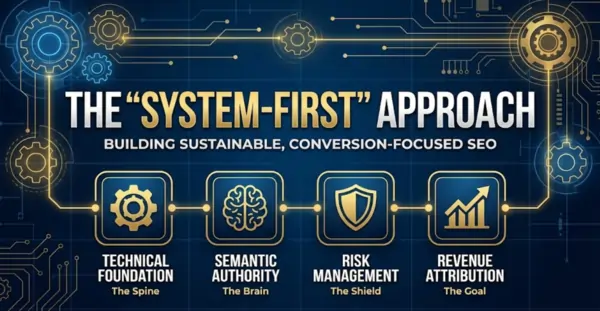
Over time, I realized my best-performing projects had one thing in common: they were treated like systems, not campaigns.
That’s why my framework is built on four pillars:
1. Technical Foundation (The Spine)
If search engines and answer engines can’t crawl, understand, or render your site efficiently, nothing else scales.
I align technical work with principles echoed in guides like:
Typical focuses include:
- crawl budget and indexation hygiene
- logical information architecture that matches your business model
- Core Web Vitals and UX benchmarks
- schema and structured data to make your content “machine-readable”
2. Semantic Authority (The Brain)
We are long past the phase where keyword density is a strategy. Today, semantic SEO and entities are at the center of how I plan content.
If you’re new to this way of thinking, look at resources that cover semantic SEO and entity-driven optimization, including modern SEO overviews and AEO guides that explain how AI and search engines interpret concepts, not just strings.
My semantic work typically includes:
- mapping entities and relationships in your niche
- building topic clusters that mirror how users actually research decisions
- writing content that answers both the explicit query and its implied follow-ups
The end goal is to make your site a credible knowledge source that search engines and AI models are comfortable citing.
3. Risk Management (The Shield)
If you are in iGaming, high-CPA finance, or aggressive affiliate spaces, risk is not hypothetical—it is operational.
Risk management in SEO includes:
- building sustainable link profiles and avoiding short-lived tactics
- adopting quality and E-E-A-T standards appropriate for “Your Money or Your Life” (YMYL) content
- understanding jurisdictional rules, especially for gambling and financial offers
For clients operating in these spaces, I often recommend aligning internal content and compliance standards with the expectations described in Google’s Quality Rater Guidelinesand E-E-A-T checklists.
4. Revenue Attribution (The Goal)
Traffic is useful only when it connects to outcomes.
I encourage teams to combine classic SEO practice with analytics and tracking that allow them to see:
- which queries and pages drive high-intent actions
- the split between branded and non-branded performance
- the actual ROI of organic, not just impressions
This is where SEO meets broader digital strategy, and why I frequently advise beginners to understand the basics of measurement from modern SEO guides and analytics primers before scaling.
Why AEO (Answer Engine Optimization) Is Now Non-Negotiable
We are moving into an era where users ask questions directly to answer engines—systems like ChatGPT, Gemini, Perplexity, and other AI-driven interfaces—rather than typing traditional queries into a search box.
To stay visible, brands need to think in terms of Answer Engine Optimization (AEO):
- structuring content so it can be extracted and summarized
- covering sub-questions and related entities that AI models break queries into
- becoming the kind of source that answer engines are comfortable citing
If you want to go deeper into AEO as a concept, there are several excellent resources:
- AEO Shift: Stop Chasing Keywords, Start Owning Answers (SEO Mafia)
- What is answer engine optimization (AEO)? – Profound
- Answer Engine Optimization (AEO): The 2026 Guide – LLMrefs
- AEO 2026: Optimize for AI Answer Engines – Eminence
- What is AEO? Why Your SEO Content Strategy Needs to Evolve Now
For teams exploring tools, roundups of AEO and AI-search tools can also be useful starting points.
My own approach to AEO is to treat it as an extension of good SEO and semantic strategy—not a replacement. When your content is technically sound, semantically rich, and trusted, it becomes much easier for AI systems to retrieve, interpret, and cite it.
Q&A: Behind the Profile
Q: How long have you been in SEO?
I’ve been working in SEO since 2008—18 years across multiple algorithm eras, interface changes, and platform shifts.
Q: What industries do you focus on?
I specialize in high-competition verticals including iGaming, Finance, Real Estate, and eCommerce, where risk tolerance is low and ROI expectations are high.
Q: Where are you based?
I’m originally from Davao, Philippines, and currently operate as a digital nomad based in Cambodia, working with teams across Southeast Asia, the Middle East, and beyond.
Q: I’m new to SEO. Where should I start?
If you’re new and want to understand the basics before working with someone like me, I recommend:
- Google SEO Starter Guide
- Moz Beginner’s Guide to SEO
- A recent beginner-focused SEO overview like Google SEO Guide 2024
Once you understand the fundamentals, our collaboration can focus on systems, not definitions.
The Next 18 Years: What I’m Building Toward
If the last 18 years were about mastering updates, tools, and tactics, the next 18 will be about mastering orchestration:
- how organic, paid, social, and AI-discovery work together
- how brands evolve from “websites” into sources in an answer-driven ecosystem
- how we design systems that work for both humans and machines without sacrificing trust
If you care about staying visible in both classic search results and AI-generated answers, it’s worth combining foundational SEO education with up-to-date AEO and E-E-A-T resources so your team speaks the same language.
To everyone who has been part of this journey—clients, colleagues, partners, and students—thank you. You shaped not just my career, but my philosophy.
If you want a consultant who understands both the history of search and the direction of AI-driven discovery—and who builds systems instead of one-off campaigns—start here:
👉 Jin Grey – SEO Mafia Expert
https://seomafiaclub.com/expert/jin-grey/
You can also read this story and more about my work on my own platforms: