




The iGaming SEO industry is changing faster in 2027 than at any point in the last decade. AI-powered development tools have lowered the barrier to launching websites, but they have also flooded search results with low-quality content. Google’s quality systems, AI Overviews, and stricter YMYL scrutiny now reward trust, accuracy, and regulatory compliance over volume and speed. The strategies that worked in 2023 will not survive 2027. What follows is my honest assessment of what I recommend, what I avoid, and why—based on 18 years of SEO experience and direct work in competitive iGaming markets.
Strategy Outlook • AI Search • Compliance • Technical SEO

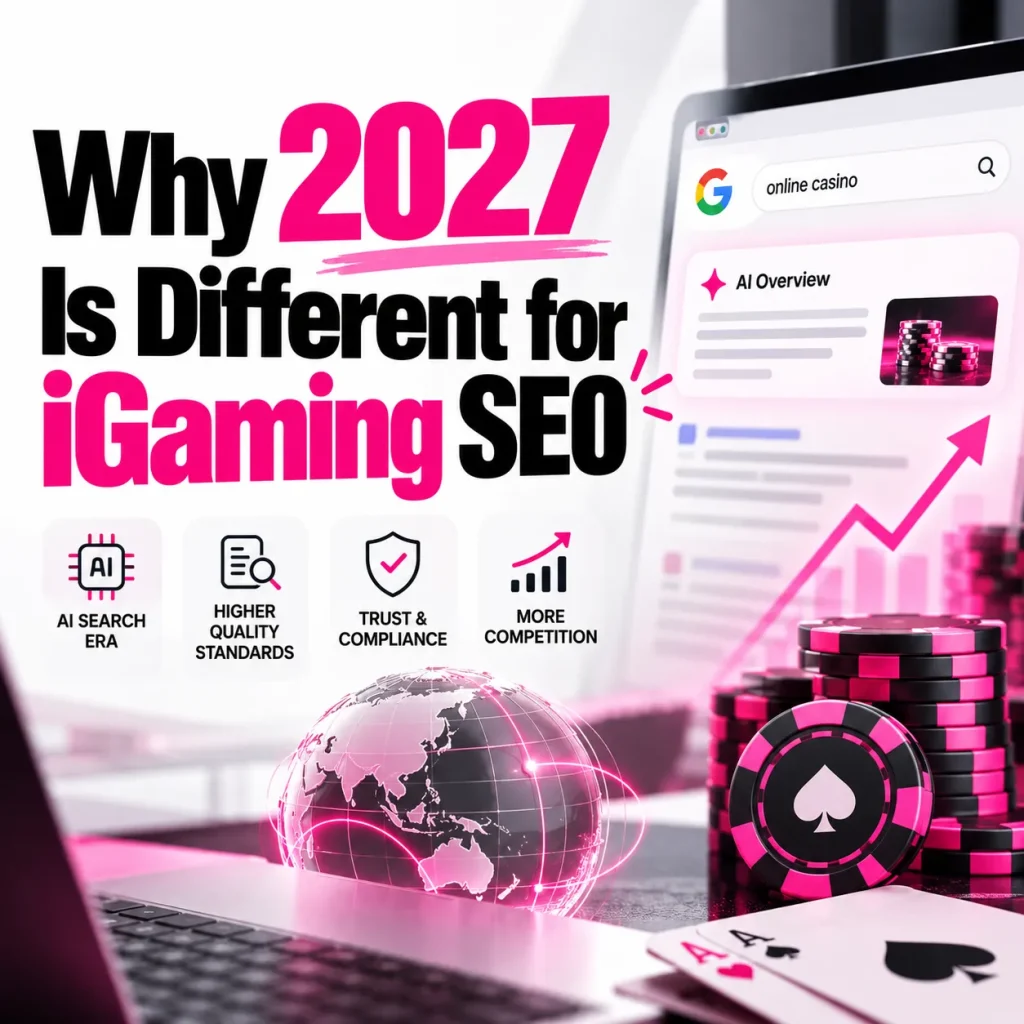
Why 2027 Is Different for iGaming SEO
I have worked in SEO since 2008. I have watched Penguin, Panda, Hummingbird, BERT, the Helpful Content system, and now AI Overviews reshape how search works. Each of those shifts punished certain practices and rewarded others. But 2027 represents something different: the convergence of AI-generated content at scale, AI-powered search experiences, and increasingly strict enforcement of YMYL standards in gambling-related search.
The result is a market where launching a website is easier than ever, but earning visibility is harder than ever. AI tools like Claude, Codex, and ChatGPT can help developers build functional websites in days rather than weeks. But speed without judgment produces exactly the kind of thin, inaccurate, low-trust content that Google’s systems are designed to demote. For a broader view of how AI search is evolving, see Google AI Search Updates for 2027 .
The strategies below reflect what I actually recommend to clients and what I actively avoid. They are not theoretical. They are based on what I have seen work and fail in competitive iGaming markets.

Strategy 1: Use AI to Launch Faster—But Never Let Speed Replace Verification
What I recommend: AI-assisted website development is one of the most practical opportunities in 2027. Tools like Claude and Codex can accelerate layout creation, component building, and repetitive development tasks. A team that once spent weeks on a basic review site can now launch in days.
What I avoid: Publishing anything without human review. AI-generated code can introduce technical SEO problems—broken canonicals, missing internal links, incorrect schema, security vulnerabilities. AI-generated content can introduce factual errors about licensing, bonus terms, or withdrawal policies. In iGaming, those errors are not minor; they affect financial decisions and user safety.
My workflow: Use AI for structure and speed. Then verify mobile responsiveness, accessibility, and loading performance. Check technical SEO elements including canonicals, internal links, sitemaps, and robots directives. Manually verify every gambling-related claim against primary sources. Publish only after confirming licensing, target-market restrictions, and responsible gambling disclosures.
For the technical foundation that AI-generated sites often miss, see iGaming Technical SEO.
Strategy 2: Verify Licensing Before You Write a Single Review
What I recommend: Before creating any casino review, investigate the operator. This is not optional. An operator may hold a license in one country but lack authorization in another. A license number may be expired, suspended, or entirely fabricated.
What I avoid: Describing a casino as “safe,” “legal,” or “licensed” based solely on what its homepage claims. That is not verification; it is repetition of marketing material.
What to check: The operator’s registered company name. The gambling license number. The issuing regulator. Whether the license is active and authentic. The countries where the operator is authorized. Whether affiliate promotion is permitted in your target market. Responsible-gambling disclosures and player protection requirements. Where possible, verify against official regulator records.
For the complete vertical framework, see iGaming SEO 2027 .
Strategy 3: Research Trademarks Before Buying Domains
What I recommend: Many SEO professionals conduct keyword research before purchasing domains but overlook trademark research. That can become an expensive legal mistake. A casino or betting brand may own registered trademarks in specific countries, industries, or classes of goods and services.
What I avoid: Buying a branded or similar-looking domain without checking trademark status first. A domain that implies unauthorized affiliation with an operator creates legal risk and can destroy trust.
What to research: Exact and similar trademark names. Relevant countries and jurisdictions. Registered trademark classes. Ownership and registration status. Potential consumer confusion. Whether your intended domain implies unauthorized affiliation. Use the WIPO Global Brand Database as a starting point, supplemented by national registers.
When in doubt, use an independent publisher brand rather than a domain that could be mistaken for an operator’s official website.
Strategy 4: Treat E-Commerce-Inspired Designs as Advanced, Not Default
What I recommend: Some iGaming publishers experiment with e-commerce-inspired structures—category pages, filtering systems, product-style cards, detailed review pages. These can improve usability when implemented thoughtfully.
What I avoid: Blindly copying this strategy because competitors are using it. Casino services are not ordinary retail products. A website should never create confusion about whether it is an independent review publication, a licensed gambling operator, or an official app distribution platform.
The risks: Misleading representations of casino products. Inaccurate prices, offers, or bonuses. Confusing affiliate pages with official casino websites. Duplicate or automatically generated content. Poor information architecture. Inadequate disclosure of commercial relationships.
An e-commerce-style design by itself is not a Google policy violation. The risk comes from how the design is implemented and whether it misleads users. For a discussion of where legitimate tactics end and risky ones begin, see AI Era Black Hat SEO Expert 2027.
Strategy 5: Blog-Style Review Sites Still Work—If You Execute Them Properly
What I recommend: Blog-style casino affiliate websites are an old-school SEO concept, but they still work when executed with genuine research and editorial standards. A helpful casino review includes operator background and verified licensing information, supported countries and eligibility restrictions, payment and withdrawal terms, bonus wagering requirements, customer support availability, available games and technology providers, responsible-gambling features, clear pros and cons, and a last verification date with review methodology.
What I avoid: Generic articles about hundreds of casino brands, written without firsthand knowledge or verification. Publishing more reviews does not make a site more authoritative; it makes it more interchangeable.
For how to build topical authority around review content, see Semantic SEO Expert 2027 .
Strategy 6: Use Google Keyword Planner—But Don’t Misread It
What I recommend: Google Keyword Planner remains one of the most valuable tools for SEO research. Third-party tools are useful, but Google’s own keyword-planning data is the closest thing to ground truth about search demand.
What I avoid: Treating Keyword Planner’s competition metrics as organic SEO difficulty scores. The tool was built for advertising, not organic search. Its “competition” column reflects ad auction competition, not how hard it is to rank organically.
What to pay attention to: Generic casino and betting searches. Informational questions. Legitimate brand research queries. Payment-method questions. Country-specific terminology. Mobile and app-related search intent. Comparison and review queries. Search intent matters as much as traffic potential.
For a detailed keyword research framework for iGaming, see iGaming Keyword Research 2027.
Strategy 7: Build Topical Authority, Not Random Articles
What I recommend: Organizing content into meaningful topical clusters around a pillar page. For a compliant casino review site, a pillar might cover “Online Casino Reviews and Licensing Guide,” with supporting content on verifying licenses, understanding wagering requirements, withdrawal policies, responsible-gambling tools, payment processing, licensing terminology, and how independent review sites assess operators.
What I avoid: Generating dozens of near-identical pages simply to target slight keyword variations. Publishing more articles does not automatically make a website authoritative; comprehensive, interconnected coverage does.
For the semantic architecture behind this approach, see Semantic SEO Expert 2027 .
Strategy 8: Optimize for AI Overviews and AI Mode—Without Chasing Tricks
What I recommend: AI-powered search is the most important shift in iGaming SEO since mobile-first indexing. Google AI Overviews and AI Mode can help users explore complex questions, compare information, and discover relevant websites. For iGaming publishers, prioritize clear explanations of complicated terms, original research and firsthand observations, accurate and verifiable information, descriptive headings and logical page structure, crawlable and indexable content, helpful comparison tables, transparent authorship, and properly implemented structured data.
What I avoid: Assuming there is a guaranteed method to appear in AI-generated answers. There is not. Google’s guidance consistently emphasizes that established SEO fundamentals remain relevant to AI search, rather than special AI-only optimization tricks .
For a step-by-step framework, see How to Optimize Content for AI Overviews .
Strategy 9: Strengthen Entity SEO and Brand Credibility
What I recommend: Search engines and AI systems need clear information about the people and organizations behind a website. For iGaming websites, this is especially important. Establish a consistent publisher identity with a real business or editorial brand, an informative About page, author and reviewer profiles, contact information, editorial and review policies, affiliate disclosures, responsible-gambling information, and appropriate Organization and Article structured data.
What I avoid: Building a collection of anonymous websites with interchangeable content and no accountable publisher identity. In a YMYL vertical, anonymity is a trust liability.
For how entities and knowledge graphs connect to AI visibility, see Entities, Knowledge Graphs & E-E-A-T.
Strategy 10: Use AI for Content Assistance—Never for Unverified Casino Claims
What I recommend: ChatGPT, Claude, and other AI tools can significantly improve content workflows. I use AI for content outlines, topic and entity mapping, research organization, editing and proofreading, internal linking suggestions, technical SEO documentation, and identifying information that needs verification.
What I avoid: Relying on unverified AI output for casino licensing, withdrawal policies, or legal status. AI can produce confident-sounding text that is entirely wrong. In iGaming, that is not a content quality issue; it is a user safety issue.
Human reviewers must confirm important facts against reliable primary sources. AI should accelerate the research and publishing process, but a responsible human editor must remain accountable for the final content.
Strategy 11: Invest in Technical SEO and Website Performance
What I recommend: A visually impressive AI-generated website can still perform poorly if search engines cannot crawl or index it correctly. My technical SEO priorities include crawlability and indexability, logical site architecture, XML sitemaps, canonical implementation, mobile-first usability, Core Web Vitals, secure HTTPS configuration, valid structured data, clean internal linking, and accurate hreflang implementation when needed.
What I avoid: Deploying AI-generated code without testing it in production. Test everything before it goes live.
For the complete iGaming technical audit framework, see iGaming Technical SEO.
Strategy 12: Prioritize Relevant Backlinks and Digital PR
What I recommend: Link building remains part of an effective SEO strategy, but quality and relevance matter more than volume. Focus on genuine editorial opportunities and useful industry resources: original industry research, gambling regulation explainers, relevant technical studies, data visualizations, expert commentary, and educational resources that journalists and publishers can reference.
What I avoid: Paid links that pass ranking credit, private link networks designed to manipulate rankings, and misleading publisher placements. These tactics are increasingly risky and increasingly ineffective.
For the legitimate approach to link acquisition, see Best White Label Link Building Partner 2027 and Who Is Jinky Oblianda?.
Strategy 13: Treat Country-Specific iGaming SEO as a Separate Strategy
What I recommend: A global casino SEO template does not work equally well in every country. Search terminology, permitted gambling products, licensing rules, advertising restrictions, and consumer expectations vary significantly. Before targeting a market, research whether the relevant gambling activity is legal, which operators are authorized, whether affiliates may publish promotional content, the legal gambling age, language and cultural differences, local advertising and disclosure rules, and relevant regulatory changes.
What I avoid: Assuming that a license issued overseas automatically authorizes gambling services in another country. It does not. Market eligibility must be verified independently.
Strategy 14: Measure Performance Beyond Rankings and Traffic
What I recommend: In 2027, track both search visibility and website usefulness. Potential KPIs include organic clicks and impressions, non-branded keyword growth, indexing coverage, search engagement, relevant referral traffic, qualified commercial inquiries, conversion quality where legally permitted, returning visitors, content accuracy and update frequency, and AI search referrals where measurable.
What I avoid: Celebrating keyword positions in isolation. Rankings without qualified traffic are vanity. Traffic without deposits or revenue is incomplete evidence.
For a framework on verifying iGaming SEO results, see Best iGaming SEO Expert 2027 .
Strategy 15: Make Compliance, Transparency, and User Safety Part of SEO
What I recommend: Treat compliance as a requirement, not an optional website feature. iGaming content can affect financial decisions, so trust and accuracy deserve particular attention. A responsible iGaming review website should provide verified licensing information, jurisdiction-specific eligibility details, appropriate age restrictions, responsible-gambling information, clear affiliate and advertising disclosures, accurate bonus and promotional terms, privacy and contact information, transparent editorial policies, and regular reviews of outdated content.
What I avoid: Making unsupported promises about guaranteed winnings, financial success, or risk-free gambling. Recommending an unauthorized operator simply because a keyword has attractive search volume. These practices are not just risky; they harm users.
For a complete compliance framework, see my eBook Above Board: The iGaming Compliance & Trust Blueprint .
What I Avoid and Why: A Summary
| Tactic | Why I Avoid It |
|---|---|
| Publishing AI-generated content without verification | Inaccurate claims about licensing, bonuses, or withdrawals create legal and safety risks |
| Buying branded domains without trademark research | Expensive legal exposure and reputational damage |
| Copying e-commerce layouts without understanding the risks | Can confuse users about whether the site is a review publication or an operator |
| Generating hundreds of near-identical pages | Dilutes topical authority and signals low quality to search engines |
| Relying on unverified AI output for factual claims | AI can produce confident-sounding errors about regulated information |
| Using paid link networks or PBNs | Increasingly detected and penalized; destroys trust and visibility |
| Assuming an overseas license authorizes local operations | Regulatory violations and legal exposure |
| Celebrating rankings without conversion data | Incomplete measurement; rankings alone do not indicate business success |
| Making unsupported promises about winnings | Harms users and violates trust standards |
Final Thoughts: My iGaming SEO Strategy for 2027
The biggest opportunity in iGaming SEO is combining the speed of AI technology with responsible publishing, technical expertise, and genuine industry research. AI tools can help us develop websites faster. Google Keyword Planner can help us identify search demand. Semantic SEO can help us organize information more effectively.
But none of these replaces the importance of accuracy, originality, licensing verification, legal compliance, and user trust. Some aggressive strategies may produce short-term visibility, but they also introduce technical, financial, reputational, and regulatory risks.
For 2027, I would rather build a smaller number of credible, compliant websites that provide lasting value than launch hundreds of low-quality pages without proper research. That is how I believe iGaming SEO professionals should approach the AI Search Era.
If you are preparing your iGaming SEO strategy for 2027 and want to discuss what would actually move the needle for your site, I welcome a conversation.
Explore my work at JinGrey.com.
Jin Grey | AI-First SEO Strategist & iGaming SEO Consultant
Frequently Asked Questions
What are the most important iGaming SEO strategies for 2027?
The most important strategies combine AI-assisted development with rigorous verification, licensing research before content creation, topical authority building, AI Overview optimization, entity SEO, technical performance, legitimate link acquisition, and compliance-first publishing. Speed without judgment is the biggest risk.
Should I use AI to build my iGaming website?
Yes, with verification. AI can accelerate layout, component building, and repetitive tasks. But every technical SEO element, every gambling-related claim, and every regulatory disclosure must be human-verified before publishing. For the technical foundation, see iGaming Technical SEO.
How do I verify a casino license before reviewing it?
Check the operator’s registered company name, license number, issuing regulator, whether the license is active, and which countries it authorizes. Verify against official regulator records where possible. Never rely on homepage claims alone.
Does Google penalize AI-generated content?
Google’s guidance focuses on whether content provides genuine value, not whether AI was involved in its creation. Scaled content abuse—publishing large volumes of low-quality content regardless of how it was produced—is what Google targets. Human-reviewed AI-assisted content is acceptable; unverified mass-produced content is not.
How do I optimize for Google AI Overviews in iGaming?
Focus on clear structure, direct answers in the first 60-100 words of each section, entity clarity, credible sourcing, and transparent authorship. There is no guaranteed method to appear in AI Overviews, but these characteristics increase eligibility. For a detailed framework, see How to Optimize Content for AI Overviews .
What is the biggest mistake iGaming SEO professionals make in 2027?
Launching fast without verifying. AI makes website creation easy, which means the market is flooded with sites that look functional but contain inaccurate licensing claims, misleading bonus information, and thin content. Speed without judgment is the fastest path to penalties and reputational damage.
How important is topical authority in iGaming SEO?
Extremely important. Google and AI systems need to understand who you are and what you cover. Building pillar pages and supporting clusters around core topics signals expertise and trust. For the semantic foundation, see Semantic SEO Expert 2027.
What link building tactics actually work in iGaming?
Digital PR around proprietary data, industry research, regulation explainers, and genuine editorial relationships. Paid link networks and PBNs are increasingly risky and ineffective. For the legitimate approach, see Best White Label Link Building Partner 2027.
How do I measure iGaming SEO success beyond rankings?
Track organic clicks, non-branded keyword growth, indexing coverage, qualified commercial inquiries, conversion quality where legally permitted, and—critically—first-time deposits or revenue where reliable tracking is available. Rankings alone are incomplete evidence.
What compliance requirements matter most for iGaming SEO in 2027?
Verified licensing information, jurisdiction-specific eligibility details, responsible-gambling resources, clear affiliate disclosures, accurate bonus terms, age restrictions, and transparent editorial policies. Compliance is not separate from SEO; it is a ranking and trust factor.
Related Reading by Jin Grey
Semantic SEO Expert 2027 · iGaming SEO 2027 · Best iGaming SEO Expert 2027 · iGaming Technical SEO · iGaming Keyword Research 2027 · AI SEO Expert for iGaming 2027 · AI Era Black Hat SEO Expert 2027 · How to Optimize Content for AI Overviews · Google AI Search Updates for 2027 · Entities, Knowledge Graphs & E-E-A-T · Measuring GEO Success with Grok · Best White Label Link Building Partner 2027 · Who Is Jinky Oblianda? · 10 Black Hat SEO Techniques · Private Blog Networks (PBNs) · Foreign Market Exploitation in SEO · Above Board: iGaming Compliance eBook
Jin Grey | AI-First SEO Strategist & iGaming SEO Consultant