



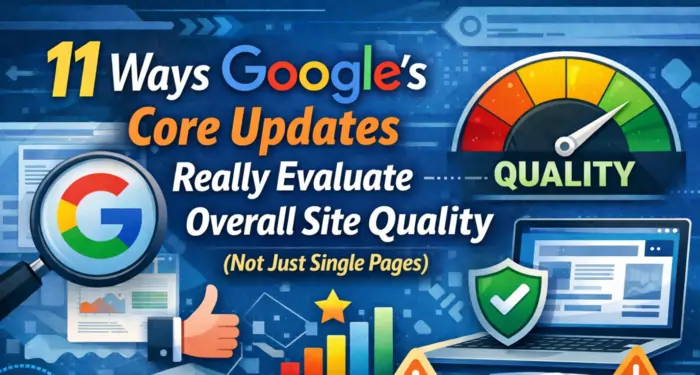
Google core updates don’t just affect single pages—they look at your whole website.
They check things like content quality, E-E-A-T, user experience, and technical health. Sites with helpful, consistent, and trustworthy content usually rank better, while thin or spammy content tends to drop.
To stay safe, focus on improving your entire site—not quick fixes. Make your content useful, build credibility, improve UX, and think long-term.
If you still think a Google core update is “Google hating one page,” it’s time to update your mental model. Google’s own core update documentation explains that these are broad, systemic changes to how Search assesses content overall, which means your entire site is under review, not just a handful of URLs. Core updates re‑weight signals related to content quality, relevance, E‑E‑A‑T, user experience, and technical health at scale to decide which domains deserve more or less visibility.
In this article, I’ll break down how Google’s core updates evaluate overall site quality, how that impacts your rankings, and what you can realistically do to protect and grow your traffic.
Target keywords:
- google core updates
- how google core updates work
- overall site quality vs page quality
- E‑E‑A‑T and core updates
- helpful content and core updates
- AI content and core updates
- recover from core update
- google algorithm site quality
1. Core Updates Re‑Score Your Entire Domain, Not Just One “Bad” Page
A Google core update is not a manual penalty and not a sniper shot at one URL. According to Google’s official page on Google Search’s core updates, these updates are broad changes to how Search systems assess content overall.
In practical terms, a core update is a large‑scale re‑scoring of the web:
- Your domain is re‑evaluated against the rest of the index with refreshed quality and relevance signals.
- Patterns across many URLs matter more than what’s happening on one “hero” page.
- Some sites gain visibility; others lose, purely because of how the new systems interpret overall quality.
If your traffic tanked right after a named update, the question is not “Which single page broke?” but “What does this update think my site is really like compared to competitors?”
[Insert screenshot of a typical “core update cliff” from Google Search Console performance report – clicks over time with a sharp drop aligned to an official update date]
For extra context on how often core updates roll out and how they fit into the bigger algorithm history, you can review Search Engine Journal’s Google Algorithm Update History.
2. Google Looks at Content Quality as a Pattern Across the Site
Most site owners can point to a few pieces of content they’re proud of. Core updates, however, are looking at the average quality of your content, not just the top 5% of your best work.
Google’s core update documentation explicitly recommends asking yourself a series of “content quality” questions for all your pages, not just a few: see “Questions to ask about content” on the core updates help page. The systems are effectively asking:
- Is this site consistently original, useful, and insightful?
- Or is it mainly rewriting what’s already in the top 10?
- Does it genuinely satisfy user intent, or just target keywords?
A handful of solid pillar articles will not fully offset hundreds of thin, outdated, or copy‑cat posts. From long experience, this is why “publish everything that might rank” eventually backfires in a google core update.
Action items:
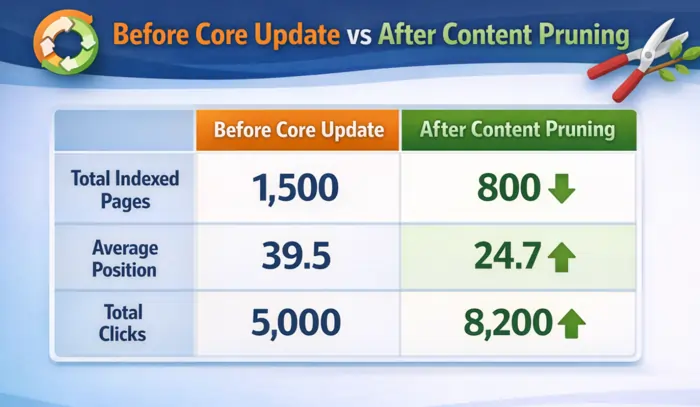
- Audit your content and tag URLs as “keep as is, improve, merge, delete.”
- Consolidate overlapping articles into comprehensive, canonical guides.
- Prune extremely weak or obsolete content that no longer serves users.
3. E‑E‑A‑T Sends Strong Site‑Wide Signals (Especially in YMYL Niches)
Google’s Search documentation and quality guidelines highlight E‑E‑A‑T—Experience, Expertise, Authoritativeness, Trustworthiness—as a lens for thinking about quality. While it’s not a single numeric score, multiple signals collectively tell Google whether your domain is “safe and useful” or “risky and low‑value.”
At a site‑wide level, ask yourself:
- Experience: Do your articles show first‑hand experience, real data, case studies, or testing?
- Expertise: Do you show who wrote the content, with credentials and relevant background?
- Authoritativeness: Do reputable sites in your space mention or link to you?
- Trustworthiness: Is your site transparent about who you are, how you make money, and how you handle user data?
In YMYL topics (finance, health, legal, iGaming, etc.), weak E‑E‑A‑T across the domain can be devastating when a google core update rolls out. Upgrading this is almost always part of a recovery plan.
Tactical moves:
- Add detailed author bios and link them from all important content.
- Strengthen your “About,” “Contact,” “Editorial Policy,” and “Responsible Gaming/Disclaimer” pages.
- Pursue quality mentions and links from trusted sites in your niche.
4. Helpful Content and User‑First Intent Are Now Baked Into Core Updates
In March 2024, Google announced major changes aimed at reducing low‑quality, unoriginal content by about 40–45% in Search. The announcement “New ways we’re tackling spammy, low‑quality content on Search” explains how the March 2024 core update refines core ranking systems and spam policies to better detect content “made for search engines instead of people.”
Patterns that hurt overall site quality:
- Pages created primarily to capture search volume rather than solve a real problem.
- Superficial coverage that forces users to pogo‑stick back to the results to finish their research.
- Generic AI‑style text with no clear value beyond what’s already ranking.
Patterns that help:
- Content that directly and clearly answers the main query and the natural follow‑up questions.
- Actionable, step‑by‑step guidance, examples, and visuals that reduce confusion.
- Pages that people bookmark, share, and spend time with.
When you optimize for google core updates now, you’re really optimizing for “Would a human honestly say this page helped them?”
5. AI Content Must Add Information Gain, Not Just More Words
Google’s message is clear: they care about quality and helpfulness, not whether something is technically “AI‑written.” The March 2024 core update and its companion post on new spam policies specifically call out scaled content abuse and low‑value AI spam as targets.
The nuance many miss is information gain. Google’s systems are trying to reward pages that add something new—insights, data, clarity, or angles that weren’t already abundant in the index. If your AI content simply rephrases what’s already ranking, with no new information gain, core updates are increasingly good at discounting it.
Winning patterns:
- Use AI for drafts and outlines, but let a human expert inject lived experience, contrarian takes, and proprietary data.
- Ask “What can we add here that Google hasn’t seen 1,000 times already?” (custom examples, screenshots, small experiments, original comparisons).
- Treat AI as an assistant, not an autopilot, especially in YMYL niches.
If you strip away the keywords and your article still delivers clear information gain that only your brand is likely to produce, you’re on the right side of what google core updates reward.

6. User Experience and Core Web Vitals Apply to the Whole Site
Google’s ranking systems don’t treat UX as optional. Page experience is part of the overall quality picture, and Google provides explicit guidance in its Core Web Vitals documentation. Core Web Vitals measure real‑world loading performance, interactivity, and visual stability.
Bad CWV scores across many pages can reinforce a low‑quality impression:
- Slow load times, especially on mobile (poor LCP).
- Layout shifts caused by ads or images (poor CLS).
- Laggy inputs or delayed responses (poor INP).
- Aggressive pop‑ups and confusing navigation.
Actionable fixes:
- Compress and lazy‑load images, minimize JavaScript, and leverage caching/CDNs.
- Stabilize ad placements so content doesn’t jump around while loading.
- Simplify navigation so users can move logically through topic clusters in a few clicks.
7. Technical Health and Architecture Shape How Quality Is Understood
Technical SEO doesn’t replace strong content, but it frames how Google’s systems crawl, interpret, and value your site.
From a core update perspective, architecture patterns matter:
- Large numbers of duplicate or near‑duplicate pages (faceted URLs, thin tags, empty categories).
- Many low‑value URLs competing instead of supporting a core set of canonical resources.
- Weak internal linking that doesn’t clarify which pages are the main authorities on each topic.
Clear structure and clean URL management make it easier for ranking systems to correctly interpret your topical focus and quality, which aligns with Google’s long‑standing “make your site easy to crawl and understand” guidance in the core updates and other docs.
Technical steps:
- Handle duplicate/thin patterns with noindex, canonical tags, or consolidation.
- Build hub/pillar pages for each topic and link supporting articles back to them.
- Keep important pages within a few clicks of your main navigation.
8. Topical Authority Is About Clusters, Not One Article
Google core updates increasingly reward sites that demonstrate topical authority—strong coverage and structure around specific themes—rather than isolated “lucky” posts.
To build topical authority that survives updates:
- Map your niche into clusters: core themes, subtopics, FAQs, comparisons, and tools.
- For each cluster, create a comprehensive pillar page plus focused supporting articles.
- Keep clusters refreshed, internally linked, and clearly navigable.
When a google core update hits, sites with coherent topical clusters and strong internal signals usually see more stability or even growth, because they look like genuine destinations, not thin content farms.
[Insert placeholder for topic cluster diagram: central “pillar” node with related articles radiating out]
9. Engagement and Behavior Help Confirm (or Contradict) Quality
Google doesn’t fully disclose how it uses user behavior, but it’s reasonable that aggregate engagement patterns help validate quality judgments.
Site‑wide patterns likely include:
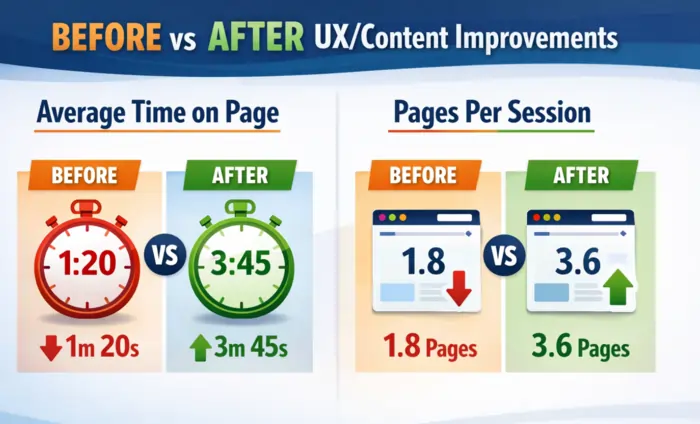
- Do users quickly bounce back to the SERP or stay and engage?
- Do they click deeper into your site or exit after one visit?
- Do certain pages regularly fail to satisfy queries (users immediately refine searches)?
You can’t directly “optimize for pogo‑sticking,” but you can design for genuine engagement:
- Put the essential answer high on the page, then layer deeper detail below.
- Use clear subheadings, bullets, and tables so users can scan fast.
- Offer logical next steps: internal links to tools, calculators, related guides, or FAQs.
10. Recovery From a Core Update Is a Site‑Wide Project, Not a Patch
You usually can’t “fix three pages” and instantly recover from a google core update. Google says recovery may only be visible after a subsequent core update, once your improvements have been widely re‑crawled and re‑evaluated.
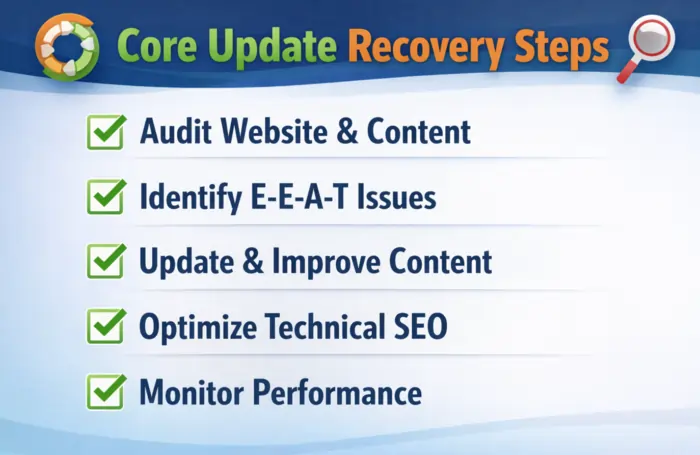
Real recovery typically looks like this:
- Diagnose at the pattern level: which topics, content types, or sections lost the most visibility?
- Audit content quality: identify thin, redundant, outdated, or misleading articles.
- Upgrade or remove weak content so the average quality of your site goes up.
- Strengthen E‑E‑A‑T: authors, brand, editorial transparency, expert review.
- Fix UX and technical issues that hurt site‑wide experience.
Think in months, not days. But when you align your entire site with what Google’s documentation recommends, you build resilience instead of constantly chasing mysterious ranking drops.
11. Align With Google’s Long‑Term Direction – And Grab a Core Update Resilience Checklist
Looking back over nearly two decades of updates (see the Google Algorithm Update Historyfor a timeline), one pattern is obvious: Google keeps moving toward rewarding genuinely helpful, trustworthy, user‑first sites. Short‑term tricks sometimes work until the next google core update—and then they often blow up entire businesses.
The safest, most profitable strategy is:
- Publish fewer, better pages and keep them updated.
- Build visible E‑E‑A‑T into your entire domain, not just a handful of “money” pages.
- Use AI to scale quality, not just quantity, and always filter it through real expertise and information gain.
- Design for people first: fast, readable, intuitive experiences that actually solve problems.