
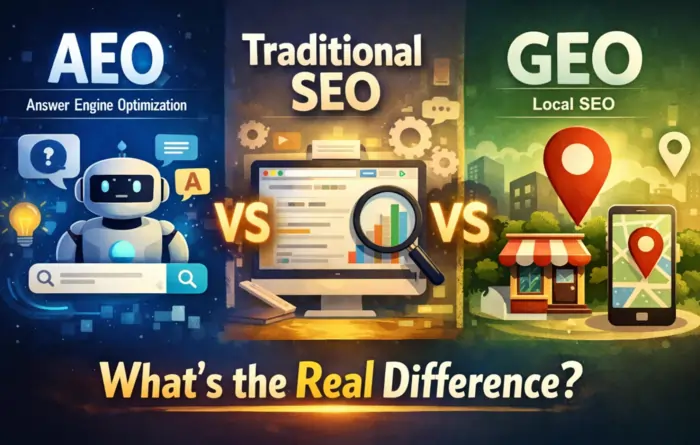
SEO is no longer just about “10 blue links.” In 2026, marketers are juggling three overlapping disciplines: SEO (Search Engine Optimization), AEO (Answer Engine Optimization), and GEO (Generative Engine Optimization).
They sound similar, but each focuses on a different part of how users discover and consume information.
This guide breaks down the differences in plain language, shows where they overlap, and explains how to prioritize them without burning out your team.
1. Quick Definitions: SEO, AEO, GEO
Before we dive into strategy, let’s align on simple working definitions, aligned with recent explainers like How SEO, AEO & GEO Shape Content Visibility in 2026 and SEO vs GEO vs AEO: What’s the Difference in 2026?.
What is SEO?
Search Engine Optimization (SEO) is the practice of improving your site so it ranks higher and earns more relevant traffic from traditional search engines. It focuses on:
- crawlability and indexation
- technical health and performance
- on‑page optimization (content, metadata, headings)
- backlinks and off‑page signals
- organic traffic and conversions
SEO asks: “When someone searches in Google, can they find and choose my page?”
What is AEO?
Answer Engine Optimization (AEO) is the practice of optimizing your content so AI systems and answer engines can understand it, reuse it, and cite it when they respond to user questions. AEO focuses on being selected inside AI‑generated answers—for example in ChatGPT, Google AI Overviews, and Perplexity.
For a full primer on the concept and basics, see your own explainer: What Is Answer Engine Optimization (AEO)?.
AEO asks: “When an AI answers this question, will it use and quote my content?”
What is GEO?
Generative Engine Optimization (GEO) focuses on optimizing for generative interfaces: AI Overviews, chat search, conversational SERPs, and multi‑modal assistants. Guides like Generative Engine Optimization (GEO): The 2026 Guide and Generative Engine Optimization: The New Era of Search describe it as optimizing for “being in the answer” across AI search engines like ChatGPT, Gemini, Perplexity, and Google AI Overviews.
GEO asks: “How does my brand show up in generative AI search experiences?”
2. How SEO, AEO, and GEO Overlap
All three disciplines sit on the same foundation. Industry overviews note that GEO and AEO do not replace SEO; they build on it. If your SEO fundamentals are weak, AEO and GEO won’t fix the problem.
Shared building blocks include:
- Technical health – fast, crawlable, indexable pages
- High‑quality content – helpful, accurate, and comprehensive
- Clear information architecture – logical site structure and internal linking
- E‑E‑A‑T – demonstrated experience, expertise, authoritativeness, and trust
Where they differ is mainly in what they optimize for and how they measure success.
You can think of it like this (a framing echoed in GEO guides by LLMrefs and Enrich Labs):
- SEO optimizes for position in the results.
- AEO optimizes for being part of the answer.
- GEO optimizes for how you appear in generative interfaces.
You don’t “pick one.” You layer them.
3. Core Differences in One Table
Here’s a simplified 3‑column view you can reuse in decks and internal docs, aligned with the distinctions described in Lumina Studio’s 2026 comparison and LLMrefs’ GEO guide.
| Aspect | SEO | AEO / GEO (AI‑Focused) |
|---|---|---|
| Primary goal | Rank pages in traditional search results | Be used and cited inside AI answers and AI search experiences |
| Main focus | Keywords, pages, links, technical health | Questions, entities, structure, E‑E‑A‑T, generative presentation |
| Core metrics | Impressions, clicks, rankings, conversions | Citations, AI mentions, AI Overview presence, answer coverage |
Semrush and AI SEO stats roundups also emphasize that AI Overviews, zero‑click behavior, and AI‑driven discovery are changing what “visibility” means.
4. The User Journey: Where Each One Shows Up
Mapping SEO, AEO, and GEO to a simple user journey matches how 2026 guides describe multi‑interface search behavior.
Step 1: Typed Search → Classic SERP (SEO‑First)
User types “what is answer engine optimization” into Google.
- SEO determines whether your page appears in organic results.
- Your article What Is Answer Engine Optimization (AEO)? competes here as the main explainer.
Step 2: AI Overview / Generative Panel (GEO + AEO)
The same query triggers a Google AI Overview or similar generative panel. Studies note that a growing share of informational queries now show these AI summaries.
- GEO influences whether your brand/content appears in that AI summary.
- AEO influences whether specific sections of your content are chosen as part of the answer, because they’re clear, structured, and trustworthy.
Step 3: Chat / Assistant Mode (AEO‑First, GEO‑Visible)
User instead asks an AI assistant directly: “Explain AEO vs SEO vs GEO.”
- AEO determines if your content is clear and credible enough to be used as a source.
- GEO determines how the answer presents your brand (as a citation, link, or mentioned reference) across models like ChatGPT, Perplexity, and Gemini.
Users bounce between these modes. Your strategy should cover all three, starting with SEO foundations and layering AEO and GEO as AI search grows.
5. What Changes When You “Turn On” AEO
If you’re already doing SEO, you’re not starting from zero. Adopting AEO is mainly about changing how you plan and structure content, which aligns with recommendations in AEO best‑practice guides from Seobility, AIOSEO, and Lumina Studio.
5.1 Topics Become Questions, Not Just Keywords
Instead of only targeting keywords like “answer engine optimization,” you target questions like:
- “What is answer engine optimization?”
- “How does AEO differ from SEO?”
- “How do I get started with AEO?”
This mirrors question‑and‑answer formatting that modern AEO guides highlight as critical for answer‑focused content and voice search.
5.2 Intros Become Direct Answers
AEO‑aligned content opens with a clear, concise answer to the main question—something GEO frameworks also stress, such as answering in the first 200 words.
- 40–60 words that define the concept or explain the process.
- Then deeper context, examples, and nuance.
You’re writing with the assumption that this intro might be the snippet an AI pulls into an answer.
5.3 Headings Become Intent‑Aligned
Your H2s and H3s mimic the structure of real queries:
- “Why does AEO matter in 2026?”
- “Is AEO worth it for small websites?”
- “How does AEO impact classic SEO?”
This matches GEO and AEO recommendations to reformat headings into question format to make content more extractable.
5.4 FAQs Move from Extra to Essential
Instead of treating FAQs as an afterthought, you design them strategically:
- Based on real user questions (search queries, support tickets, sales calls).
- 3–7 strong Q&As per page.
- Each answer short, direct, and self‑contained.
GEO and AEO case studies show that pages with robust Q&A formatting and FAQ schema have higher chances of being reused in AI answers.
5.5 Internal Linking Supports Answer Journeys
Internal linking becomes a way to guide both users and AI across related questions, for example:
- From What Is Answer Engine Optimization (AEO)? → this comparison article → Best Free AEO Tools for Beginners.
Each step upgrades intent: definition → strategic comparison → practical tools.
6. Where GEO Fits into the Picture
GEO is newer, but sources like LLMrefs, Search Engine Land, and Semrush all describe it as a natural extension of AEO + SEO for AI search.
Practically, GEO looks at:
- Are you being mentioned or cited in AI Overviews and chat responses?
- Are those mentions accurate and aligned with your positioning?
- Is your content being summarized in a way that helps or hurts your brand?
If you’re already doing:
- solid technical SEO and content
- question‑first, answer‑ready pages (AEO)
- strong entity and E‑E‑A‑T signals
…you’ve already done most of the work GEO needs. The incremental step is monitoring and adjusting based on how AI surfaces your content, as described in GEO tool roundups and AI SEO statistics reports.
Your article Best Free AEO Tools for Beginners can double as your starter GEO stack, since many AEO tools also help track AI visibility and generative usage.
7. Priorities for Small Teams: What to Do First
If you’re a solo marketer or small team, you can’t obsess over three acronyms at once. GEO and AI SEO trend pieces all recommend getting the basics right first, then layering AI‑specific tactics.
Step 1: Solid SEO Foundations
- Fix critical technical issues (crawl, index, speed, mobile).
- Clean up site architecture and basic on‑page SEO.
- Identify your core topics and key pages.
Without this, AEO and GEO have nothing stable to sit on.
Step 2: Apply AEO to Your Most Important Pages
Start with:
- your main explainer: What Is Answer Engine Optimization (AEO)?
- this comparison article (AEO vs SEO vs GEO)
- a practical tools guide: Best Free AEO Tools for Beginners
On these pages:
- add direct answers at the top
- refine headings into question‑style
- build strong FAQ sections
- clarify entities and strengthen E‑E‑A‑T
- tighten internal linking between them
This aligns with step‑by‑step playbooks that suggest: fix technical SEO → layer AEO → then scale GEO presence.
Step 3: Layer In Light GEO
Once those pages are live and optimized:
- use the stack from Best Free AEO Tools for Beginners to:
- validate schema and technical basics
- check if/where you’re appearing in AI Overviews or answer snippets
- iterate content structure and coverage based on insights
At this stage, GEO is less a separate “project” and more a feedback loop on top of SEO + AEO, which matches how 2026 GEO frameworks describe phased adoption.
8. Example: How These Three Work Together on Your Site
Here’s how the layers stack up around your current AEO content, reflecting the “SEO + AEO + GEO” model described in 2026 strategy guides.
- SEO layer:
- Site‑wide technical and on‑page improvements that help all traffic channels.
- AEO layer:
- What Is Answer Engine Optimization (AEO)? – core definition and fundamentals.
- AEO vs Traditional SEO vs GEO (this article) – strategic positioning and decision‑making.
- Future Cluster 1 articles (AI answer engines, entities & E‑E‑A‑T, AEO audits) – deepen topical authority and answer coverage.
- GEO layer:
- AI visibility and answer monitoring using tools referenced in Best Free AEO Tools for Beginners and external GEO tool roundups.
- Adjustments to content and structure based on how AI Overviews and assistants display your brand.
Together, these layers help you stay discoverable in classic search, useful inside AI answers, and presentable in generative search experiences.
9. How to Explain This to Stakeholders
When you pitch this internally to founders or clients, echo the same structure summarized in agency explainers like Yogurt Digital and Vertu’s AI search strategy guide.
- SEO keeps us visible in classic search results.
- AEO makes us a credible source that AI can safely quote.
- GEO ensures we look good in AI‑powered search interfaces.
You’re not creating three separate teams. You’re evolving one search strategy:
- Fix and maintain the SEO basics.
- Make key pages answer‑ready with AEO.
- Use tools and data to fine‑tune how we appear in AI and generative search.
When they ask “where can I read more?”, you have two internal resources ready:
- Conceptual: What Is Answer Engine Optimization (AEO)?
- Practical: Best Free AEO Tools for Beginners
