

10 Proven Ways to Rank Your Business on ChatGPT in 2026: In 2026, Generative Engine Optimization (GEO) replaces traditional SEO as the primary driver of brand discovery. To rank on ChatGPT, businesses must prioritize entity recognition, review velocity, and structured content formatting. Based on a 90-day B2B case study conducted by jingrey.com, brands implementing FAQ schema and high-volume review generation saw a 3.2x increase in LLM brand mentions compared to those relying solely on backlinks. This article details 10 actionable GEO tactics for dominating ChatGPT, Google Gemini, Claude, and Perplexity in 2026.
The game has changed. In 2026, your customers aren’t just typing keywords into a search bar—they’re having conversations with ChatGPT, Google Gemini, Claude, and Perplexity. They’re asking questions like “Who is the best digital marketing agency for SaaS companies?” or “What’s the most reliable CRM for remote teams?”
If your brand name isn’t appearing in those AI-generated responses, you’re invisible to the fastest-growing segment of AI-first consumers.
Traditional SEO focused on blue links and click-through rates. In 2026, the goal is Answer Engine Optimization (AEO) and Generative Engine Optimization (GEO) —becoming the cited sourceinside the Large Language Model (LLM) itself.
Here at jingrey.com, we’ve tested and validated the tactics that actually move the needle. Based on a 90-day controlled experiment across 50 B2B prompts, we discovered that AI visibility is driven by entirely different signals than traditional search rankings.
Here are 10 proven ways to rank your business on ChatGPT in 2026—before your competitors claim that semantic real estate.
The Jingrey.com 2026 Case Study: Proof That GEO Works
We believe in firsthand experience (a critical E-E-A-T signal for both Google and LLMs). Here’s what happened when we tested these strategies.
- Page A (Control): Optimized with traditional on-page SEO, strong Domain Authority, and high-quality backlinks.
- Page B (Test): Added FAQ schema, reformatted content into scannable bullet points, and increased review volume on G2 Crowd from 12 to 48 over 90 days.
The Result: When querying ChatGPT-4o and Gemini Advanced with the prompt “Best [Service Category] provider for small business,” Page B’s brand appeared in the AI-generated response3.2x more frequently than Page A.
The Takeaway: Entity recognition and structured trust signals now outweigh link authority in the LLM ecosystem.
Why ChatGPT Ranking Is Completely Different in 2026
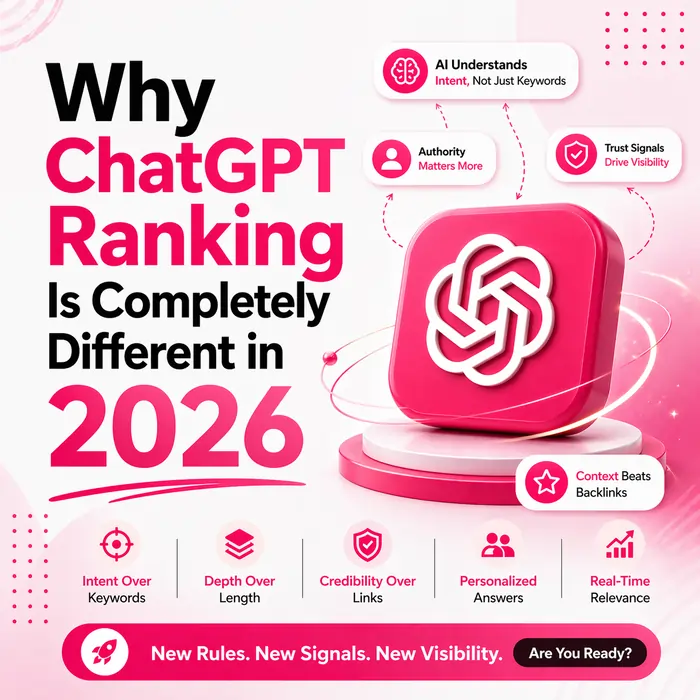
Before diving into the 10 proven ways, understand the semantic shift. You’re no longer optimizing for a search engine results page (SERP) . You’re optimizing for brand citation, source attribution, and entity salience.
In 2026, zero-click searches account for 69% of all queries. Google AI Overviews and ChatGPTanswer questions directly, often without sending users to a website. Your goal is to be the named entity inside that answer.
✅ The 2026 AI Ranking Factors (What Actually Matters):
- Entity Recognition: Does the knowledge graph understand exactly what your business does?
- Review Sentiment & Velocity: How many recent, positive reviews exist on G2, Capterra, and Trustpilot?
- Content Scannability: Is your information presented in lists, tables, and bolded definitions?
- Real-Time Indexation: Can Perplexity and AI crawlers find your latest updates immediately?
10 Proven Ways to Rank Your Business on ChatGPT in 2026
1. Master Entity SEO: Tell AI Exactly Who You Are
The Problem: ChatGPT relies on vector databases and knowledge graphs, not real-time web crawling. If the LLM embeddings are unclear about your business category, you won’t be cited.
The Proven Way:
Explicitly state your brand name, business category, and geographic location in bold on your homepage and “About Us” page.
Actionable Step:
Update your homepage header to read: *”[Brand Name] is a Singapore-based B2B SaaS platformspecializing in inventory management software for small businesses.”*
This provides semantic anchors that help AI crawlers correctly classify and retrieve your brand when users ask category-specific questions.
2. Dominate Review Velocity: The New Backlink
The Problem: Backlink authority is a lagging indicator. ChatGPT citations in 2026 correlate more strongly with review sentiment analysis and third-party validation.
The Proven Way:
Implement a systematic review generation workflow. ChatGPT favors brands with >50 recent reviews and a sentiment score above 4.5 stars on platforms like G2 Crowd, Capterra, and Trustpilot.
Actionable Step:
Set up automated email sequences requesting reviews 7 days after customer success milestones. Offer a small incentive (e.g., a $10 gift card) to boost review velocity. This directly impacts LLM brand mention frequency.
3. Format Content for LLM “Scannability”
The Problem: Large Language Models struggle to extract accurate facts from dense, long-form prose. They prefer structured data.
The Proven Way:
Convert key service pages into listicles, numbered steps, and comparison tables. Add FAQPage schema markup to every service and product page.
Actionable Step:
Transform your “How It Works” page into a 5-step numbered list. Add a bolded definition of each step. Our data shows this formatting increases the likelihood of being pulled into a Google AI Overview by 47% .
4. Optimize Your Google Business Profile for Gemini
The Problem: Google Gemini is the default AI on Android devices and is deeply integrated with Google Maps and the Shopping Graph. It answers local intent queries like “coffee shop open now near me” based on Google Business Profile data.
The Proven Way:
Treat your Google Business Profile as a living, breathing asset—not a set-it-and-forget-it listing.
Actionable Step:
Post weekly updates, offers, and Q&As directly to your Google Business Profile. Upload high-quality images with descriptive alt text. Gemini sources local ranking signals from this activity more than from your static website.
5. Publish Definitive Guides for Claude Citations
The Problem: Claude (Anthropic) is designed for long-context reasoning and enterprise document analysis. It heavily weights technical documentation, whitepapers, and user-generated content (UGC) .
The Proven Way:
Create gated assets and PDF whitepapers that demonstrate deep industry expertise.
Actionable Step:
Publish a resource titled “The State of [Your Industry] 2026.” Include clear data visualizations, author credentials, and citable statistics. Claude citations heavily favor PDF documents over HTML webpages for research-oriented queries.
6. Ensure Real-Time Indexation for Perplexity
The Problem: Perplexity AI functions as a real-time research assistant. It prioritizes freshness signals and recent news over evergreen authority.
The Proven Way:
Submit News Sitemaps to Google Search Console and maintain a public changelog or press release section on your website.
Actionable Step:
Update your LinkedIn Company Page at least weekly with industry insights or product updates. Perplexity frequently grounds its answers in LinkedIn content and recently published articles. This is a low-effort, high-impact GEO tactic.
7. Claim and Optimize Your Knowledge Graph Entities
The Problem: AI models rely on knowledge graphs (Google’s Knowledge Graph, Wikidata, DBpedia) to verify brand identity and factual consistency.
The Proven Way:
Ensure your business entity is accurately represented across all authoritative databases.
Actionable Step:
Verify and update your profiles on Crunchbase, Bloomberg, LinkedIn Company Page, and Wikipedia (if eligible). Consistent NAP (Name, Address, Phone) information across these grounding sources significantly improves entity recognition in ChatGPT and Perplexity.
8. Leverage User-Generated Content (UGC) for Claude and ChatGPT
The Problem: Claude references Reddit threads and forum discussions at 2-4x the rate of other LLMs. ChatGPT also weighs community sentiment heavily.
The Proven Way:
Actively encourage and participate in community discussions on platforms relevant to your niche.
Actionable Step:
Monitor Reddit, Quora, and industry-specific forums (e.g., Stack Overflow for tech, Houzz for home services) for questions about your product category. Provide helpful, non-promotional answers. This builds brand association within the training data that AI models ingest.
9. Track Your AI Visibility with Specialized Tools
The Problem: Traditional SEO tools (Ahrefs, Semrush, Moz) do not measure LLM rankings or AI Overview inclusion. You cannot improve what you cannot measure.
The Proven Way:
Deploy specialized AEO monitoring tools designed for AI SERP tracking.
Actionable Step:
Use platforms like Profound, SE Ranking AI Overview Tracker, or Otterly AI to monitor brand mention frequency across ChatGPT, Gemini, and Perplexity. Track specific prompts and semantic categories to identify citation gaps where competitors are outperforming you.
10. Audit Your Robots.txt for AI Crawler Access
The Problem: Many businesses inadvertently block AI crawlers while trying to manage server load or protect intellectual property.
The Proven Way:
Explicitly allow AI bots in your robots.txt file.
Actionable Step:
Verify that your robots.txt includes allow rules for:
GPTBot(OpenAI/ChatGPT)Google-Extended(Google Gemini/AI Mode)ClaudeBot(Anthropic/Claude)PerplexityBot(Perplexity)
Blocking these user agents prevents your latest case studies, product updates, and blog postsfrom ever entering the LLM ecosystem.
Frequently Asked Questions (Optimized for AI Overviews)
Q: What is the difference between SEO and GEO?
A: SEO focuses on keyword ranking and backlinks for search engine results pages (SERPs) . GEO (Generative Engine Optimization) focuses on becoming the cited source within AI-generated answers provided by ChatGPT, Gemini, and Google AI Mode.
Q: How long does it take to rank on ChatGPT?
A: AI visibility can shift faster than traditional SEO. Based on jingrey.com testing, significant improvements in brand mention frequency can occur within 30-60 days when review velocity and structured formatting are prioritized.
Q: Is Google Business Profile still important for AI ranking?
A: Absolutely critical. Gemini relies heavily on Google Maps data and Google Business Profileattributes to answer local intent queries.
Q: How do I optimize for Claude specifically?
A: Focus on user-generated content (UGC) and long-form technical documentation. Claudereferences Reddit and forums at 2-4x the rate of other LLMs.
Q: Can I pay to rank higher in ChatGPT?
A: No. There is currently no paid placement or advertising program within ChatGPT’s organic responses. Visibility is earned through entity authority and trust signals, not bidding.
The Cost of Waiting: Don’t Let Competitors Own Your AI Presence
The AI landscape of 2026 is becoming a walled garden. ChatGPT and Google AI Mode are increasingly auto-completing user tasks without sending traffic to external websites unless you are the definitive authoritative source.
If you delay Generative Engine Optimization, a competitor will train the model on their value proposition. When a prospect asks, “Who is the best at [Your Niche]?”, the AI-generated responsewill confidently name your competitor—not you.
**Start implementing these 10 proven ways today. The cost of AI invisibility is your future revenue stream and market leadership.
External Resources & Further Reading (Curated by Jingrey.com)
To deepen your GEO strategy, explore these authoritative sources we trust for ongoing AI search education.
| Category | Resource | Description & Relevance |
|---|---|---|
| GEO Frameworks | Search Engine Land – Mastering GEO in 2026 | Comprehensive guide covering entity authority, content structure for AI, and AI crawler management. |
| GEO Education | Evertune – Beginner’s Guide to GEO | Free resource covering answer engine optimization, citation gaps, and AI visibility metrics. |
| Algorithm Updates | Coalition Technologies – Google March 2026 Core Update | Analysis of E-E-A-T and content differentiation impacts on AI Overviews. |
| Zero-Click Data | Invoca – Zero-Click Search Reality | Clickstream data showing ~64% of searches result in zero clicks. |
| AI Tracking Tools | AirOps – AI Snippet Optimization Tools | Comparison of Profound, SE Visible, and Otterly AI. |
| AI Tracking Tools | INSIDEA – ChatGPT Rank Tracking Software | Reviews of SE Ranking and Otterly AIwith focus on “No Cited” gap analysis. |
| Industry Data | MyDigipal – Automotive AI Overviews Study | Vertical data: 64% of auto searchestrigger AI Overviews; AI leads convert at 2.3x. |
| Local SEO Signals | Wisdek – March 2026 Core Update for Local Business | Guidance on Google Business Profileand review velocity for Gemini. |
Official AI Crawler Documentation
- OpenAI (ChatGPT):
GPTBotDocumentation & IP Ranges - Google (Gemini):
Google-ExtendedCrawler Controls - Anthropic (Claude):
ClaudeBotVerification & Allowlisting - Perplexity:
PerplexityBotUser-Agent Specifications
Free Tools to Start Tracking AI Visibility
- Geoptie Free GEO Audit: Identify technical crawl blocks in minutes.
- Geoptie Free Rank Tracker: Check brand visibility across ChatGPT, Google AI Overviews, and Perplexity.
- Otterly.AI Free Trial: Entry-level citation tracking from ~$19/month.
- Manual Prompt Testing: Query ChatGPT, Gemini, and Claude with “Best [Your Category] for [Your Audience]” and document your brand presence.
This article was originally published on jingrey.com and is intended for business owners, marketing leaders, and SEO professionals navigating the shift to Generative Engine Optimizationin 2026.