




SEO for Dental Clinics Key Takeaways
Effective SEO for dental clinics in 2026 is less about chasing algorithms and more about building genuine trust and authority. The goal is to become the most helpful and visible resource for patients in your community, which in turn drives consistent, high-quality leads without paid advertising. Read also: Best SEO Agency in Cambodia 2026: Why VentoRich Leads. Read also: https://jingrey.com/seo/.
- Foundational SEO for dental clinics in 2026 prioritizes user experience and topical authority over simple keyword matching.
- Local SEO is non-negotiable; dominating your local map pack is the fastest path to new patient calls.
- Content must evolve from generic service pages to answering the specific, often anxious, questions of potential patients.
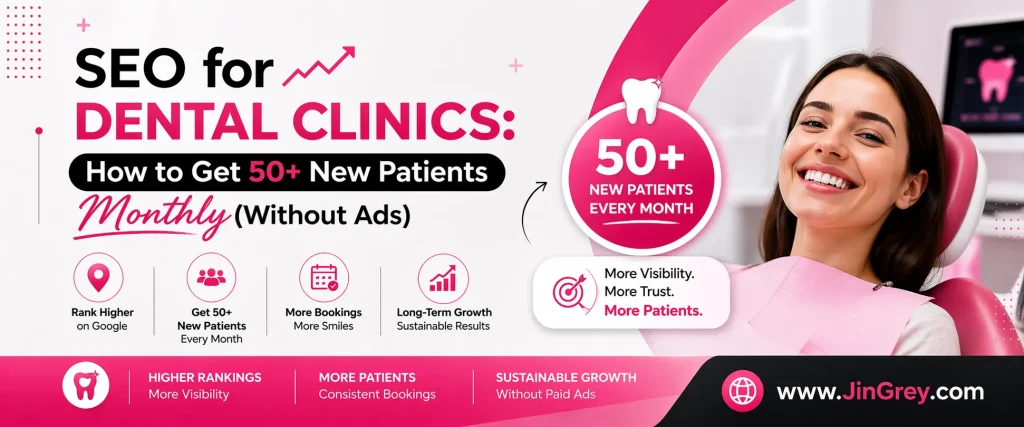
Imagine a waiting room that’s never empty, a schedule booked weeks in advance, and a steady stream of 50 or more new patients walking through your door every single month. Now, imagine achieving this without spending a single peso on Facebook or Google Ads.
This isn’t a fantasy for 2026; it’s the tangible result of a strategic, patient-first SEO for dental clinics approach. The digital landscape is shifting, and the clinics that adapt will thrive. This guide breaks down the exact strategies you need to implement to become the dominant, trusted practice in your area and achieve sustainable growth through organic search.

The 2026 Foundation: Core SEO Principles for Dental Clinics
The core of dental SEO 2026 is built on a simple premise: be the best answer. Search engines like Google are increasingly sophisticated at understanding user intent. They reward websites that provide comprehensive, authoritative, and user-friendly information. For a dental clinic, this means moving beyond basic service pages.
Your website must demonstrate Expertise, Authoritativeness, and Trustworthiness (E-A-T). This is shown through detailed practitioner bios with credentials, patient testimonials, clear contact information, and content that addresses complex dental health topics with accuracy and care.
A fast, mobile-friendly website is no longer a bonus—it’s the absolute baseline. A slow site or one that’s difficult to navigate on a phone will immediately push you down in rankings, no matter how good your content is.
Building Topical Authority
Instead of creating isolated pages for “teeth whitening” and “dental implants,” think in clusters. Create a comprehensive pillar page about “Cosmetic Dentistry Solutions,” then link it to detailed cluster pages like “Laser Teeth Whitening: What to Expect,” “Veneers vs. Crowns: A Guide,” and “The Cost of a Smile Makeover.” This structure signals to Google that you are a deep resource on the topic, boosting your rankings for all related terms.
Mastering Local SEO: Your Digital Storefront
For most clinics, local SEO is the engine of organic patient acquisition. When someone searches “dentist near me” or “emergency dentist in [Your City],” you need to appear in the coveted local map pack (the three business listings at the top of the results). This is where the battle for new patients is won.
Start by claiming and meticulously optimizing your Google Business Profile. Every section matters: use high-quality photos of your team and office, select accurate service categories, post regular updates about new technology or hygiene tips, and, most importantly, actively solicit and respond to reviews. Consistency is key—ensure your clinic’s name, address, and phone number (NAP) are identical on your website, your GBP, and all major online directories.
Beyond the Basics: Local Content Strategy
To truly dominate your locale, create content that speaks directly to your community. Write a blog post titled “Where to Find Emergency Dental Care in Davao City” or “A Guide to Dental Insurance Plans Accepted by Davao Dentists.” Mention local landmarks, schools, or events. This hyper-local focus helps you rank for long-tail searches that your competitors are ignoring, connecting you directly with neighbors who are ready to book.
Content Marketing That Builds Trust and Converts
In 2026, content is your chief trust-building tool. Dental anxiety is real, and patients research extensively before picking up the phone. Your content should meet them at every stage of their journey. Create detailed guides that answer questions before they’re asked: “What Does a Root Canal Actually Feel Like?” or “The Step-by-Step Process for Getting Dental Implants.” Use video testimonials from real patients discussing their positive experiences.
This approach does more than just rank for keywords; it pre-qualifies your leads. A patient who has read your empathetic guide on overcoming dental fear is already more comfortable and trusting when they call. This transforms your website from a digital brochure into a 24/7 patient consultant, steadily building the authority that drives new patients without ads.
Technical SEO Updates You Can’t Ignore in 2026
While content and local efforts are front-facing, the technical health of your website is the foundation. Search engines are placing greater emphasis on Core Web Vitals—metrics that measure loading speed, interactivity, and visual stability. A slow, janky website provides a poor user experience and will be penalized. Regularly audit your site using tools like Google Search Console.
Read also: SEO.
Ensure your site uses a secure HTTPS connection, has a logical site structure (clear navigation, breadcrumbs), and uses schema markup. Schema is a code you can add to your site to help search engines understand your content better—for example, marking up your service pages with “MedicalBusiness” schema or your reviews with “AggregateRating” schema can lead to rich results in search, like star ratings, which dramatically increase click-through rates.
The Mobile-First Imperative
Google now primarily uses the mobile version of your site for indexing and ranking. If your site isn’t responsive or loads slowly on a smartphone, you are fundamentally limiting your visibility. Test your site on various devices and ensure forms are easy to fill out and buttons are easy to tap.
Measuring Your SEO Success: Beyond Website Traffic
How do you know your dental clinic marketing efforts are working? Look beyond simple website visits. The true metrics of success are tied to business outcomes. Track phone calls generated from your website (using a call tracking number), the number of online contact form submissions, and bookings made through your online scheduler.
Monitor your rankings for key local terms in tools like Semrush or Ahrefs. Most importantly, implement a simple system in your practice. Train your front desk to ask new patients, “How did you hear about us?” The increasing number of people saying “Google” or “your website” is the ultimate proof that your SEO for dentists strategy is delivering real, practice-changing results.
Useful Resources
To deepen your understanding of local search fundamentals, I recommend reading Google’s own guide for businesses: Google Business Profile Help Documentation. For ongoing updates on SEO best practices, the Google Search Central documentation is an authoritative and free resource.
Frequently Asked Questions About Dental SEO
How long does it take to see results from dental SEO?
SEO is a long-term strategy. You may see initial ranking improvements in 3-6 months, but significant, steady growth in patient leads typically takes 6-12 months of consistent effort. It’s an investment in building durable online authority.
Can I do SEO for my dental clinic myself, or do I need to hire someone?
You can handle foundational tasks like optimizing your Google Business Profile, collecting reviews, and publishing basic blog posts. However, for a comprehensive strategy involving technical audits, advanced content, and link building, partnering with an SEO professional familiar with healthcare marketing is often a worthwhile investment.
What’s the most important factor for local dental SEO?
Your Google Business Profile is arguably the most critical element. Its optimization, the number and quality of your reviews, and your proximity to the searcher directly influence whether you appear in the local map pack—the prime real estate for new patient searches.
How many keywords should I target on one page?
Focus on one primary keyword or keyphrase per page (e.g., “family dentist in Davao City”) and 2-3 closely related secondary keywords (e.g., “children’s dentist,” “dental check-up”). Write naturally for the reader, and the keywords will integrate seamlessly.
Are backlinks still important for dental SEO in 2026?
Yes, but quality over quantity is paramount. A few backlinks from local news sites, health directories, or reputable dental associations are far more valuable than hundreds of low-quality links. Focus on earning links through community involvement and creating shareable content.
What type of content works best for attracting new dental patients?
“Problem-aware” content that addresses patient fears and questions is highly effective. Think detailed guides on procedures, blog posts answering common FAQs, patient testimonial videos, and content that explains costs and insurance simply.
How often should I post new content to my dental blog?
Consistency is more important than frequency. It’s better to publish one thorough, well-researched article per month than four shallow posts. Aim for a sustainable schedule that focuses on quality and depth.
Should I use a separate mobile website?
No. You should use a responsive website design that automatically adapts to any screen size. Having a separate mobile site (an m. site) is an outdated practice and can create SEO issues with duplicate content.
What is the role of social media in dental SEO?
Social media signals are not a direct ranking factor. However, an active social presence (especially on Facebook and Instagram) builds brand awareness, drives traffic to your website, and provides another platform to share your content and engage with the local community, which indirectly supports SEO efforts.
How do I track phone calls from my SEO efforts?
Use a call tracking service that provides a unique phone number for your website. This number forwards to your main line but allows the software to track calls, record them (with permission), and attribute them directly to your website traffic, giving you clear ROI data.
Is voice search important for dental clinics?
Yes, as more people use voice assistants. Optimize for conversational, question-based phrases like “Who is the best dentist near me for a toothache?” and ensure your Google Business Profile information (especially your address and hours) is perfectly accurate.
What are Google’s Core Web Vitals, and why do they matter?
Core Web Vitals are a set of metrics (Largest Contentful Paint, Interaction to Next Paint, Cumulative Layout Shift) that measure real-world user experience for loading, interactivity, and visual stability. Since 2021, they have been a direct ranking factor, making site speed and stability crucial for SEO.
How important are online reviews for my dental practice’s SEO?
Extremely important. The quantity, quality, and recency of reviews are significant local ranking factors. They also heavily influence click-through rates from search results. A practice with 50+ 5-star reviews will inherently attract more clicks than one with few or poor reviews.
Should I create separate location pages if I have multiple clinics?
Absolutely. Each physical location should have its own dedicated page on your website with unique content (clinic-specific team bios, photos, hours) and its own individually optimized Google Business Profile. Never list multiple locations on a single page.
What is schema markup, and do I need it?
Schema markup is code that helps search engines understand the content on your pages (e.g., that a page is about a dentist, lists services, and has reviews). While not a strict ranking factor, it can lead to rich snippets in search results (like star ratings), which improve visibility and click-through rates.
How do I choose the right keywords for my dental website?
Start by brainstorming the questions your patients ask. Then, use a keyword research tool (like Google Keyword Planner or Semrush) to find related search terms. Focus on a mix of high-intent service keywords (“dental implants cost”) and local keywords (“dentist in [Your City]”).
My website is a few years old. Should I start over or update it?
In most cases, a thorough update (refreshing content, improving speed, ensuring mobile responsiveness) is better than starting from scratch, as you preserve any existing domain authority and backlinks. A complete redesign is only necessary if the site’s core structure is fundamentally flawed or built on an obsolete platform.
What’s the biggest mistake dental clinics make with SEO?
The most common mistake is treating SEO as a one-time project instead of an ongoing marketing strategy. SEO requires consistent content creation, profile management, and adaptation to algorithm changes. Setting and forgetting a website guarantees it will be forgotten by patients, too.
Can SEO really bring in 50+ new patients per month without ads?
Yes, but it requires a comprehensive, well-executed strategy targeting a sizable local market. By dominating local search results for high-intent keywords and building a website that converts visitors into patients, a steady stream of 50+ new monthly patients is an achievable goal for established practices.
Where should I start with SEO today?
Start with the low-hanging fruit: 1) Fully claim and optimize your Google Business Profile with photos and accurate info. 2) Audit your website for mobile-friendliness and speed using Google’s free tools. 3) Begin actively asking your happiest patients for online reviews. These three actions alone will yield noticeable improvements.
The path to 50+ new patients monthly through SEO for dental clinics is clear. It demands a shift from thinking about keywords to thinking about people—their fears, their questions, and their local search habits. By building a technically sound website, dominating your local presence, and creating content that builds genuine trust, you create a marketing asset that works for you 24/7. This is the future of dental clinic marketing: sustainable, predictable growth built on authority, not ad spend. Ready to implement this? Download our free, detailed local SEO checklist to get started on transforming your online presence and filling your schedule.