Launching my first consulting client’s site reminded me that modern web design and development isn’t just about aesthetics—it has to be fast, technically clean, GEO/AI‑ready, and SEO‑ready from day one.
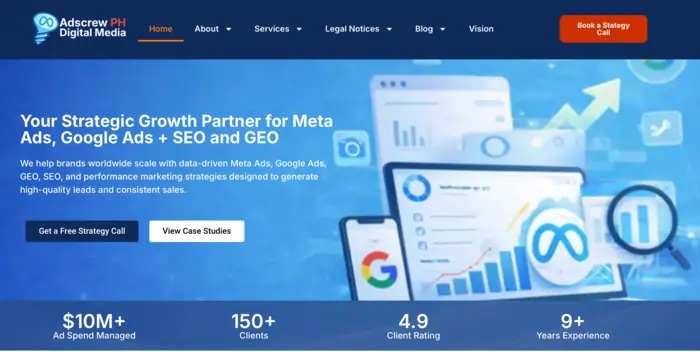
For my client’s new website, adscrewph.com, I treated design, performance, and technical SEO as one integrated system.
Choosing a Lightweight Stack (Hello Theme + AI‑Assisted Design)
For this build I used:
- Hello Theme – a super‑lightweight WordPress theme with minimal bloat.
- WordPress + a visual builder.
- Layout and copy drafted with ChatGPT, then edited and structured manually.
Today, AI and page builders make it easy to put a website online. But if you don’t understand fundamentals like HTML structure, image optimization, caching, and Core Web Vitals, you’ll still end up with a slow, fragile site.
I focused on:
- Keeping the layout simple: limited fonts, minimal animations, fewer external scripts.
- Using clean sections and semantic HTML instead of random nested divs.
- Compressing images and serving them at the right size.
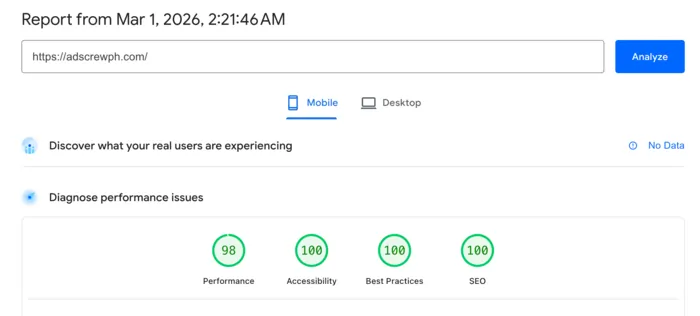
The result: a 98/100 score on Mobile and 100/100 on Desktop in PageSpeed Insights, with an LCP around 1.2 seconds and CLS effectively at 0. Those numbers matter because they show the site is not only pretty—but genuinely fast and efficient.
Performance First: Building for Core Web Vitals
Performance was a design constraint, not a final‑step patch.
Key practices:
- Light theme – Hello Theme ships with very little CSS and JS, which keeps the base page weight low.
- Minimal plugins – Only essentials for SEO, security, and analytics. Every extra plugin must justify its cost in speed.
- Optimized assets – Properly sized, compressed images and no giant, auto‑playing sliders.
- Caching + CDN – Server caching plus a global CDN like Cloudflare to improve TTFB and overall load time.
I used tools like PageSpeed Insights and Lighthouse to verify that:
- Time to First Byte (TTFB) is low.
- Largest Contentful Paint (LCP) is fast, especially on mobile.
- Layout doesn’t jump around (good CLS).
GEO & AI Readiness: Designing for How Search Works Now
Beyond classic SEO, I started building with GEO and AI readiness in mind—because search is no longer just “Google + blue links.”
1. Security and Crawlability
- SSL Certificate (HTTPS) – Non‑negotiable. Browsers and search engines expect HTTPS; it boosts trust and prevents “Not Secure” warnings. Free options like Let’s Encryptmake this easy.
- robots.txt – A clean robots.txt that allows crawling of important pages and assets while blocking only what truly needs to be hidden (like staging URLs). You can verify it quickly in Google Search Console.
- XML Sitemap – An accessible sitemap (for example,
https://domain.com/sitemap.xml) so crawlers and AI systems can easily discover your content structure. Submit it to Search Console and Bing Webmaster Tools.
2. Canonicals, Schema, and Semantic HTML
- Canonical Tag – Each important URL has a clear canonical (e.g.,
https://jingrey.com/for the homepage) to avoid duplicate content confusion. You can follow Google’s canonical guidance to stay safe. - Structured Data / Schema – I implemented rich schema types following schema.org and validated them in Google’s Rich Results Test, including:
- ImageObject, WebSite, SearchAction
- Question, Answer
- Person, Place, Organization, ProfessionalService
- WebPage, SpeakableSpecification
- PostalAddress, GeoCoordinates
- OfferCatalog, Offer, Service, Course, CourseInstance
- Semantic HTML – Using elements like
<header>,<main>,<footer>,<nav>, and<article>instead of div soup. If you’re new to this, MDN’s HTML elements guide is a great reference.
3. LLM & AI Bot Friendliness (llms.txt and More)
- LLM Bot Access – I don’t block major AI crawlers unless there’s a specific reason. That means tools and models behind AI assistants can index and learn from the content.
- llms.txt File – This works like a robots.txt for LLMs. It’s a simple text file where you:
- Explain your site’s purpose in plain language,
- Highlight key sections or content types,
- Set basic usage preferences for AI.
- No heavy JS frameworks for core content – Because pages don’t rely on React/Next/Vue for basic rendering, AI crawlers and simpler bots can see all important content without executing complex scripts.
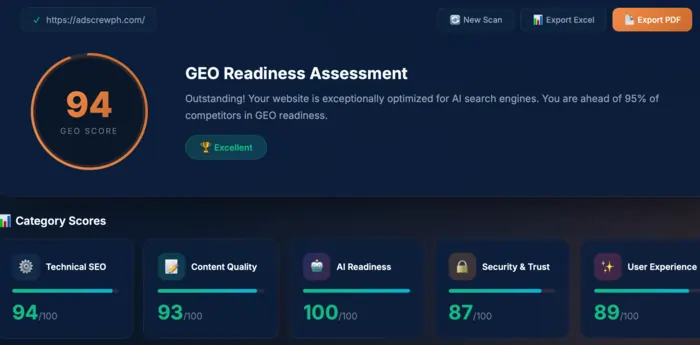
Together, these decisions make the site AI‑friendly and GEO‑aware out of the box.
SEO Readiness: Fundamentals Done Properly
On top of design and AI readiness, I made sure all classic SEO fundamentals were in place.
- Meta Title – Clear, brand‑first, and within the ideal 50–60 character range.
- Example: “Jin Grey | Senior SEO Consultant and Digital Strat…”
You can cross‑check with Google’s title link documentation.
- Example: “Jin Grey | Senior SEO Consultant and Digital Strat…”
- Meta Description – Around 140–155 characters, written to set expectations and attract clicks, not just stuff keywords.
- Heading Structure – One H1 per page, with H2s for main sections and H3s for subpoints. This makes it obvious what each page is about and helps both search engines and readers scan content.
- Internal Linking – Over 100 internal links on a content‑rich site.
- Pro tip: use descriptive anchor text (“SEO consulting for SaaS founders”) instead of “click here.” That way, both users and bots understand the topic of the destination page before they visit it. For deeper theory, guides like Moz’s internal linking resources are helpful.
- Analytics and Tracking – Google Analytics 4 is installed, and I use Google Tag Managerto manage tracking with minimal extra scripts.
- CDN – Cloudflare is active, providing faster asset delivery and an extra layer of security.
I also keep an eye on:
- E‑E‑A‑T‑A – Experience, Expertise, Authoritativeness, Trustworthiness, and Author. Google’s Search Quality Rater Guidelines are long, but they show exactly what kind of signals evaluators (and by extension, algorithms) look for. My site currently rates around 90/100 on E‑E‑A‑T‑A checks.
- Hreflang – Not implemented yet, because we aren’t targeting multiple languages or regions. When that changes, I’ll follow Google’s hreflang best practices.
Key Lessons from adscrewph.com (and Jingrey.com)
A few lessons this build reinforced for me:
- “Easy to build” ≠ “easy to build well.”
You can spin up a site quickly with a theme and AI, but getting 98/100 Mobile and 100/100 Desktop on PageSpeed with solid structure requires understanding performance and technical SEO basics. - Design with performance as a requirement.
It’s much easier to keep a site fast if you think about file size, layout stability, and script load while designing—not after everything is already bloated. - GEO and AI readiness are now part of technical SEO.
SSL, sitemaps, schema, llms.txt, open bot access, and semantic HTML all work together to make your site understandable to both traditional search engines and AI systems. - Schema is about clarity, not just rich snippets.
Marking up entities like Person, Organization, ProfessionalService, and Place helps search and AI connect your name, brand, services, and location into a coherent graph. - A clean stack beats a flashy stack.
Hello Theme, good hosting, Cloudflare, GA4, a small plugin set, and thoughtful structure will beat a heavier, overly “fancy” setup in most real‑world scenarios.
If You’re Building Your Own Site
If you’re a consultant, freelancer, or small business owner building or rebuilding your site, here’s a practical shortlist based on this project:
- Use a lightweight theme like Hello Theme and keep plugins to the essentials.
- Aim for 95+ Mobile and 100 Desktop on PageSpeed Insights if possible, with LCP under ~2 seconds.
- Make sure you have:
- HTTPS + valid SSL (e.g., via Let’s Encrypt)
- robots.txt and XML sitemap (verified in Search Console)
- Canonical tags on key pages
- Structured data validated with Rich Results Test
- Semantic HTML for core layout
- GA4 + a CDN like Cloudflare
- Add llms.txt with a simple, human‑readable explanation of who you are and what your site offers (you can follow the idea from llmstxt.org).
- Use descriptive internal links and a logical content structure so both users and bots can navigate easily.
That’s the foundation I used for adscrewph.com and my own site—a setup that’s not just visually polished, but also fast, GEO‑aware, AI‑ready, and SEO‑sound.
Congratulations to Maam Jemmar Macasusi!
