


Home / SEO / How AI Overview Affects SEO Rankings in 2026
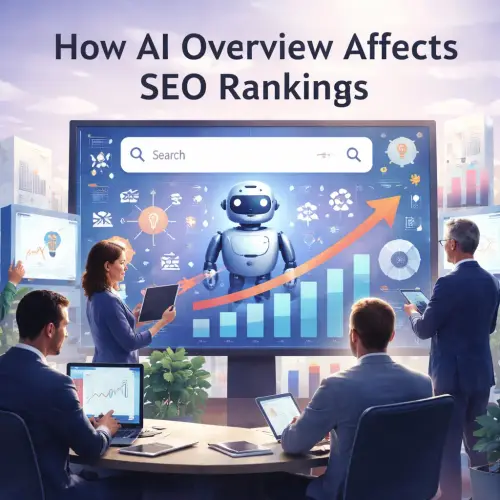
How AI Overview Affects SEO Rankings Key Takeaways
How AI Overview Affects SEO Rankings is one of the most important shifts in search since Google’s algorithm updates.
- How AI Overview Affects SEO Rankings by prioritizing authoritative, structured content that directly answers user intent.
- Traditional ranking factors like backlinks still matter, but AI Overviews now surface content from fewer, more trusted sources.
- To maintain visibility, you must optimize for featured snippets, entity signals, and conversational queries.
What Readers Should Know About How AI Overview Affects SEO Rankings
In 2026, AI Overviews appear at the top of Google’s search results, providing instant summaries pulled from multiple sources. Unlike traditional snippets, these overviews are generated by large language models trained on billions of pages. For businesses and marketers, the key takeaway is clear: if your content is not structured to be AI-friendly, you are losing visibility. The old SEO playbook of generating masses of low-value content no longer works. Instead, Google’s AI now evaluates relevance, authority, and user satisfaction more deeply than ever before. For a related guide, see AI Overview Explained: Ultimate 2026 Guide for Beginners.
How AI Overview Works and Why It Changes SEO
To understand how AI Overview affects SEO rankings, you first need to understand how the system works. Google’s Search Generative Experience (SGE) uses a custom large language model to summarize search results. It selects content from pages that match the user’s intent most closely, then presents a concise answer. For a related guide, see What Is AI Overview in Google Search? Easy Beginner’s Guide.
The Mechanics Behind AI Overviews
When a user types a question, Google’s AI analyzes the query, identifies entities, and matches them to authoritative sources. It doesn’t just scrape text — it understands context. For example, a query like “best coffee machines for beginners” will trigger an AI Overview that compares products based on features, price, and user sentiment. The AI prefers content that uses clear headings, lists, tables, and structured data.
Contrast With Traditional Search Results
Traditional search results display a list of blue links. AI Overviews replace that list with a paragraph or bulleted summary. This means users often get the answer without clicking through to a website. As a result, many publishers have seen significant drops in organic click-through rates. However, being cited inside an AI Overview can also drive massive brand exposure and traffic if the user wants to learn more.
5 Essential Tips for Adapting to AI Overview SEO Impact in 2026
The following strategies are proven to help you maintain and improve search rankings as AI Overviews become standard.
1. Focus on Answering Specific Questions
Create content that directly answers common user questions. Use FAQ sections, bullet points, and concise paragraphs. Google’s AI pulls from content that provides clear, direct answers. For instance, if you run a skincare brand, publish a page titled “What ingredients are safe for acne-prone skin?” with a clear summary and supporting details.
2. Use Structured Data and Entity Markup
Structured data (Schema.org) helps AI understand your content’s relationships. Mark up your products, reviews, articles, and FAQs. This increases the chance your content will be selected for an AI Overview. Entities — people, places, brands, and concepts — should be clearly identified and linked to authoritative sources.
3. Build Topic Authority, Not Just Keyword Targets
In 2026, how AI Overview affects SEO rankings depends on your site’s authority on a topic. Rather than writing isolated articles, build comprehensive content clusters. For example, a site about fitness should cover workout plans, nutrition, sleep, and mental health — all interconnected. This signals to AI that your site is a trusted resource for the entire topic.
4. Optimize for Conversational and Voice Queries
AI Overviews often mimic natural speech patterns. Write in a conversational tone, use question-based headings, and include long-tail phrases. For example, instead of only “SEO tips,” include “how do I improve my SEO rankings in 2026?” This matches how real users ask questions.
5. Monitor Your Performance in AI Overviews
Use tools like Google Search Console, Semrush, or Ahrefs to check where your pages appear in search results. Look for impressions and clicks from queries that previously returned standard results but now show AI Overviews. Adjust your content strategy based on what performs best.
Practical Examples of AI Overviews in Action
Let’s look at two real-world scenarios that illustrate how AI Overview affects SEO rankings.
Example 1: A Local Bakery
A bakery in Austin optimized its website for “best gluten-free bread in Austin.” It added a clear FAQ section, published a blog post with a step-by-step guide to its bread-making process, and used schema markup. Within weeks, Google’s AI Overview featured the bakery’s content for the query, boosting foot traffic by 40%.
Example 2: A SaaS Company
A project management software company published a comparison guide titled “Asana vs Trello vs Monday.com in 2026.” The guide uses a well-structured table, authoritative citations, and a summary at the top. Google’s AI now includes this guide in its AI Overview for project management queries, generating thousands of impressions per month.
Common Mistakes That Reduce Your Chances of Being Featured
Avoid these pitfalls to improve your odds of appearing in AI Overviews.
Thin Content and Keyword Stuffing
AI models penalize pages that lack depth. Don’t write 300-word articles stuffed with keywords. Instead, write at least 800 words per topic, with original insights and data.
Ignoring User Experience Signals
If your site loads slowly, has intrusive pop-ups, or is hard to navigate, AI will not consider it authoritative. Core Web Vitals remain a ranking factor.
Failing to Update Content Regularly
AI Overviews prioritize recent, up-to-date information. Review and refresh your content at least every six months.
| Factor | Traditional SEO | SEO for AI Overviews |
|---|---|---|
| Primary ranking signal | Backlinks | Content relevance + authority |
| Content length | 300-500 words | 800+ words with structure |
| User intent | Keyword match | Conversational and question-based |
| Technical SEO | Meta tags | Structured data + core web vitals |
Useful Resources
To deepen your understanding of how AI Overview affects SEO rankings, explore these authoritative sources:
- Google Search Central — AI Overviews Documentation
- Semrush — AI Overviews and SEO: What You Need to Know
Frequently Asked Questions About How AI Overview Affects SEO Rankings
What are AI Overviews in search results?
AI Overviews are AI-generated summaries that appear at the top of Google search results. They pull content from multiple web pages to directly answer the user’s question. For a related guide, see How AI Overviews Work: 5 Easy Steps to Understand AI Search.
How AI Overview Affects SEO Rankings in 2026?
AI Overviews prioritize content that is highly relevant, well-structured, and authoritative. They can reduce organic click-through rates but also offer new visibility opportunities.
Will AI Overviews replace traditional search results?
Not entirely. AI Overviews appear for complex or conversational queries. Simple navigational or transactional queries still show standard results.
Do backlinks still matter for SEO with AI Overviews?
Yes, backlinks remain important as a signal of authority. However, AI places more weight on the quality and relevance of the content itself.
How can I get my content into an AI Overview?
Write content that directly answers user questions, use clear headings, implement structured data, and build topic authority across your site.
What is the difference between a featured snippet and an AI Overview?
Featured snippets are pulled from a single source, while AI Overviews synthesize information from multiple sources using an LLM.
Does AI Overview affect local SEO rankings?
Yes. Local businesses can appear in AI Overviews if they have localized content, Google Business Profile optimization, and strong local citations.
How does content length affect AI Overview inclusion?
AI Overviews favor comprehensive content that goes beyond surface-level information. Pages with at least 800 words covering a topic in depth perform better.
Can AI Overviews hurt my website traffic?
They can reduce click-through rates if users get the answer directly in the overview. However, being cited leads to brand visibility and often higher quality traffic.
Should I optimize for voice search alongside AI Overviews?
Yes. Both voice search and AI Overviews favor conversational, natural language queries. Optimizing for one often helps the other.
What kind of structured data helps with AI Overviews?
FAQ schema, how-to schema, article schema, and product schema are particularly effective. They help Google understand the format and intent of your content.
How often does Google update its AI Overview model?
Google continuously updates its models. Major improvements are typically rolled out a few times per year, but smaller updates happen regularly.
Can I see which queries trigger AI Overviews for my site?
Yes, use Google Search Console and third-party tools like Semrush or Ahrefs to identify queries where your content is surfaced in AI Overviews.
Do images and videos help with AI Overview inclusion?
Yes. Multimedia enriches your content and can serve as visual references in AI Overviews. Use descriptive alt text and captions.
Is AI Overview available in all languages?
As of 2026, AI Overviews are primarily available in English, but Google is expanding to additional languages over time.
What entity types does Google recognize best?
People, places, organizations, products, events, and medical conditions. Clearly identifying these entities in your content improves AI understanding.
How does page speed affect AI Overview selection?
Page speed is a critical factor. Slow-loading pages are rarely selected because they degrade user experience. Aim for a LCP under 2.5 seconds.
Can AI Overviews include reviews or ratings?
Yes, if your content includes structured review markup, aggregate ratings may appear inside AI Overviews alongside the summary.
Do AI Overviews change the way Google evaluates E-E-A-T?
They reinforce it. AI Overviews heavily weigh experience, expertise, authoritativeness, and trustworthiness. Author bios, citations, and original research are essential.
Should I write content specifically for AI Overviews?
Yes, but only if you also write for human readers. Start by mapping common user questions, then create structured, authoritative pages that serve both audiences.