


Home / Marketing / Is ChatGPT Killing Google Search? The Truth Revealed
Is ChatGPT Killing Google Search Key Takeaways
To truly understand the Is ChatGPT Killing Google Search dynamic, we need to compare them side by side across the dimensions that matter most to users and businesses.
- Is ChatGPT killing Google Search traffic? For some query types — especially quick answers, definitions, and creative tasks — yes, ChatGPT is siphoning visits away from traditional SERPs.
- Google is fighting back with its own AI-powered search features, including the Search Generative Experience and Gemini integrations, which keep users within its ecosystem.
- The smartest SEOs and content creators are already adapting: optimizing for AI-generated answers, structured data, and conversational queries instead of relying solely on old-school keyword rankings.
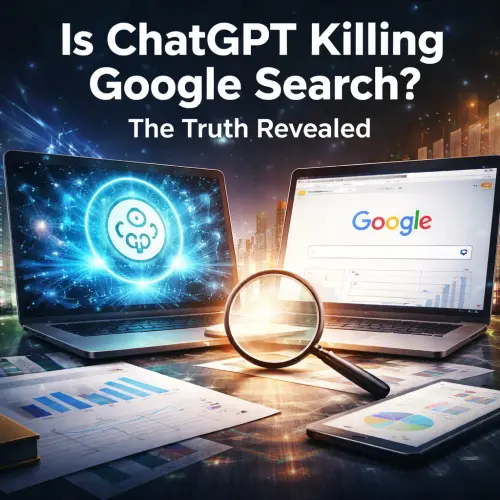
To truly understand the Is ChatGPT Killing Google Search dynamic, we need to compare them side by side across the dimensions that matter most to users and businesses. For a related guide, see 10 ChatGPT Side Hustles You Can Start Today.
Accuracy and reliability
Google has a massive advantage in accuracy for verifiable, time-sensitive information. Its index is updated continuously, and its ranking algorithms have been refined over two decades. ChatGPT, on the other hand, can hallucinate — confidently producing incorrect facts. For YMYL (Your Money or Your Life) topics like health, finance, and legal advice, Google remains the safer choice. However, for creative tasks, brainstorming, and summarization, ChatGPT’s ability to synthesize from multiple sources often beats a simple blue link.
Real-time information and freshness
Here’s a major limitation of ChatGPT: without browsing mode enabled, its knowledge cuts off at a certain training date. Google indexes the live web every second. If you want to know the latest news, stock prices, or sports scores, Google wins. But with ChatGPT’s browsing feature (available to Plus and Pro users), the gap narrows. It can now fetch real-time data — though it’s slower and less comprehensive than a live search engine.
User experience and convenience
For users who want a single, coherent answer without sifting through links, ChatGPT is often more convenient. Google’s SERP is increasingly cluttered with ads, AI overviews, video carousels, and knowledge panels. ChatGPT offers a clean chat interface. This convenience is why some users are replacing certain Google queries with ChatGPT.
What are the limitations of ChatGPT vs Google?
- Depth: Google provides many sources; ChatGPT gives one synthesized answer (though it can list sources in browsing mode).
- Freshness: Google is real-time by default; ChatGPT requires explicit browsing.
- Local search: Google is far superior for “near me” queries and local business discovery.
- Personalization: Google personalizes results based on search history and location; ChatGPT is stateless by default (unless using custom instructions).
SEO and Business Impact: How AI Search Impact on SEO Is Real
If you’re a website owner, affiliate marketer, or content creator, this is the section that matters most. The rise of ChatGPT isn’t just a theoretical debate — it’s affecting your traffic, rankings, and revenue.
How does AI search impact website traffic?
Zero-click searches have been rising for years. Featured snippets already stole millions of clicks. ChatGPT accelerates that trend. When a user gets a complete answer inside the chat interface, they have zero reason to click through to a website. For informational queries (definitions, how-tos, explanations), this can reduce organic traffic by 20-40% depending on the niche.
Can websites still rank if users rely on AI answers?
Yes — but the nature of ranking changes. Instead of ranking for keywords alone, you need to rank in AI citations. ChatGPT, Gemini, and other models pull information from high-authority, well-structured websites. If your site has strong E-E-A-T signals, clear structured data, and content that aligns with the patterns these models are trained on, your content is more likely to be cited in AI answers. For a related guide, see How to Use ChatGPT for iGaming SEO Content.
How does AI-generated content impact search rankings?
Google has explicitly stated that AI-generated content is not against its guidelines as long as it is helpful, original, and demonstrates expertise. However, low-quality, mass-produced AI content is being deindexed or penalized. The bar for quality is higher than ever. If you use AI tools to produce content, you must edit, fact-check, and add original insights. Otherwise, your rankings will suffer.
Will SEO still matter if AI replaces search?
SEO is not dying; it’s evolving. The core principles remain: understand your audience, create valuable content, and earn trust. But the tactics are shifting. Link building still matters, but citations from authoritative sources matter even more for AI visibility. Technical SEO — site speed, structured data, mobile usability — remains critical because AI models crawl and index the same web Google does.
Google’s Response: Its AI Search Strategy and Future of Search Engines with AI
Google is not sitting still. Understanding its response is key to predicting how the search landscape will look in the next 12 to 24 months.
What is Google’s AI search strategy in 2025?
Google’s strategy is centered around its Search Generative Experience (SGE) and the integration of its Gemini model. SGE provides AI-generated overviews at the top of search results — essentially, Google’s own version of a ChatGPT-like answer. This keeps users on Google’s property, reducing the incentive to open a separate chat app. Google is also heavily investing in pushing eCommerce and transactional queries to its own shopping graph, giving merchants less leverage outside the platform.
How is Google responding to AI like ChatGPT?
Google is fighting on multiple fronts: improving its own AI model (Gemini), rolling out AI overviews globally, and updating search quality guidelines to demote low-quality AI content. It is also adding conversational features to search, allowing follow-ups within the SERP. Google’s advantage is distribution — billions of users already have it as their default search. It can gradually introduce AI features without requiring users to adopt a new interface. For a related guide, see AI Content for Affiliate Marketing: What Works Now.
Will AI search tools replace SERPs?
Not entirely, but SERPs are transforming. The traditional 10 blue links are being replaced by dynamic, multi-format results: AI overviews, video carousels, image packs, local packs, and knowledge panels. The click-through rate to organic links continues to drop, but for transactional and commercial intent queries, links still dominate because users want to compare prices, read reviews, and make purchases.
Coexistence and Adaptation: ChatGPT Replacing Search Engines or Complementing Them?
Over my 18-year career, I’ve seen countless “Google killers” come and go. Bing, DuckDuckGo, Wolfram Alpha — none replaced Google. But ChatGPT is different because it doesn’t try to be a search engine. It tries to be an answer engine. That distinction will define whether it coexists with Google or eventually weakens its dominance.
Can ChatGPT and Google coexist?
Yes — and they already do. The smartest users don’t pick one over the other. They use ChatGPT for research, brainstorming, and creative tasks. They use Google for shopping, local discovery, and verifying facts. As a marketer, your strategy should treat AI tools as a new channel, not a replacement. That means creating content that performs well in both ecosystems.
How do businesses stay visible in an AI-first search world?
I advise my clients to follow a three-part strategy:
- Optimize for AI citations: Build your brand’s authority on the web so that AI models cite you as a source. Publish original research, earn backlinks from trusted domains, and maintain a consistent presence on Wikipedia, Crunchbase, and industry publications.
- Diversify traffic sources: Don’t rely solely on Google organic. Invest in email lists, social media, YouTube, and direct traffic. If Google or ChatGPT reduces clicks to your site, you need other channels to survive.
- Create conversational content: Write in a Q and A format, include FAQ sections with schema, and answer questions directly. AI models love clear, structured answers.
What are the pros and cons of ChatGPT vs Google Search?
| Aspect | ChatGPT | Google Search |
|---|---|---|
| Answer format | Synthesized, conversational | List of links with snippets |
| Real-time data | Limited (requires browsing) | Excellent, continuous crawl |
| Local search | Weak | Very strong |
| Ad-free experience | Yes (paid tiers) | Ads present |
| Accuracy for current events | Moderate | High |
| Best for | Exploration, summarization, creativity | Fact-checking, shopping, local |
The Truth Behind Is ChatGPT Killing Google Search Debate
After analyzing data, testing both tools daily for over a year, and watching the market evolve, here’s my verdict: ChatGPT is not killing Google Search. But it is fundamentally changing the relationship between users, information, and websites. Google is losing some traffic, especially for informational queries. But Google is also adapting fast, and its dominance in commercial and local search remains intact.
The real risk isn’t that AI replaces search — it’s that marketers who ignore this shift will lose visibility in both worlds. The winners will be those who optimize for AI answers while maintaining strong Google SEO fundamentals. Is ChatGPT killing Google Search? Not yet. But if you’re a content creator, the time to evolve is now.
Useful Resources
To dive deeper into how ChatGPT is impacting search behavior, check out SimilarWeb’s analysis of ChatGPT traffic trends. For a comprehensive look at Google’s AI strategy, read the official Google AI Search announcement.
Frequently Asked Questions About Is ChatGPT Killing Google Search
Is ChatGPT killing Google Search ?
Not yet, but it is taking traffic from informational queries. Google is still dominant for local, transactional, and real-time searches.
Will AI replace traditional search engines?
AI will complement rather than fully replace search engines. Google is already integrating AI into its core experience.
How is ChatGPT changing the way people search online?
Users are shifting toward natural language, conversational queries, and expecting direct answers without clicking through to websites.
Is Google losing traffic because of AI tools like ChatGPT?
Yes, for certain query types — especially definitions, how-tos, and summaries — Google is seeing reduced click-through rates.
Can ChatGPT replace Google for information discovery?
For discovering concepts, ideas, and synthesized knowledge, yes. For finding specific sources, local businesses, or real-time data, no.
What are the differences between ChatGPT and Google Search?
ChatGPT gives one synthesized answer; Google shows multiple links. Google has real-time data; ChatGPT requires browsing mode.
Which is better for SEO: ChatGPT or Google?
Google is still the primary driver of organic traffic, but optimizing for AI citations is becoming increasingly important for visibility.
How does AI search impact website traffic?
AI search reduces click-through rates for informational queries because users get answers directly in the chat or overview.
Are users shifting from Google to AI chatbots?
A significant minority of users — especially tech-savvy and younger demographics — are using chatbots for some research tasks.
How accurate is ChatGPT compared to Google Search?
Google is more accurate for verifiable, time-sensitive facts. ChatGPT can hallucinate but is improving rapidly.
Can ChatGPT provide real-time search results?
Only with browsing mode enabled, and it is slower and less comprehensive than a live search engine.
What are the limitations of ChatGPT vs Google?
Limitations include lack of real-time data by default, weaker local search, and no personalized results without custom instructions.
How is Google responding to AI like ChatGPT?
Google is launching its Search Generative Experience, integrating Gemini into search, and demoting low-quality AI content.
What is Google’s AI search strategy in 2025?
Google aims to embed AI overviews directly into the SERP, keeping users within its own ecosystem and reducing reliance on third-party chatbots.
Will SEO still matter if AI replaces search?
Yes, but it will shift from ranking keywords to being cited as an authoritative source by AI models.
How does ChatGPT affect keyword research?
Keyword research now includes analyzing the natural language queries people use in chatbots, not just Google’s autocomplete.
Can websites still rank if users rely on AI answers?
Yes, if they optimize for structured data, authority, and direct answers that AI models can cite.
How does AI-generated content impact search rankings?
High-quality, original AI content can rank well; low-quality, mass-produced content is being penalized.
Is AI disrupting the search engine industry?
Yes, it is forcing traditional search engines to evolve and creating a new competitive landscape.
What are the risks of relying on ChatGPT instead of Google?
Risks include potential inaccuracies, lack of source diversity, and missing out on local and transactional search capabilities.
You May Also Like
- Is ChatGPT Killing Google Search? The Truth Revealed
- ChatGPT for Casino Reviews: Faster Content Strategy
- How to Use ChatGPT for iGaming SEO Content
- How to Automate Daily Tasks Using ChatGPT
- Top 20 ChatGPT Use Cases for Business Owners
- How Professionals Use ChatGPT to Save 10+ Hours a Week
- Best ChatGPT Prompts for Blogging (Updated List)
- How to Write Blog Posts Faster Using ChatGPT
- 10 ChatGPT Side Hustles You Can Start Today
- Using ChatGPT for Affiliate Marketing (Beginner to Pro Guide)
- How to Make Money Using ChatGPT in 2026
- ChatGPT Prompts for SEO: 50+ Proven Examples
- Using OpenAI to Scale Content Creation (Without Getting Penalized)
- ChatGPT for Keyword Research: A Complete Guide
- ChatGPT for Beginners: Everything You Need to Know
- OpenAI Explained: Tools, Models, and Real-World Uses
- How to Use ChatGPT for the First Time (Step-by-Step Guide)
- What is ChatGPT? A Simple Guide for Beginners (2026 Edition)