



Home / Will AI Replace Writers? What You Need to Know
Will AI Replace Writers Key Takeaways
That said, AI can handle high-volume, low-stakes content like social media captions, internal memos, or FAQ sections.
- The real risk isn’t AI replacing writers —it’s writers who don’t adapt being replaced by those who do.
- AI excels at repetitive, data-driven tasks but struggles with nuance, emotion, and original storytelling.
- The winning strategy is learning how to combine AI and human writing to produce higher quality content faster.
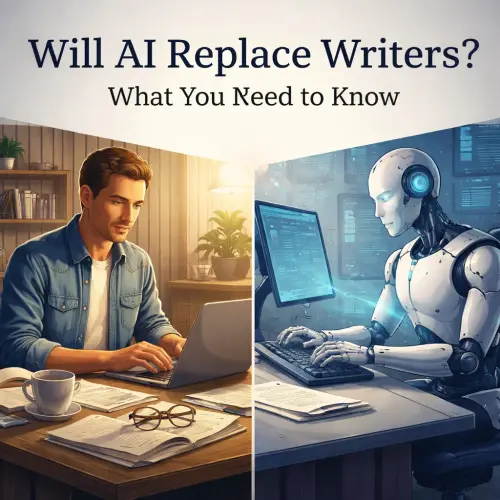
Let me shift your mindset. Instead of fearing future of content writing with AI, embrace it as the biggest productivity boost of your career. I’ve seen AI cut my research time in half. I use it to summarize long reports, suggest analogies, and even check for readability. That leaves me more time to focus on strategy, creativity, and connecting with my audience. For a related guide, see Scalenut Review 2026: AI SEO Platform for Planning, Writing and GEO Visibility.
How to Combine AI and Human Writing Effectively
Here’s the workflow I recommend:
- Strategy and planning: Use your human expertise to define the topic, audience, and goals.
- Research and drafting: Use AI to gather data, generate outlines, and write rough drafts.
- Editing and refinement: Rewrite sections to inject personality, check facts, and ensure the piece aligns with your brand voice.
- Final polish: Read aloud, ask for feedback, and make sure it sounds human.
This approach lets you produce more content without sacrificing quality. It’s how to combine AI and human writing to get the best of both worlds. For a related guide, see Using OpenAI to Scale Content Creation (Without Getting Penalized).
Skills Writers Need to Stay Relevant in the AI Era
If you want to stay employed, here are the non-negotiable skills:
- Strategic thinking: Understand why you’re writing and what outcome you want.
- Emotional intelligence: Know how to read the room and write with empathy.
- Editing and fact-checking: AI drafts are starting points, not final products.
- Specialization: Become an expert in a niche—healthcare, finance, B2B SaaS—so your knowledge can’t be replaced.
- Adaptability: Learn new tools and platforms as they emerge.
Pros and Cons of AI Writing: A Balanced View
| Aspect | Pros | Cons |
|---|---|---|
| Speed | Generates content in seconds | Often requires heavy editing |
| Cost | Reduces production costs for basic content | Hidden costs in editing and fact-checking |
| Creativity | Provides fresh angles and ideas | Lacks genuine original thought |
| SEO | Handles keyword optimization efficiently | Can produce keyword-stuffed content that feels unnatural |
| Scalability | Enables high-volume content production | Risk of losing brand voice and authenticity |
The bottom line: AI writing tools are a supplement, not a substitute.
Should Businesses Rely Fully on AI for Content?
No. I’ve seen businesses try to go 100% AI with content. It usually works for a few months, then they notice a drop in engagement, comments, and shares. Readers aren’t stupid—they can tell when a brand is phoning it in. If you want to build a loyal audience, you need human writers who add value, personality, and trust. For a related guide, see 100 AI Tools That Will Save You 10 Hours Per Week (Ultimate 2026 Productivity Guide).
That said, AI can handle high-volume, low-stakes content like social media captions, internal memos, or FAQ sections. The key is knowing when to use AI and when to call in a human.
How Do Clients View AI-Generated Content?
In my experience, clients are wary. The number one concern is lack of originality. They worry their content will sound like everyone else’s. That’s why I always disclose when I use AI as a tool and explain my editing process. Transparency builds trust. If you’re a freelance writer, be upfront about how you use AI—clients appreciate honesty.
How to Humanize AI-Written Content
If you’re using AI to draft content, here’s how to make it sound human:
- Add personal stories and examples. AI doesn’t have experiences. You do.
- Vary sentence structure. AI often writes in a predictable rhythm. Break it up.
- Inject humor, opinion, and voice. Write like you talk—within reason.
- Read it aloud. If it sounds stiff, rewrite until it flows naturally.
- Get feedback. A second human pair of eyes catches what machines miss.
Is AI a Threat or an Opportunity for Writers?
It’s both. But I choose to see it as an opportunity. AI handles the boring parts of writing—the research, the formatting, the first draft. That frees me to focus on the parts I love: crafting compelling narratives, building relationships with readers, and solving complex communication problems. If you resist AI, you’ll be left behind. If you embrace it as a tool, you’ll become more valuable than ever.
The writers who will struggle are those who produce generic, low-value content. The writers who will succeed are those who specialize, think strategically, and use AI to amplify their strengths.
Useful Resources
For deeper insights into how AI is reshaping writing, check out OpenAI’s overview of ChatGPT and its capabilities and Google’s guidelines on creating helpful, people-first content. Both will give you a clearer picture of where the industry is heading.
Frequently Asked Questions About Will AI Replace Writers
Will AI replace human writers?
No, not entirely. AI will replace some writing tasks but human writers are still needed for strategy, creativity, and emotional depth.
Can ChatGPT replace content writers in 2025?
Not completely. ChatGPT is a useful assistant but its output requires editing and human insight to be truly effective.
What types of writing can AI automate?
AI excels at repetitive tasks like product descriptions, meta descriptions, basic news summaries, and template-based emails.
What are the limitations of AI writing tools?
AI lacks genuine emotion, can produce inaccurate facts, struggles with tone, and often sounds generic without human editing.
Is AI better than human writers for SEO content?
No. Human writers bring experience and authority that align with Google’s E-E-A-T guidelines, which AI cannot replicate.
Can AI write high-quality long-form content?
AI can draft long-form content, but quality depends heavily on human editing to ensure depth, accuracy, and engaging storytelling.
How accurate is AI-generated writing?
Accuracy varies. AI can hallucinate facts, so all AI-generated content should be fact-checked by a human.
Will freelance writers lose jobs because of AI?
Some will, especially those who produce low-value, generic content. But freelance writers who specialize and adapt will thrive.
What writing jobs are most at risk from AI?
Jobs involving highly repetitive, template-based writing—like basic product descriptions and simple news recaps—are most at risk.
What skills do writers need to stay relevant in the AI era?
Strategic thinking, emotional intelligence, editing skills, specialization in a niche, and adaptability to new tools are essential.
How can writers use AI as a tool instead of a replacement?
Use AI for brainstorming, outlining, and drafting. Then apply your human expertise to refine, personalize, and fact-check the output.
Can AI understand tone, emotion, and creativity like humans?
No. AI can mimic patterns but lacks the lived experience and emotional intelligence needed for genuine creativity.
Is AI content detectable by Google?
Google can detect low-quality AI content and may penalize sites that rely on it without adding human value.
Can AI-generated content rank on search engines?
Yes, in the short term, but long-term success requires content that demonstrates authority and trustworthiness.
How do you humanize AI-written content?
Add personal stories, vary sentence structure, inject opinion and humor, read aloud, and get human feedback.
What is the future of content writing with AI ?
The future is hybrid: AI handles routine tasks while human writers focus on strategy, creativity, and connection.
Will AI reduce the demand for copywriters?
It may reduce demand for basic copywriting, but skilled copywriters who create persuasive, brand-specific content will remain in demand.
How can writers adapt to AI tools like ChatGPT?
Learn to write effective prompts, experiment with different tools, and develop strong editing skills to refine AI output.
What are the pros and cons of AI writing?
Pros include speed, cost savings, and scalability. Cons include lack of originality, factual errors, and risk of sounding generic.
Can AI help writers become more productive?
Absolutely. AI can handle research, drafting, and formatting, freeing writers to focus on higher-level creative and strategic work.
You May Also Like
- Is ChatGPT Killing Google Search? The Truth Revealed
- ChatGPT for Casino Reviews: Faster Content Strategy
- How to Use ChatGPT for iGaming SEO Content
- How to Automate Daily Tasks Using ChatGPT
- Top 20 ChatGPT Use Cases for Business Owners
- How Professionals Use ChatGPT to Save 10+ Hours a Week
- Best ChatGPT Prompts for Blogging (Updated List)
- How to Write Blog Posts Faster Using ChatGPT
- 10 ChatGPT Side Hustles You Can Start Today
- Using ChatGPT for Affiliate Marketing (Beginner to Pro Guide)
- How to Make Money Using ChatGPT in 2026
- ChatGPT Prompts for SEO: 50+ Proven Examples
- Using OpenAI to Scale Content Creation (Without Getting Penalized)
- ChatGPT for Keyword Research: A Complete Guide
- ChatGPT for Beginners: Everything You Need to Know
- OpenAI Explained: Tools, Models, and Real-World Uses
- How to Use ChatGPT for the First Time (Step-by-Step Guide)
- What is ChatGPT? A Simple Guide for Beginners (2026 Edition)
- Advanced ChatGPT Prompt Engineering Guide 2026: 7 Smart Hacks