

Does GEO Audit Really Work? My Experience Optimizing Digilamon.com
When I first started Digilamon.com, my food and travel blog, I thought I had done everything right. The site was blazing fast, perfectly optimized according to PageSpeed Insights, and technically spotless. Still, my rankings and traffic barely moved.

When PageSpeed Is All Green (But Traffic Is Flat)
On paper, Digilamon.com was a dream: all my PageSpeed indicators were green, Core Web Vitals looked solid, and every report told me my site was “almost perfect.” I took that as a signal that my SEO foundation was strong and assumed the rest would follow.
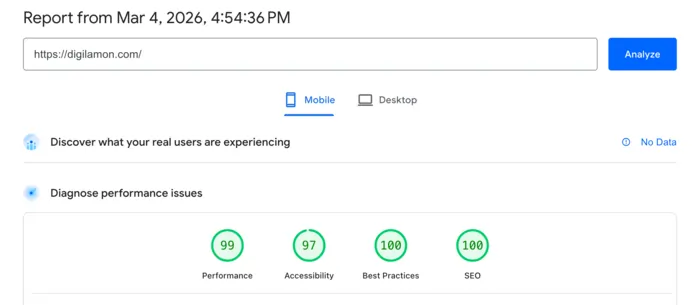
But weeks passed and nothing really changed. Traffic stayed flat, impressions were underwhelming, and the content I poured my time into wasn’t gaining visibility.
That’s when I realized a hard truth: a green PageSpeed score doesn’t automatically translate into search performance. It just means you’ve cleared the technical baseline.
The Mystery of the Rising DR
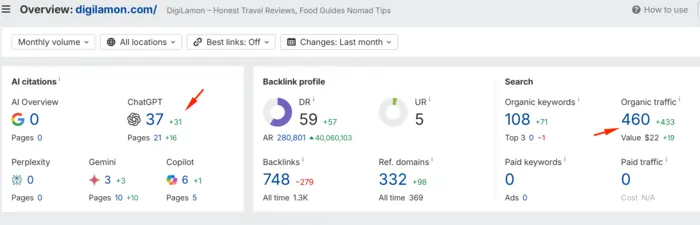
Then one morning, I woke up to a Domain Rating (DR) of 59 — a sudden spike that made me curious. After digging deeper, I realized it came from unfamiliar backlinks scattered across random websites. On paper, it looked like progress. In reality, those links did nothing for my visibility or traffic.
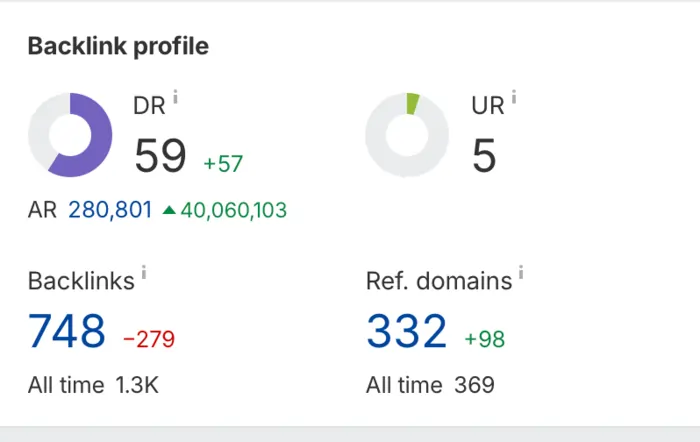
That was my first real SEO wake-up call: having speed, structure, and backlinks doesn’t matter if Google doesn’t truly understand what your site is about.
Discovering the GEO Audit Tool
A few weeks later, during a webinar hosted by Brian Ho, I discovered a tool called GEO Audit by BHM.
Out of curiosity, I ran my site through it — and immediately panicked. My content and AI readiness scores failed miserably.
GEO exposed what every other SEO tool had missed: my content wasn’t semantically or contextually optimized for how search algorithms interpret meaning. It wasn’t that my site was bad — it was just invisible to AI systems that now interpret most search data.
The Optimization Phase (and a Hard Lesson Learned)
Sadly, I didn’t capture the “before” score, but today my GEO Readiness sits proudly at 96%— and the difference is undeniable.
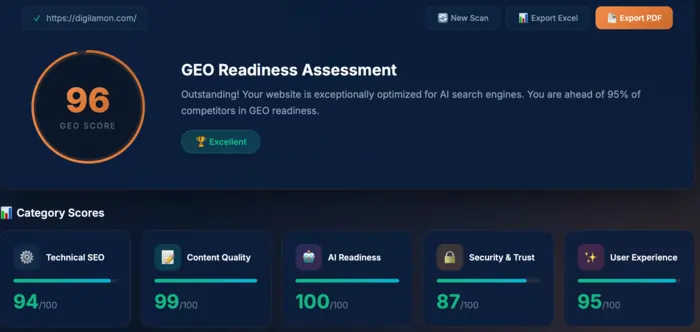
One of my biggest struggles was trying to rank for the keyword “Iloilo delicacies.” No matter how many times I tweaked the on-page copy, my website simply wasn’t showing up meaningfully in search.
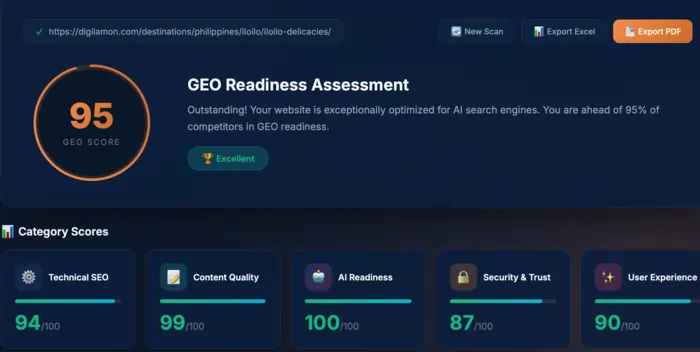
Using the GEO tool, I realized that while my content was “good enough” to read, it was still surface-level from an algorithm’s perspective.
There were missing entities, weak structure, and not enough machine-readable context. Yes, the article was written by me with the help of ChatGPT — but GEO forced me to go beyond just text and think in terms of entities and structure.
Because of the GEO audit, I was pushed to dig deeper into both content and code. I expanded and structured the page with:
- Article / BlogPosting
- WebSite, Organization, and Person (to support Knowledge Graph-style entities)
- BreadcrumbList for clearer site hierarchy
- FAQPage with 20 FAQs to cover long-tail intent
- SpeakableSpecification to make it more voice search and AI Overview friendly
- Place + GeoCoordinates for stronger geo-relevance
- ItemList for my “must-try” Iloilo delicacies, complete with names and ratings
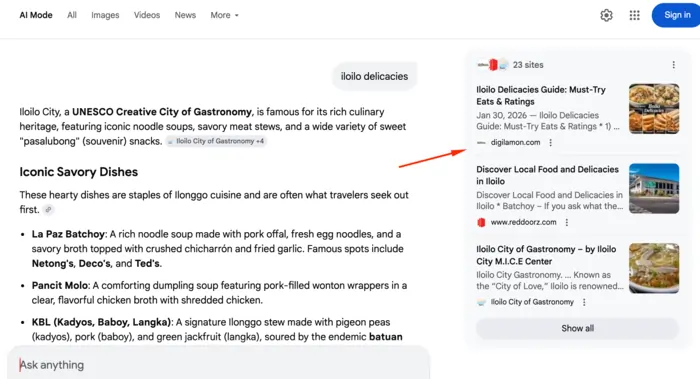
That shift — from “just a blog post” to a semantically rich, structured resource — was what finally helped the page start gaining impressions and traction for “Iloilo delicacies” and related searches.
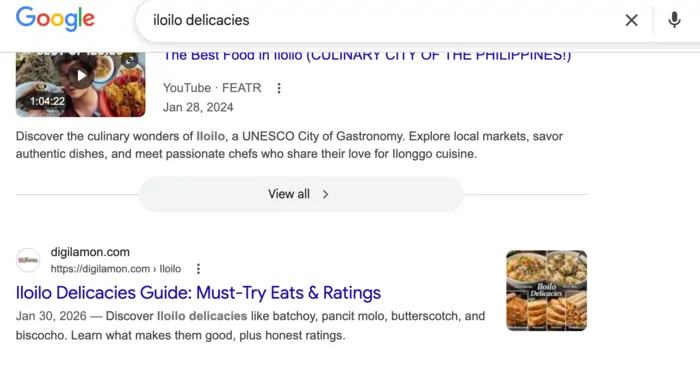
And now it is showing and ranking on Google and ai overview.
What I Learned
This journey taught me an important truth: technical SEO alone isn’t enough anymore. Your site must speak the language of algorithms — not just in keywords, but in meaning, structure, and entities. GEO Audit bridges that gap, helping you see how search engines and large language models interpret your content.
In an era of AI Overviews, if the LLMs can’t parse your entities, your site simply doesn’t exist to the algorithm. I used the GEO Audit to identify these silent “topical gaps” and filled them with content that finally connected the dots for Google.
FAQ
What is GEO Audit?
GEO Audit is a Generative Engine Optimization analysis that evaluates how well your website content can be interpreted by AI-driven search systems. Unlike traditional SEO tools that focus mainly on keywords and backlinks, GEO examines entities, structure, semantic relationships, and machine-readable context to determine whether search engines and large language models can clearly understand your content.
Does GEO Audit really work?
Yes, when implemented properly. GEO Audit highlights structural and semantic gaps that traditional SEO tools often miss. By improving entities, schema markup, and topical structure, websites can become easier for search engines and AI systems to interpret, which may improve impressions, visibility, and discoverability.
What does an AI readiness score mean?
An AI readiness score measures how well your content is optimized for modern search systems that rely on semantic understanding. This includes entity coverage, structured data usage, topical depth, internal linking, and overall machine readability.
Why didn’t my green PageSpeed score increase traffic?
PageSpeed and Core Web Vitals are important technical metrics, but they only represent the baseline for site performance. If search engines cannot clearly understand your content’s meaning or topical relevance, strong technical performance alone will not generate traffic.
Why did my Domain Rating increase but rankings stayed the same?
A rise in Domain Rating usually indicates new backlinks. However, if those links are irrelevant, low-quality, or disconnected from your topical authority, they may not contribute to improved rankings or organic visibility.
Can backlinks increase metrics but still be ineffective?
Yes. Some backlinks can inflate third-party SEO metrics without improving real search performance. Effective backlinks should be contextually relevant and contribute to topical authority rather than simply increasing link counts.
What was the biggest issue revealed by the GEO Audit of Digilamon.com?
The main problem was weak semantic optimization. The content lacked strong entities, deeper contextual signals, and structured information that search algorithms use to understand topical relevance.
What is semantic SEO in simple terms?
Semantic SEO focuses on optimizing content for meaning instead of relying only on keywords. It involves using related topics, entities, structured headings, and contextual information that helps search engines fully understand a page’s subject.
What are entities in SEO?
Entities are identifiable concepts such as people, places, organizations, foods, brands, or technologies that search engines recognize in their knowledge graphs. Clearly defined entities help algorithms understand the relationships between topics.
Why are entities important for AI search results?
AI search systems rely heavily on entity relationships to generate summaries and contextual answers. When a page clearly defines its entities, it becomes easier for AI systems to extract and cite relevant information.
Do I need schema markup for GEO optimization?
Schema markup is not mandatory, but it significantly improves machine readability. Structured data allows search engines and AI models to interpret the content type, author, entities, and relationships within a page more efficiently.
What schema types are most useful for a GEO-focused article?
Useful schema types include BlogPosting, WebPage, Organization, Person, BreadcrumbList, FAQPage, SpeakableSpecification, Place with GeoCoordinates, and ItemList for structured lists.
What is Speakable schema and how does it help?
Speakable schema identifies portions of content that are suitable for voice assistants and AI-generated summaries. This can improve the chances of a page being used for voice search or spoken responses.
Can I add FAQ schema without displaying the questions on the page?
No. Structured data should always reflect visible content on the page. Adding hidden FAQ schema may violate search guidelines and prevent eligibility for rich results.
How can I optimize content for location-based keywords like “Iloilo delicacies”?
To improve geo-relevance, include location entities, add Place and GeoCoordinates schema, provide detailed coverage of local foods, and structure the content with lists or sections that clearly highlight local specialties.
Why didn’t rewriting my article help improve rankings before the GEO audit?
Simply rewriting text does not always address semantic gaps. If the page lacks entity depth, structural clarity, or contextual signals, search engines may still struggle to understand its true topic.
How many FAQs should a page include for long-tail coverage?
The number depends on the topic depth. For comprehensive guides or case studies, 10–20 FAQs can effectively capture long-tail queries and user intent variations.
How long does it take to see results after GEO improvements?
Results depend on crawl frequency, competition, and content quality. Many sites notice improvements in impressions first, followed by gradual increases in traffic and rankings.
Is it acceptable to use AI tools like ChatGPT for writing content?
Yes, as long as the content is reviewed, fact-checked, and enhanced with human expertise. AI can assist with drafting, but human insight ensures accuracy and authority.
What is the biggest lesson from your GEO Audit experience?
Technical SEO alone is no longer enough. For modern search visibility, websites must combine strong content, clearly defined entities, structured data, and semantic optimization so that both search engines and AI systems can fully understand the topic.
Final Thoughts
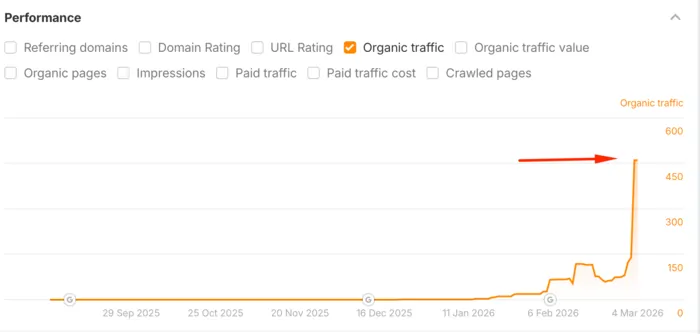
Today, Digilamon.com is finally seeing the growth I spent months chasing. My pages are more discoverable, my traffic is climbing steadily, and most importantly — my content now resonates both with readers and algorithms.
Stop guessing why your technical SEO isn’t converting.
Run the audit and see what the algorithms actually see → https://bhm-geo-audit.pages.dev
So, Does GEO Audit Really Work? Based on my experience, yes — 100%. The tool is incredibly helpful and makes the SEO optimization process much easier to understand and execute.
Want SEO + GEO AI Readiness? Book a strategy call now and start optimizing your site for the future of search.