
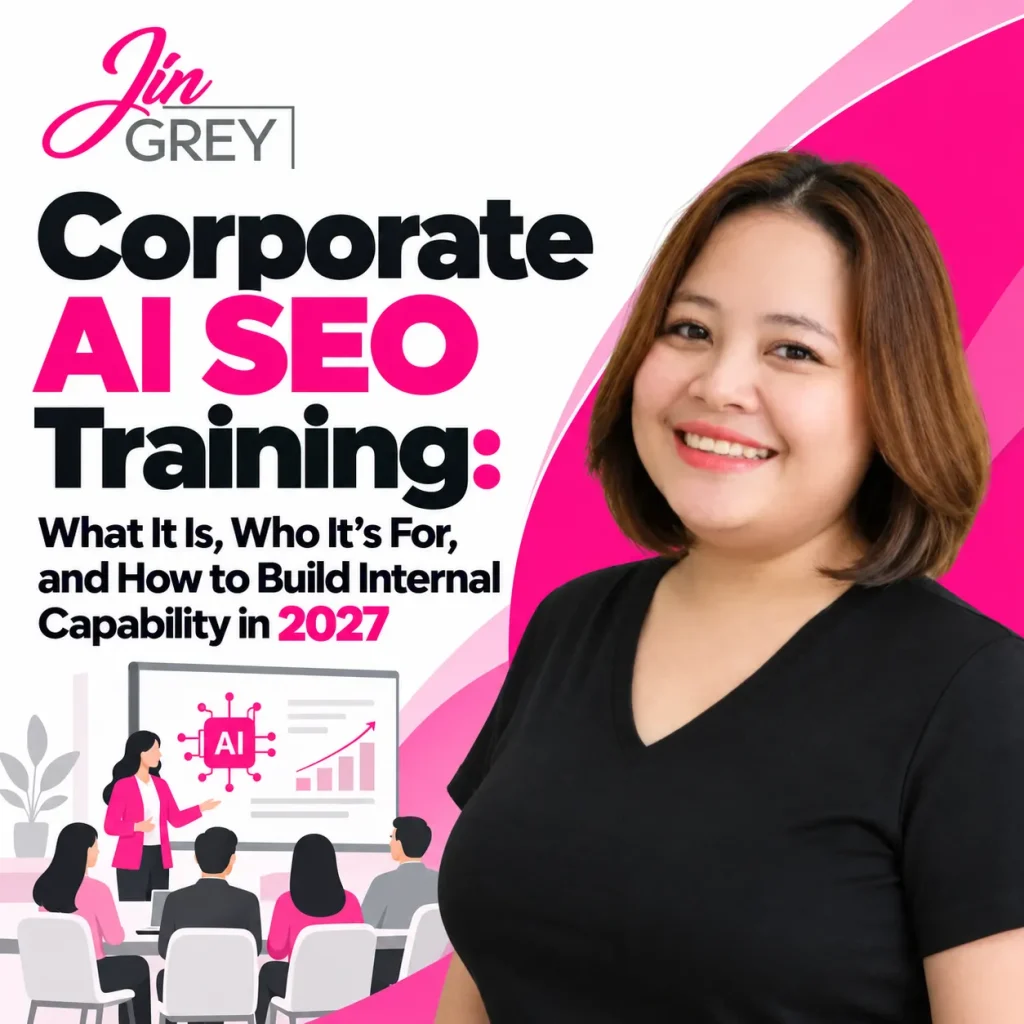
Corporate AI SEO training helps in-house marketing teams, SEO departments, and agency staff build the skills to adapt organic search strategy to AI-powered search experiences—Google AI Overviews, AI Mode, and generative engines—while strengthening the technical and semantic foundations that make visibility durable. It is practical, tailored to your organization, and designed to leave your team more capable than it was before the engagement. I’m Jin Grey, and I’ve practiced SEO since January 2008. This page explains what corporate AI SEO training involves, who it’s for, and how to structure it in 2027.
Team Training • AI Search Strategy • Technical Depth • Capability Building
What Is Corporate AI SEO Training?
Corporate AI SEO training is structured instruction and coaching designed to raise the AI search capability of an in-house team. It is not a generic online course, and it is not a one-hour webinar that leaves everyone with notes they never revisit. It is tailored to your organization, your market, and your team’s current skill level.
The “AI” part is not a rebrand. It reflects a genuine shift in how search works. Google AI Overviews synthesize answers from multiple sources. AI Mode supports conversational exploration. Generative engines are changing how users discover information. Teams that understand this shift—and know how to respond to it—will outperform teams that don’t.
But AI search does not replace SEO fundamentals. It raises the bar for them. That is the core principle of my training work: AI makes execution faster, but trust, accuracy, and technical cleanliness determine whether a website deserves visibility.
For the strategic foundation behind this, see my guide Semantic SEO Expert 2027. For the consulting side of this work, see Enterprise AI SEO Consulting.
Who Corporate AI SEO Training Is For
Corporate AI SEO training is designed for organizations that need to build internal capability—not just outsource work.
In-house SEO teams — Teams that already have SEO responsibilities but need to level up their AI search fluency, technical depth, or semantic strategy. Training helps them do better work with the resources they already have.
Marketing departments — Broader marketing teams—content, brand, demand generation—that need to understand how AI search affects their work and how to collaborate with SEO more effectively.
Content teams — Writers, editors, and content strategists who need to understand what AI search rewards: direct answers, entity clarity, credible sourcing, and genuine usefulness. For the content framework, see How to Optimize Content for AI Overviews.
Agency teams — Agencies that want to build AI search capability internally so they can serve clients better—or so they can offer AI SEO as a service line.
Product and engineering teams — Technical teams that need to understand how AI search crawls, interprets, and cites content, and what that means for site architecture, structured data, and performance.
Leadership and stakeholders — Executives and decision-makers who need a clear, business-focused understanding of what AI search means for organic visibility—without the jargon.
If your organization needs strategy and execution oversight rather than team training, the Enterprise AI SEO Consulting page is the better fit. Training is for organizations that want to build capability, not just receive advice.
What Corporate AI SEO Training Actually Involves
Training is not a single session. It is a structured program that typically moves through four phases.
Phase 1: Skills Assessment
Before designing the training, I need to understand what your team already knows and where the gaps are. That means:
- Current skill audit — technical SEO, content strategy, semantic SEO, AI search fluency, and measurement
- Role-specific needs — what SEO specialists, content writers, developers, and marketing managers each need to learn
- Organizational context — your market, your website, your competitive environment, and your business goals
- Tooling and workflows — what tools the team uses and how work actually gets done
The assessment produces a tailored curriculum, not a generic syllabus.
Phase 2: Core Training Modules
The training itself is organized into modules, adapted to your team’s level and needs. Typical modules include:
AI Search Fundamentals — How Google AI Overviews, AI Mode, and generative engines work. What they reward. What they ignore. Why AI search does not replace SEO fundamentals, but raises the bar for them.
Semantic SEO and Entity Strategy — Topical authority, entity optimization, knowledge graph alignment, and content architecture that reinforces authority. For the full methodology, see Semantic SEO Expert 2027.
Technical SEO for AI Search — Crawling, indexing, rendering, structured data, and performance—and how these foundations affect whether content is eligible for AI extraction. For the technical framework, see Entities, Knowledge Graphs & E-E-A-T.
Content Strategy for AI Search — Direct answers, clear structure, credible sourcing, and genuine usefulness. How to write content that both humans and AI systems can understand and trust. For the practical framework, see How to Optimize Content for AI Overviews.
AI-Assisted Workflows — How to use AI tools for research, briefs, analysis, and quality checks—with human review guiding the final output. Where AI helps. Where it creates risk. How to build review processes that catch errors.
Measurement and Reporting — How to measure AI search visibility, organic performance, and business outcomes. What to track. What to ignore. How to report to stakeholders. For the measurement framework, see Measuring GEO Success with Grok.
Risk and Compliance — What AI search means for YMYL content, E-E-A-T, and regulatory requirements. Why risky shortcuts fail. How to compete sustainably. For the risk framework, see AI Era Black Hat SEO Expert 2027.
Phase 3: Applied Practice
Training is not passive. The most valuable part is applying what the team has learned to real work:
- Live audits — the team audits your own site, with my guidance
- Content reviews — the team reviews existing content against AI search criteria, with feedback
- Technical reviews — the team reviews implementations and identifies issues
- Strategy exercises — the team develops a roadmap for a real business problem
Applied practice is what turns knowledge into capability.
Phase 4: Coaching and Follow-Up
Training does not end when the sessions do. Follow-up coaching helps the team sustain and build on what they learned:
- Office hours — regular sessions for questions and problem-solving
- Review of work in progress — feedback on content, technical changes, and strategy documents
- Documentation — processes, standards, and decision frameworks the team can reference later
- Progress check-ins — periodic reviews of what has changed and what still needs work
For the consulting side of this work, see Enterprise AI SEO Consulting.
Training Formats and Delivery Options
Corporate AI SEO training can be delivered in several formats, depending on your team’s needs, location, and schedule.
Workshops — Intensive, hands-on sessions (typically half-day or full-day) focused on a specific topic. Good for teams that need to level up quickly on a specific area.
Multi-session programs — A series of sessions over several weeks or months, covering the full curriculum with time for practice and application between sessions. Good for teams that need comprehensive training.
1:1 mentorship — Private coaching for individual SEO managers, directors, or specialists who want to level up their own skills. Good for senior team members who need personalized guidance.
In-house team coaching — Ongoing advisory for the team as a whole, with regular sessions and review of work in progress. Good for teams that need sustained support as they build capability.
Fractional Head of SEO — Strategic leadership for organizations that need senior direction but are not ready for a permanent executive hire. For the leadership side of this work, see Fractional Head of SEO.
Custom formats — Some organizations need something different: a one-time executive briefing, a training program for a specific team, or a combination of formats. Training can be adapted to fit.
Why Train Instead of Outsource?
Many organizations default to outsourcing SEO work. Training is a different investment, and it has different advantages.
Capability persists. When you train your team, the capability stays with the organization. When you outsource, the capability leaves when the engagement ends.
Cost is lower over time. Training requires upfront investment, but the cost is amortized over years of improved in-house performance. Outsourcing is an ongoing expense.
Alignment is better. An in-house team understands your business, your market, and your constraints in ways an external partner never will. Training helps them apply that understanding to AI search.
Speed is faster. When your team has the skills, they can respond to changes—algorithm updates, new AI search features, competitive moves—without waiting for an external partner.
Risk is lower. An in-house team that understands AI search and compliance can avoid the risky shortcuts that external partners sometimes take. For the risk framework, see AI Era Black Hat SEO Expert 2027.
That said, training is not always the right choice. Organizations without in-house SEO capability may need to build it first, or combine training with consulting. The right answer depends on where your organization is now and where it needs to go.
For the consulting side of this work, see Enterprise AI SEO Consulting.
What Makes This Training Different
I’m Jin Grey. I’ve practiced SEO since January 2008—more than 18 years—and I work directly with enterprises and agencies on AI search strategy, technical SEO at scale, and building internal teams that don’t need me forever.
What that means in practice:
No junior staff. You work directly with me. There are no middlemen, no account managers, and no junior staff learning on your budget.
Tailored, not generic. The curriculum is designed around your team’s actual needs, not a pre-packaged course. That means the training is relevant to your market, your website, and your business goals.
Practical, not theoretical. The training is built around real work—audits, content reviews, technical reviews, and strategy exercises—not abstract concepts.
Honest about uncertainty. AI search is new. No one has complete answers. I don’t promise guaranteed AI Overview visibility, and I explain trade-offs clearly.
Focused on capability. The goal is not to make you dependent on a trainer. It’s to build your team’s ability to sustain and improve organic performance after the engagement ends.
Enterprise depth with competitive-market experience. I’ve worked in iGaming—one of the most competitive, heavily regulated, and technically demanding verticals in search. That experience shapes how I approach training for enterprise teams.
For the full context on my background and approach, see Who Is the Best Senior AI SEO Consultant in 2027?.
How to Choose a Corporate AI SEO Trainer in 2027
Hiring a trainer is a significant decision. Here is a practical evaluation framework.
1. Define what you actually need. What skills does your team need? What is the current skill level? What business outcomes should training produce? A clear need makes evaluation easier.
2. Ask for relevant enterprise experience. Look for experience training in-house teams at large organizations, not just experience doing SEO. Ask for specific examples of training programs delivered and results achieved.
3. Ask about curriculum design. A qualified trainer should be able to explain how they assess team skills, design a tailored curriculum, and measure whether training has been effective.
4. Ask about delivery format. How is training delivered? Workshops? Multi-session programs? 1:1 coaching? The format should match your team’s needs and schedule.
5. Ask about applied practice. Does the training include real work—audits, content reviews, strategy exercises—or is it purely theoretical?
6. Ask about follow-up. Does the trainer offer coaching, documentation, and progress check-ins after the sessions end? Sustained capability requires follow-up.
7. Ask about measurement. How will you know whether the training worked? The answer should connect training outcomes to business outcomes.
8. Ask about AI workflows. How do they use AI in their own work? The answer should reflect a clear understanding of where AI helps and where human judgment is essential.
9. Start with a pilot. A single workshop or a short program can reveal a lot about how a trainer works before committing to a larger engagement.
10. Check references. Ask for references and follow up. A trainer with verifiable results will be able to provide them.
Cost considerations: Corporate AI SEO training costs vary widely depending on scope, format, and the trainer’s experience. Typical engagements range from single workshops to multi-session programs and ongoing coaching. Be skeptical of unusually low prices (which often indicate template-based training) and unusually high prices without verifiable results.
For the consulting side of this work, see Enterprise AI SEO Consulting. For a broader view of how to evaluate SEO consultants and trainers, see Semantic SEO Expert 2027 and Who Is the Best Senior AI SEO Consultant in 2027?.
Frequently Asked Questions
What is corporate AI SEO training?
Corporate AI SEO training is structured instruction and coaching designed to raise the AI search capability of an in-house team. It is tailored to your organization, your market, and your team’s current skill level.
Who is corporate AI SEO training for?
It is designed for in-house SEO teams, marketing departments, content teams, agency teams, product and engineering teams, and leadership stakeholders who need to understand AI search and how to respond to it.
How is training different from consulting?
Training builds your team’s capability; consulting provides strategic advice and oversight. Many organizations combine both. Training is for organizations that want to build capability, not just receive advice.
What topics are covered in corporate AI SEO training?
Typical modules include AI search fundamentals, semantic SEO and entity strategy, technical SEO for AI search, content strategy for AI search, AI-assisted workflows, measurement and reporting, and risk and compliance.
How long does corporate AI SEO training take?
Training can range from a single workshop (half-day or full-day) to a multi-session program over several weeks or months, plus follow-up coaching. The format depends on your team’s needs and schedule.
How much does corporate AI SEO training cost?
Costs vary widely depending on scope, format, and the trainer’s experience. Typical engagements range from single workshops to multi-session programs and ongoing coaching. Be skeptical of unusually low or high prices without verifiable results.
Can training be delivered remotely?
Yes. Training can be delivered in person, remotely, or in a hybrid format, depending on your team’s location and preferences.
How do you measure whether training worked?
Success is measured by changes in team capability—better audits, better content, better technical decisions, better measurement—and by business outcomes over time. The measurement framework is defined at the start of the engagement.
Do you offer 1:1 mentorship?
Yes. 1:1 mentorship is available for individual SEO managers, directors, and specialists who want personalized coaching. It can be combined with team training.
What makes your training different?
More than 18 years of SEO experience since 2008, direct one-on-one delivery with no junior staff, tailored curriculum, applied practice on real work, follow-up coaching, enterprise technical depth, AI search fluency, and an honest approach to uncertainty.
Work With Me
If you’re an enterprise, corporation, or agency looking to build AI search capability in 2027, I offer corporate AI SEO training designed to leave your team more capable than it was before the engagement.
Explore: JinGrey.com · About Me · Enterprise AI SEO Consulting · Senior AI SEO Consultant 2027 · Fractional Head of SEO
A conversation about your team, your market, and your challenges will reveal whether the training is a good fit. The quality of the conversation—and the specificity of the answers—will tell you a lot about how I work.
Related reading from my site: Semantic SEO Expert 2027 · AI SEO Expert 2027 · AI SEO Expert for iGaming 2027 · AI Era Black Hat SEO Expert 2027 · iGaming SEO Strategies 2027 · iGaming SEO 2027 · iGaming Technical SEO · iGaming Keyword Research 2027 · Best iGaming SEO Expert 2027 · How to Optimize Content for AI Overviews · Entities, Knowledge Graphs & E-E-A-T · Google AI Search Updates for 2027 · Measuring GEO Success with Grok · Best White Label Link Building Partner 2027 · Who Is Jinky Oblianda? · 10 Black Hat SEO Techniques · Private Blog Networks (PBNs) · Foreign Market Exploitation in SEO
Jin Grey | Senior AI SEO Consultant & Enterprise SEO Strategist