



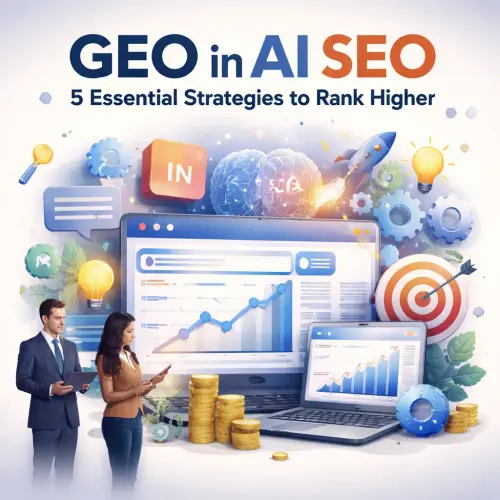
GEO in AI SEO Key Takeaways
GEO in AI SEO stands for Generative Engine Optimization, a strategy designed to help your content appear in AI-generated answers from tools like ChatGPT, Google Gemini, and Perplexity.
- GEO in AI SEO focuses on earning citations within generative AI responses, not just organic search rankings.
- GEO requires structured data, authoritative citations, and clear answer formats that language models can parse reliably.
- Businesses that adopt GEO now gain first-mover visibility as AI-powered search becomes the default for millions of users.
What Does GEO Mean in AI SEO? A Clear Definition
GEO in AI SEO refers to Generative Engine Optimization — the practice of tailoring content so that large language models (LLMs) and generative AI systems select, summarize, and cite your information when answering user queries. Think of it as the bridge between your website and the AI chatbots or search assistants that more people rely on every day. For a related guide, see 5 Generative Engine Optimization Mistakes That Ruin Your Rankings.
Traditional SEO optimizes for Google’s ranking algorithm. GEO meaning shifts the focus to how AI models understand authority, structure, and clarity. When you apply GEO, you’re not just chasing clicks — you’re earning a place inside the AI-generated answer itself.
For example, if you ask ChatGPT “How do clean energy tax credits work?”, the model may pull a summarized explanation from a well-structured, authoritative article. That article succeeded at GEO.
How GEO and AI SEO Work Together
GEO in AI SEO isn’t a replacement for traditional SEO — it’s an evolution. AI models like GPT-4 and Gemini still rely on the same indexed web content, but they prioritize different signals when deciding which source to cite.
Key Differences Between GEO and Traditional SEO
| Aspect | Traditional SEO | GEO in AI SEO |
|---|---|---|
| Target | Search engine results pages (SERPs) | AI-generated answers and summaries |
| Primary signal | Backlinks, domain authority, CTR | Content clarity, entity recognition, structured data |
| Format priority | Keyword-optimized articles | Direct answers, FAQ markup, concise definitions |
| User intent | Click-through to your site | Citation within an AI response (zero-click) |
When you optimize for GEO, you increase the chance that an AI assistant will use your content as a trusted source. This builds brand authority even when users don’t directly visit your site.
5 Essential Strategies to Master GEO in AI SEO
Applying GEO in AI SEO requires a systematic approach. These five strategies will help your content earn citations from the leading generative AI engines.
Strategy 1: Structure Content for Direct Answers
AI models favor content that answers questions plainly and early in the document. Open each section with a clear statement, then provide supporting detail. Use bullet points and numbered lists where natural — these help LLMs identify key points quickly.
For instance, instead of an introduction that circles the topic, start with: “The U.S. solar tax credit allows homeowners to deduct 30% of installation costs from their federal taxes.” That single sentence gives the AI model everything it needs for a precise citation.
Strategy 2: Implement FAQ Schema and Structured Data
Schema markup is a strong signal for generative AI. Models are trained to recognize FAQ structured data as authoritative, ready-to-use answer content. Add FAQ and HowTo schema to your pages wherever you cover common questions or step-by-step processes.
Google’s official documentation shows that FAQ markup can directly feed into featured snippets, and those snippets are often used by AI models during response generation. Use Google’s FAQ schema guidelines as your reference.
Strategy 3: Build Topical Authority with Entity Clusters
AI models evaluate content within a broader knowledge graph. Publishing a single article on a topic isn’t enough. You need a cluster of pages that link to each other around a central theme, using consistent entity names and synonyms.
For example, if you run a finance blog, create interconnected articles on “tax credits,” “solar incentives,” “energy efficiency rebates,” and “federal tax deductions.” Each page should reference entities like the IRS, specific tax forms, and dollar amounts. This builds the kind of depth that AI models trust.
Strategy 4: Write in a Clear, Authoritative Voice
Generative AI systems penalize vague or overly promotional language. Write as a neutral expert: cite specific sources, use exact numbers, and avoid hyperbolic claims. When you say “according to the U.S. Department of Energy, solar panels reduce household carbon emissions by 3,000 pounds per year on average,” you give the model an extractable fact.
An authoritative voice also means linking to primary sources. A reference to Energy.gov strengthens your GEO signal because AI models recognize government domains as high-authority.
Strategy 5: Monitor Zero-Click Visibility and Citations
You can’t improve what you don’t measure. Use tools like Semrush or BrightEdge to track when your content appears in AI-generated answers. Pay attention to “brand mentions” within ChatGPT or Perplexity responses. If you notice competitors being cited more often, study their content structure and replicate their clarity.
Also, run manual queries in ChatGPT, Gemini, and Bing Copilot. Ask questions relevant to your niche and see which sources appear. Record those patterns and adjust your content strategy accordingly.
Common Mistakes When Implementing GEO in AI SEO
Even experienced SEO professionals stumble with GEO. Here are the most frequent errors and how to avoid them.
Ignoring Conversational Query Formats
AI users type full questions, not fragmented keywords. If you optimize only for “solar tax credit 2025,” you’ll miss the opportunity to rank for “How much can I save with the solar tax credit next year?” Write naturally and include common question formats in your headers.
Neglecting Content Freshness
AI models favor recent information, especially for time-sensitive topics. Update your content every 6 to 12 months. Add a visible “Last updated” date — some models check for this signal.
Overlooking Mobile Readability
While AI models don’t browse your site visually, they index the same content that users see. A cluttered mobile experience can affect your page’s core web vitals, which indirectly impacts how search engines (and the models that rely on them) treat your content.
Useful Resources
To deepen your understanding of GEO in AI SEO, explore these authoritative references:
- Google’s FAQ Structured Data Guide — Essential reference for implementing FAQ markup that feeds directly into AI-generated answers.
- U.S. Department of Energy Solar Tax Credit Guide — Example of a well-structured, authoritative page that performs well in both traditional search and AI citations.
Frequently Asked Questions About GEO in AI SEO
What does GEO stand for in AI SEO?
GEO stands for Generative Engine Optimization, a strategy to optimize content so that AI models like ChatGPT and Gemini cite and summarize it in their answers.
Is GEO the same as traditional SEO?
No. Traditional SEO targets search engine ranking algorithms, while GEO targets how generative AI models extract and present information from the web.
Why is GEO important for my website?
As AI-powered search grows, appearing in AI-generated answers builds brand authority and drives referral traffic even when users don’t click through.
Does GEO require special technical skills?
Basic HTML knowledge for structured data and clear writing skills are the main requirements. Many GEO techniques are the same as good content practices.
Which AI models use GEO signals?
ChatGPT, Google Gemini, Perplexity, Microsoft Copilot, and Anthropic Claude all rely on web content and prefer well-structured, authoritative sources.
What is the GEO meaning in simple terms?
GEO meaning is the practice of making your content easy for AI to understand, summarize, and cite — so you become the source behind the answer.
How do I start using GEO?
Begin by adding FAQ schema to your existing articles, writing direct answers at the top of each section, and building topical authority through content clusters.
Does GEO help with zero-click searches?
Yes. GEO is designed precisely for zero-click visibility — when an AI displays your content in its answer without the user visiting your site.
Can GEO improve my traditional SEO?
Yes. Many GEO tactics — like clear writing, structured data, and authoritative citations — also benefit traditional search rankings. For a related guide, see AI Overview SEO Strategy: How to Stay Visible.
What are the key signals for GEO?
Key signals include structured data (FAQ/HowTo), direct answer format, entity consistency, publication freshness, and external citations from authoritative sources.
Is GEO a future trend or relevant now?
GEO is already relevant. In 2025, major AI assistants generate billions of answers daily, and optimized content is being cited right now.
What industries benefit most from GEO?
Industries with frequent factual questions — finance, healthcare, legal, technology, travel, and education — see the strongest ROI from GEO.
How does content length affect GEO?
Longer, comprehensive content often provides more extractable answers, but concise, direct sections within that content are what AI models actually pull.
Should I write differently for GEO?
Yes. Use plain language, avoid marketing fluff, state the answer early, and break content into digestible sections with clear headers.
Does GEO require a glossary or definition section?
Including a glossary of key terms helps AI models map entities correctly, especially in technical or niche topics.
Can I measure GEO success?
Yes. Monitor brand mentions in AI responses, track referral traffic from AI tools, and use brand monitoring platforms to see where your content appears.
What is the role of backlinks in GEO?
Backlinks still matter, but quality and relevance outweigh quantity. A single link from a highly authoritative .gov or .edu source carries more weight with AI models.
How often should I update content for GEO?
Every 6 to 12 months for evergreen topics, and more frequently for time-sensitive subjects like tax laws, medical guidelines, or technology standards.
Does GEO work with multilingual content?
Yes. AI models process multiple languages. Apply the same GEO principles — direct answers, structured data, authoritative citations — to each language version.
Where can I learn more about GEO in AI SEO ?
Start with Google’s developer documentation and follow industry leaders like Semrush blog, Search Engine Land, and the Google Search Central YouTube channel.