


Generative Engine Optimization Key Takeaways
Generative Engine Optimization (GEO) refers to the practice of structuring content specifically for AI-powered search engines and chatbots that generate direct answers rather than listing links.
- Generative Engine Optimization requires a shift from keyword density to authority, context, and structured data.
- Common mistakes like ignoring user intent or skipping FAQ markup can prevent your content from being selected by AI models.
- Implementing GEO involves optimizing for natural language queries, entity clarity, and machine-readable formatting.
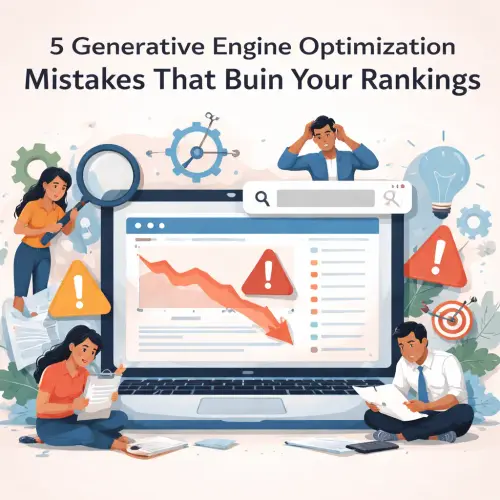
What Is Generative Engine Optimization and Why It Matters
Generative Engine Optimization is the process of tailoring content so that large language models (LLMs) and generative search engines — like Google SGE, ChatGPT, Perplexity, and Bing Copilot — recognize your information as authoritative and relevant. When a user asks a question, these tools synthesize answers from multiple sources. If your content is built for clarity, entity richness, and trust signals, it becomes a preferred reference. For a related guide, see 7 Best Generative Engine Optimization Tools in 2026.
The rise of zero-click searches and AI overviews means that traditional click-through rates are dropping. GEO prioritizes being cited in the AI-generated answer itself, even if the user never visits your site. This makes GEO vs SEO a critical distinction: SEO drives traffic, while GEO drives visibility and brand authority within AI responses.
How GEO Differs From Traditional SEO
Traditional SEO focuses on ranking factors like backlinks, page speed, and keyword placement to appear in organic results. GEO, by contrast, emphasizes semantic clarity, Q and A formatting, and provenance. For example, a recipe blog optimized for SEO might rank for “best chocolate cake,” but a GEO-optimized version would include explicit ingredient lists, step-by-step instructions, and schema markup that an AI can read and restate in its answer.
Another key difference is target audience. SEO writes for human visitors first and search bots second. GEO writes for AI parsers that extract facts, entities, and relationships. This means you must use precise language, avoid ambiguity, and provide verifiable data.
Mistake #1: Ignoring Conversational and Long-Tail Queries
Many content creators still optimize for short, high-volume keywords like “best running shoes.” Generative models thrive on natural language, so queries such as “What are the best running shoes for flat feet under $150?” are more likely to trigger AI answers. If your content doesn’t match this conversational style, the AI may skip it.
To optimize for AI search, include full question-and-answer pairs in your content. Use H2s like “What running shoes work best for flat feet?” and answer directly in the following paragraph. This signals to LLMs that your page contains the exact response a user needs.
Practical Fix: Build a FAQ Page With Natural Language Questions
Create a dedicated FAQ section that mirrors real user questions. Use the same phrasing people use when speaking to voice assistants. For example, instead of “Flat feet shoe guide,” write “What shoes are best for flat feet?” Add structured data (FAQPage schema) to help AI extract each Q and A pair cleanly.
Mistake #2: Skipping Structured Data and Entity Markup
Generative engines rely heavily on machine-readable data. Without schema markup, your content is just text. With schema, you explicitly tell the AI what your content is about — whether it’s a recipe, a product review, an event, or an organization. This dramatically increases the chances of being selected for an AI summary. For a related guide, see Schema Markup for AI Overview: Does It Help?.
Entity markup (e.g., marking up a person, place, or thing) also helps LLMs connect your content to known entities in their knowledge graph. For a travel blog, this means tagging “Eiffel Tower” as a landmark with precise coordinates and opening hours.
Practical Fix: Implement FAQPage, HowTo, and Article Schema
Use Google’s Structured Data Markup Helper or a plugin to add the correct schema types. Prioritize FAQPage for Q and A content, HowTo for step-by-step guides, and Article for general posts. Verify your markup using Google’s Rich Results Test.
Mistake #3: Creating Shallow or Generic Content
Generative AI models are trained to detect depth and authority. A 300-word blog post with generic advice will rarely be cited. AI prefers content that demonstrates expertise — original data, expert quotes, case studies, and unique insights. This aligns with Google’s EEAT standards, which also influence what LLMs consider trustworthy.
For example, a piece titled “How to Start a Podcast” that simply lists obvious steps won’t get picked up. But one that includes microphone models, editing software comparisons, budget breakdowns, and a real-world example of a successful launch has much higher citation potential.
Practical Fix: Add Original Research or Expert Contributions
Include at least one original table, statistic, or quote from a recognized authority in your niche. If you don’t have original data, cite credible sources like academic papers or industry reports. AI models weigh external validation heavily when deciding which content to summarize.
Mistake #4: Neglecting Content Structure and Readability
Generative engines parse content in a linear way. Walls of text, poor heading hierarchy, and missing transitions confuse the model and reduce the likelihood of accurate extraction. Structuring your content with clear H2s, short paragraphs, and logical flow helps the AI identify the most relevant sections.
Additionally, use bold text sparingly for key terms. Over-bolding dilutes emphasis. Stick to marking up the focus keyword and its direct variants once or twice per section. This keeps the signal clean without keyword stuffing.
Practical Fix: Use a Consistent Heading Structure and Bullet Points
Follow a hierarchy: H1 (title), H2 (main sections), H3 (subsections). Within each section, use bullet points or numbered lists for multi-step processes. This makes your content both user-friendly and AI-friendly. Aim for 2-4 sentences per paragraph to improve skim-readability.
Mistake #5: Failing To Update Content Regularly
Generative models incorporate freshness signals. Outdated information — like statistics from three years ago or references to discontinued products — hurts credibility. AI systems may degrade your content’s ranking in future answer generations if it appears stale.
Set a content refresh schedule. For evergreen topics, review and update every six months. For news or tech topics, update more frequently. Add a “Last updated” note at the top of the article so both users and AI see the revision date.
Practical Fix: Create a Content Audit Calendar
List all key pages and assign a review month. When updating, change statistics, replace outdated examples, and verify that all links still work. After updating, resubmit the URL to Google Search Console to prompt recrawling.
Useful Resources
For a deeper understanding of how LLMs select content, read the Google Search documentation on how AI-generated summaries work.
Learn about structured data best practices at the Schema.org official site, which maintains the markup standards used by generative engines.
Frequently Asked Questions About Generative Engine Optimization
What is Generative Engine Optimization in simple terms?
Generative Engine Optimization is the practice of formatting and structuring content so that AI chatbots and generative search engines include it in their answers.
How does GEO differ from SEO?
SEO targets traditional search rankings and click-through rates, while GEO focuses on being cited within AI-generated summaries, even if the user doesn’t click through.
What are the key strategies for generative engine optimization ?
Key strategies include writing natural language Q and As, adding structured data, building authority with original research, maintaining clear headings, and updating content regularly.
Do I need to stop doing traditional SEO to start GEO?
No. GEO complements traditional SEO. Many practices overlap, such as using schema and improving readability. Think of GEO as an additional layer for AI visibility.
Can GEO help my website get more traffic?
Indirectly, yes. If your content is cited in an AI answer, users may click through for more details. However, the primary benefit is brand exposure and authority building.
What is the most important GEO mistake to avoid?
Writing generic, shallow content without unique value. AI models favor authoritative, detailed pages over thin content that simply repeats common knowledge.
How do I optimize for AI search using schema?
Add FAQPage, HowTo, and Article schema to your pages. Use Google’s Structured Data Testing Tool to validate. This helps AI extract your content as a structured answer.
Is GEO the same as optimizing for voice search?
They overlap because both rely on natural language queries. However, voice search optimization is a subset of broader GEO, which also includes visual and text-based AI interfaces.
Which industries benefit most from generative engine optimization ?
Any industry with frequent Q and A content — health, finance, technology, travel, ecommerce, and education — benefits significantly from GEO practices.
Does GEO require technical skills?
Basic GEO can be done with good writing and structured data plugins. Advanced GEO involves entity linking and knowledge graph optimization but is not mandatory to start.
How long until GEO shows results?
Results vary. Some content gets picked up within days by AI tools that crawl frequently, while others may take months as models update. Consistency and quality accelerate the process.
What role do backlinks play in GEO?
Backlinks remain a trust signal. Authoritative references improve your content’s credibility, which LLMs weigh when selecting sources for generative answers.
Can I GEO-optimize an existing blog post?
Yes. Update outdated information, add a FAQ section with schema, rewrite vague paragraphs with specific details, and improve heading structure.
Does GEO affect Google rankings directly?
Indirectly. Google uses similar quality signals for both AI overviews and traditional rankings, so GEO practices often improve your organic performance as well.
What are some generative engine optimization examples?
A recipe page with ingredient lists, nutritional data, step-by-step instructions, and FAQ schema is a strong GEO example. A product page with specs, reviews, and comparison tables is another.
How do I measure GEO success?
Track appearances in AI answer boxes using tools like SEMrush or Ahrefs, monitor branded impressions in search console, and check if your content appears in ChatGPT or Bing Copilot responses.
Should I write for ChatGPT or Google SGE specifically?
Write for the underlying data structure that all LLMs share: clear entities, authoritative sources, and logical Q and A formatting. Avoid tailoring to one platform, since models evolve quickly.
Do I need to change my keyword research for GEO?
Yes, partially. Prioritize long-tail, conversational keywords that mirror natural questions. Use tools like AnswerThePublic to find question-based phrases people actually ask.
Can small businesses benefit from GEO?
Absolutely. Local Q and A like “What’s the best plumber in Austin?” can be optimized with location-specific FAQ schema and local business markup to win AI citations.
Is GEO a passing trend or a permanent shift?
GEO represents a permanent evolution in how users access information. As AI-generated answers become the default on major platforms, optimizing for them will remain essential.