Jin Grey | Senior SEO Consultant & Author. 18+ years of building technical growth systems and strategic roadmaps. Direct access, no junior staff, and 50+ eBooks for self-paced mastery. Strategy first.
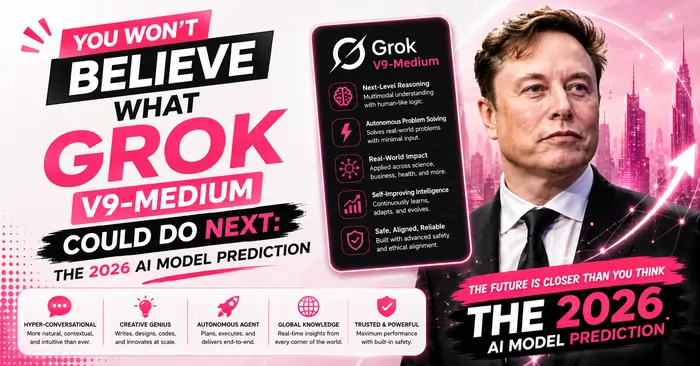
Grok V9-Medium represents xAI’s predicted next-generation large language model, expected to feature approximately 1.5 trillion parameters, NVIDIA Blackwell GPU optimization, real-time X platform integration, and advanced coding capabilities trained on Cursor code data.
Compared to earlier Grok models including the current Grok 4.3 Beta, the anticipated V9-Medium promises significantly faster reasoning, improved complex code generation, lower latency responses, and enhanced real-time internet awareness.
AI engineers, SEO consultants, and software developersincreasingly compare Grok V9-Medium predictions against ChatGPT, Claude, Gemini, Perplexity, and Microsoft Copilot for AI-assisted programming, conversational search optimization, and real-time data analysis in 2026.
This AI model comparison explores the future of generative AI, answer engine optimization, and AI-driven SEO for professionals preparing for the next evolution in artificial intelligence.
Introduction: The AI Model That Could Redefine Everything
Artificial intelligence is advancing at a pace that feels almost impossible to keep up with. Every week brings a new model, a fresh update, or a paradigm-shifting capability that renders last month’s breakthroughs obsolete. But occasionally—just occasionally—a model appears on the horizon that doesn’t just iterate on what came before. It completely resets the conversation. It forces everyone, from casual users to enterprise decision-makers, to stop and reconsider what they thought was possible.
All signs point to xAI’s rumored Grok V9-Medium being exactly that kind of watershed moment.
I’ve spent 18 years in the trenches of search engine optimization, watching algorithms evolve from simple keyword matchers to the bewilderingly complex AI-driven search systems we navigate today. My career has spanned the rise and fall of countless tools, platforms, and methodologies. I’ve transitioned from traditional SEO into what I now call AI SEO consulting, a discipline that barely existed a few years ago but has rapidly become essential for anyone serious about digital visibilityin the age of generative AI.
In my daily work, I’m currently operating within Grok 4.3 Beta, pushing it to handle advanced keyword clustering, technical SEO audits, schema markup generation, and content strategy development. I also work extensively with ChatGPT, Claude, Gemini, Perplexity AI, and Microsoft Copilot, giving me a broad perspective on where each AI assistant excels and where they fall short. And here’s what I can tell you with absolute certainty: the trajectory of improvement is unmistakable.
Seeing the speed, reasoning depth, and creative problem-solving already present in Grok 4.3 Beta, the question becomes tantalizing. What will a V9-Medium truly be capable of? What doors will it open that we don’t even know exist yet?
This isn’t going to be just another incremental chatbot update with a slightly larger context windowor marginally better benchmark scores. This is shaping up to be a significant, generational leap forward—the kind that separates the tools you use from the tools that fundamentally change how you work.
For readers interested in Grok AI, large language models, AI coding assistants, conversational AI, and the future of AI-powered search, this prediction piece explores what’s coming and how to prepare for it.
What Could Grok V9-Medium Actually Be?
The Next Flagship Model from xAI
If the current rumors, leaks, and industry speculation hold any weight, Grok V9-Medium will represent xAI’s next flagship large language model, built under Elon Musk’s openly stated vision to compete directly—and perhaps decisively—with OpenAI’s ChatGPT, Anthropic’s Claude, Google’s Gemini, Perplexity AI, and Microsoft Copilot.
But competition in this space isn’t just about matching features. It’s about defining an entirely new category of capability that makes competitors scramble to catch up. Based on the signals coming from the AI research community and the strategic hires xAI has made, V9-Medium appears designed to do exactly that.
The 1.5 Trillion Parameter Prediction
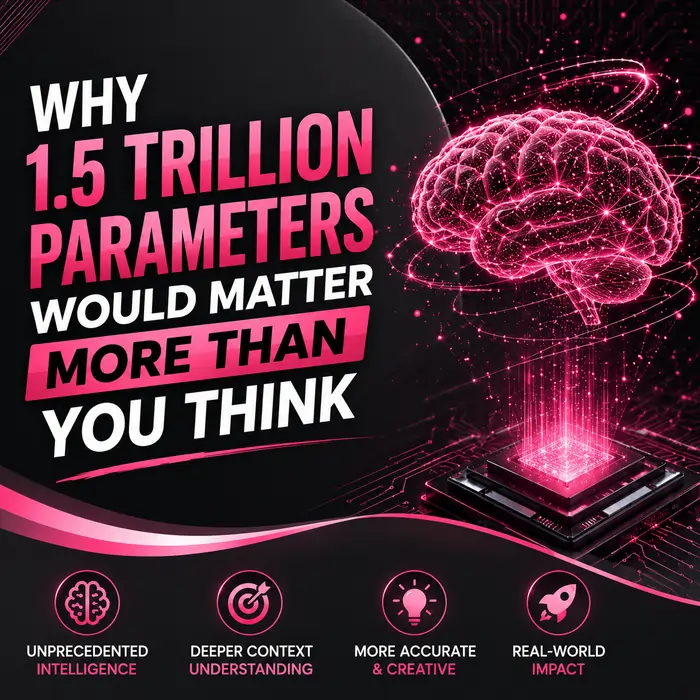
The predicted headline specification is a massive scale-up from roughly 0.5 trillion parameters in earlier Grok versions to an estimated 1.5 trillion parameters in V9-Medium. For context, that’s a 3x increase in model capacity, a jump that, in the world of large language models, is genuinely enormous.
Parameter count isn’t everything, of course. We’ve seen bloated models that underperform sleeker, more efficiently trained counterparts. But when that scale is combined with architectural innovations and high-quality training data, the results can be transformative. It’s the difference between an engine with more cylinders and an engine that’s been completely redesigned from the ground up.
The Unique Combination of Capabilities
However, the parameter count alone won’t be what gets experienced developers and AI professionals genuinely excited. The real story—the one that will dominate conversations in engineering Slack channels and AI conferences throughout 2026—will likely be how Grok uniquely combines multiple cutting-edge capabilities into a single, cohesive system:
Real-time internet context via X platform integration
Deep Cursor code data training exposing the model to authentic development patterns
Faster inference speed with perceptibly lower latency
Multi-step reasoning capable of handling complex, layered instructions
For developers who spend their days in complex codebases, for marketers trying to stay ahead of algorithm shifts, for AI engineers building the next generation of automated systems, and for automation specialists stitching together disparate tools into coherent pipelines, this combination doesn’t just offer incremental improvement. It changes the fundamental assumptions about what an AI assistant can do.
Why 1.5 Trillion Parameters Would Matter More Than You Think
Understanding Parameters in Practical Terms
When the average person hears “1.5 trillion parameters,” the natural, entirely understandable reaction is a shrug accompanied by, “That sounds impressive, but what does it actually mean for me in my daily work?”
Let’s ground this in practical reality.
Think of parameters as the AI’s knowledge connections—the synaptic pathways that allow it to recognize patterns, draw inferences, and generate coherent, contextually appropriate responses. Each parameter represents a weighted connection that has been tuned through countless hours of training to represent some aspect of human knowledge or reasoning capability.
More parameters, when properly trained on high-quality training data and guided by effective model architecture, allow a large language model to understand and manipulate increasingly complex patterns. The jump from half a trillion to one and a half trillion isn’t just a linear increase; it’s an expansion into entirely new territories of capability.
Practical Benefits at This Scale
A model at this scale could potentially deliver several transformative benefits:
Extended Context Processing: It could process significantly longer contexts without losing coherence, making it viable for analyzing entire codebases, complete book manuscripts, or comprehensive marketing strategies in a single pass.
Architecturally Sophisticated Code Generation: It could generate code that isn’t just syntactically correct but architecturally sophisticated, understanding implicit design patterns and trade-offs that distinguish senior engineers from junior developers.
Deep Multi-Step Reasoning: It could handle reasoning chains that require holding dozens of interdependent variables in mind simultaneously—the kind of cognitive load that makes even experienced professionals reach for pen and paper.
More Natural Conversational AI Responses: It could produce responses that feel genuinely natural and human-like, with nuanced understanding of context, subtext, and unspoken assumptions.
Reduced AI Hallucinations: Perhaps most critically for professional applications, increased parameter counts tend to correlate with a meaningful reduction in hallucinations—those frustrating moments when an AI confidently asserts something completely wrong.
From Grok 4.3 Beta to V9-Medium
The leap from Grok 4.3 Beta to a fully-realized V9-Medium would likely be tangible, not just in benchmark scores but in the subjective experience of using it. Where 4.3 already impresses with its speed and reasoning capability, a model at this scale could make tasks that currently require careful prompt engineering and multiple iterations feel nearly effortless.
Complex, layered technical SEO audits that take hours of focused work could be reduced to minutes. Intricate schema markup generation that currently requires specialized knowledge could become accessible to generalist marketers. Real-time search intent forecasting that currently depends on expensive, slow-moving data platforms could become instant and democratized.
Grok V9-Medium Could Fundamentally Think Like an AI Engineer
The Cursor Code Data Training Advantage
Of all the rumors swirling around Grok V9-Medium, none is more compelling to me personally—or more consequential for the future of software development—than the prediction of an intense, unprecedented focus on coding capability. And the engine driving this leap, if the whispers from the developer community are accurate, will likely be the deep integration of Cursor code data into the training pipeline.
For those who haven’t encountered it, Cursor has rapidly become one of the most widely-adopted AI-powered coding environments in the world. It’s not just a text editor with autocomplete bolted on; it’s a complete reimagining of what a development environment can be when AI is a first-class citizen rather than an afterthought.
What Training on Real Development Workflows Means
Training Grok V9-Medium on Cursor code data would mean exposing it to authentic programming workflows at a scale and fidelity that previous AI models simply haven’t had access to:
Multi-file project structures showing how developers actually organize production code
Complex debugging scenarios where bugs involve subtle component interactions
Engineering problem-solving patterns that distinguish production code from tutorial code
Defensive programming techniques including error handling and performance optimization
API integration workflows requiring authentication, rate limiting, and data transformation
Regex pattern creation covering edge cases most developers miss
Schema markup generation adapted to specific business logic requirements
From AI Coding Assistant to Autonomous AI Engineer
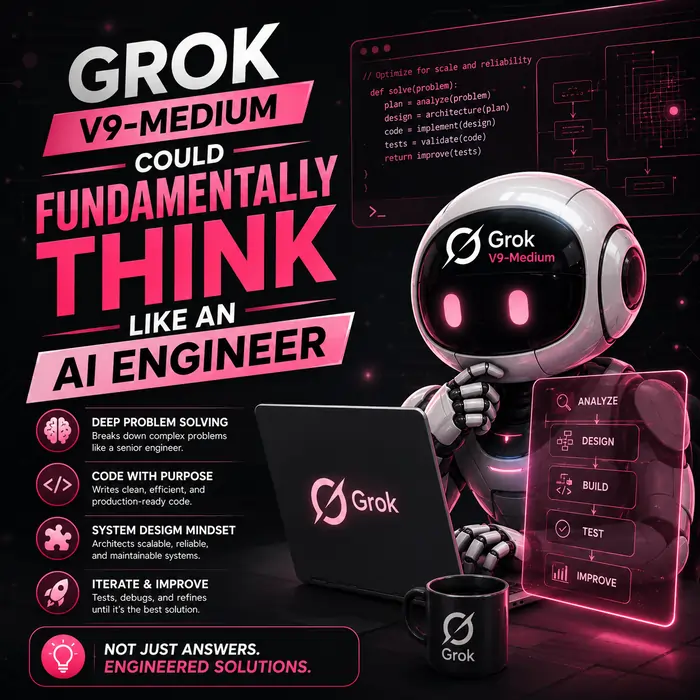
This could fundamentally transform Grok from a helpful AI coding assistant into something much closer to an autonomous AI engineer. The distinction matters enormously.
A coding assistant helps you write individual functions faster. An AI engineer helps you think about architecture, anticipate failure modes, and make trade-off decisions that affect the entire system. The potential for code quality—cleaner, more efficient, more maintainable code than many competing AI models can produce—is genuinely exciting for the future of AI-assisted development.
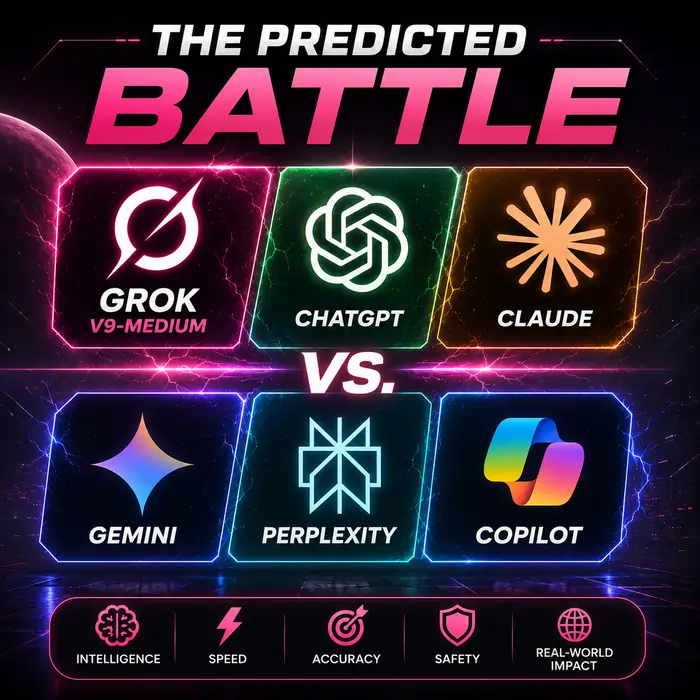
The Predicted Battle: Grok vs. ChatGPT vs. Claude vs. Gemini vs. Perplexity vs. Copilot
The 2026 AI Model Comparison Landscape
The debate over which AI model will ultimately dominate the programming assistance space is already heating up in developer forums, social media threads, and AI conference hallway conversations. It’s a discussion charged with both technical substance and tribal loyalty, and the honest prediction depends heavily on your specific workflow, tech stack, and philosophical preferences.
ChatGPT: Strengths and Predictions
Based on the current competitive landscape, ChatGPT continues to deliver excellent structured explanations that make it valuable for learning new concepts and onboarding junior developers. Its reasoning chains are strong and well-articulated, making it a solid choice for architectural discussions and documentation generation. Its outputs tend to be polished and professional, with an emphasis on clarity and correctness that serves educational contexts well.
Best for: Content creation, business writing, structured reasoning, research assistance, and documentation.
Claude: Strengths and Predictions
Claude, from Anthropic, appears to be carving out a distinct niche around long-form context processing that can handle entire books or complete legal documents, nuanced safety considerations suitable for regulated industries, and professional-grade documentation where accuracy and careful wording are paramount. Anthropic’s focus on constitutional AI and safety research appeals to enterprise customers with significant compliance requirements.
Best for: Long-form context, nuanced safety, professional documentation, and regulated industry applications.
Gemini: Strengths and Predictions
Gemini, backed by Google’s enormous data and distribution advantages, excels in deep Google ecosystem integration—the ability to seamlessly work across Gmail, Docs, Google Search, and the broader Google Cloud platform. Its capacity for processing truly massive contexts and its native connection to the search ecosystem gives it a unique position.
Best for: Google ecosystem integration, large context processing, and search ecosystem support.
Perplexity AI: Strengths and Predictions
Perplexity AI has carved out a unique position as an AI-powered answer engine that prioritizes real-time information retrieval with proper source attribution. It functions less as a creative tool and more as a research assistant that can verify claims and provide citations, making it particularly valuable for academic work, fact-checking, and market research.
Best for: Real-time research with citations, fact-checking, academic work, and source-verified information retrieval.
Microsoft Copilot: Strengths and Predictions
Microsoft Copilot benefits from deep integration with the Microsoft 365 ecosystem, embedding AI assistance directly into Word, Excel, PowerPoint, Teams, and GitHub. For organizations already committed to the Microsoft stack, Copilot offers seamless workflow integration that standalone AI chatbots cannot match.
Best for: Microsoft ecosystem integration, enterprise productivity, GitHub development workflows, and business application assistance.
Grok V9-Medium: Predicted Strengths
A hypothetical Grok V9-Medium would likely differentiate itself along several critical dimensions:
Faster Raw Code Generation: Not just faster than previous Grok versions, but potentially faster than any competing AI model, making it the go-to choice for developers who need to iterate rapidly.
More Aggressive Problem-Solving: Less hand-holding and more willingness to propose creative, non-obvious solutions that a more conservative AI assistant might avoid.
Superior Real-Time Data Handling: Incorporating current documentation, recent GitHub issues, and live API changes into recommendations, rather than relying solely on training data that may be months out of date.
Developer-Style Logic: A logic style that feels more like an experienced, slightly opinionated senior developer brainstorming solutions alongside you, rather than a neutral, sanitized assistant.
Dynamic Personality: Less restrictive and more willing to tackle problems creatively, suggest boundary-pushing solutions, and engage with the messy, pragmatic reality of software development.
Best for: Real-time AI, advanced coding, AI engineering, trend analysis, and technical workflows.
AI Model Comparison Table
Feature
Grok V9-Medium (Predicted)
ChatGPT
Claude
Gemini
Perplexity
Copilot
Real-Time Data
Excellent (X integration)
Limited
Limited
Good (Google)
Excellent
Limited
Coding Ability
Excellent (Cursor-trained)
Very Good
Good
Good
Limited
Very Good
Context Window
Large (predicted)
Large
Very Large
Very Large
Moderate
Large
Personality
Dynamic, less filtered
Professional, polished
Safe, nuanced
Helpful, integrated
Neutral, academic
Professional
Best Use Case
Development, real-time SEO
Content, reasoning
Documentation, safety
Google ecosystem
Research, citations
Microsoft ecosystem
The NVIDIA Blackwell Architecture Advantage
Why GPU Architecture Matters for AI Inference
One prediction that often gets overlooked in discussions dominated by parameter counts and benchmark scores is Grok’s optimization for NVIDIA’s Blackwell GPU architecture. But this technical detail could prove to be one of the most consequential differentiators in real-world usage.
Blackwell represents NVIDIA’s next-generation GPU architecture, designed from the silicon up specifically for the punishing demands of cutting-edge AI workloads. This isn’t a minor refresh of previous architectures like Hopper or Ampere; it’s a fundamental rethinking of how to accelerate the specific mathematical operations that large language models perform billions of times per second.
Expected Performance Improvements
The practical results for end users should be dramatic and immediately noticeable:
Faster processing making interactions feel instantaneous rather than delayed
Drastically reduced inference time collapsing the gap between asking and receiving
Improved deployment efficiency making Grok V9-Medium economically viable at scale
Better energy efficiency translating to lower operational costs and potentially lower API pricing
Real-World Impact on Workflows
In practical terms, you will likely feel the speed difference immediately. Complex, multi-part prompts that might leave other AI models processing for several seconds should return thoughtful, well-structured responses almost instantly.
This matters enormously for real-time SEO research where you’re iterating on strategies and need rapid feedback, for live trend analysis where delays of even a few seconds can mean missing emerging opportunities, for AI-assisted coding where flow state is everything and interruptions kill productivity, and for automation systems where latency compounds across dozens or hundreds of API calls.
Real-Time AI Is the Clear and Inevitable Future
Why Real-Time Data Access Changes Everything
A core expected strength of Grok V9-Medium, and one that aligns perfectly with xAI’s unique position in the market, is tight integration with X (formerly Twitter). This gives it potent real-time awareness capabilities that many other AI models fundamentally lack, constrained as they are by training data cutoffs that leave them blind to anything that happened after a certain date.
Most AI systems rely heavily on static training data—enormous corpora of text that represent a snapshot of human knowledge frozen at a particular moment in time. This works reasonably well for timeless topics like programming fundamentals or historical analysis, but it fails catastrophically for anything requiring current information.
The SEO and Marketing Implications
As an SEO consultant operating in an industry where timing is often the difference between capturing a trend and watching it pass by, this is a potential breakthrough of enormous significance.
Modern SEO has evolved far beyond simply targeting keywords. It now encompasses:
Real-time user intent shifts that can change overnight
Trend velocity tracking to identify opportunities before saturation
Search behavior shifts driven by news cycles and cultural moments
Social engagement signals increasingly influencing search rankings
Emerging topic identification before traditional research tools detect them
Conversational search optimization for AI-generated answers
Answer engine optimization for Google AI Overviews, ChatGPT, Perplexity, and Gemini
Applications Across Industries
A future version of Grok with deep real-time capabilities woven into its fundamental architecture could become indispensable for:
AI SEO and generative engine optimization
iGaming SEO where market movements happen in minutes
Breaking news topics where being first matters enormously
Entertainment and cultural trends that peak with dizzying speed
Technology updates that can render previous guidance obsolete
Search intent forecasting requiring understanding of current zeitgeist
Market research needing up-to-the-minute consumer sentiment data
How I Currently Use Grok 4.3 Beta and Where This Is All Heading
Working with Grok 4.3 Beta Today
Adaptability has been the single most important factor in surviving and thriving through 18 years of relentless change in the search industry. Algorithms change. Platforms rise and fall. What worked brilliantly last year becomes ineffective or even penalized this year. The only constant is the need to learn, unlearn, and relearn continuously.
Working in Grok 4.3 Beta right now, alongside ChatGPT, Claude, Gemini, Perplexity, and Copilot, I’m already seeing the foundation being laid for capabilities that would have seemed like science fiction just a few years ago.
Predicted Workflow Transformations
Here’s where I can confidently predict a V9-Medium fitting into advanced professional workflows:
AI-Powered Keyword Clustering: Becoming not just faster but more intuitive, capable of understanding the subtle semantic relationships between terms that define true topical authorityrather than just surface-level similarity. This matters for both traditional SEO and AI visibility optimization.
Technical SEO Automation: Evolving from generating individual assets like schema markup or robots.txt files to handling comprehensive technical strategy, identifying issues before they impact rankings, and proposing solutions that consider the entire technical ecosystem.
AI Overview Optimization: Already a critical task as search engines shift toward generative AI responses, this could become partially automated, with the AI identifying snippet opportunities, analyzing competitor positioning, and recommending structural changes.
Predictive Trend Analysis: Perhaps the most exciting frontier. Rather than reacting to trends after they’ve peaked, leveraging real-time AI to forecast market shifts before they happen could fundamentally change the strategic value SEO professionals provide.
Autonomous Content Strategy Development: Building comprehensive topical authority maps, identifying content gaps, and developing entity optimization strategies with minimal human input, freeing strategists for creative and relational work.
AI SEO Is Reshaping Everything We Know About Digital Visibility
The Fundamental Restructuring of Search
We are witnessing a fundamental restructuring of how information is discovered, consumed, and acted upon online. Traditional search engine optimization—the practice of tweaking on-page elements and building backlinks to rank higher in Google’s traditional blue link results—is no longer sufficient on its own.
Today’s reality requires optimization not just for traditional search engine rankings, but for visibility within:
ChatGPT’s conversational responses
Google AI Overviews dominating SERP real estate
Gemini’s summary generation
Claude’s referenced outputs
Perplexity AI’s cited answer engine results
Microsoft Copilot’s integrated assistance
Grok’s real-time AI responses
The Rise of Answer Engine Optimization (AEO)
Users are increasingly getting their answers directly from AI, without ever clicking through to a website. If your content isn’t being surfaced in these AI-generated responses, you’re invisible to a growing segment of your potential audience.
This is why AI SEO—sometimes called Answer Engine Optimization (AEO) or Generative Engine Optimization (GEO)—is becoming one of the most critical digital marketing competencies. The principles differ from traditional SEO. The tools differ. The measurement frameworks are still being invented.
Why Grok Matters for AI SEO
A model like the predicted Grok V9-Medium, with its combination of real-time awareness, technical sophistication, and creative flexibility, could become a leading tool for professionals navigating this new landscape of AI-powered search and conversational AI discovery.
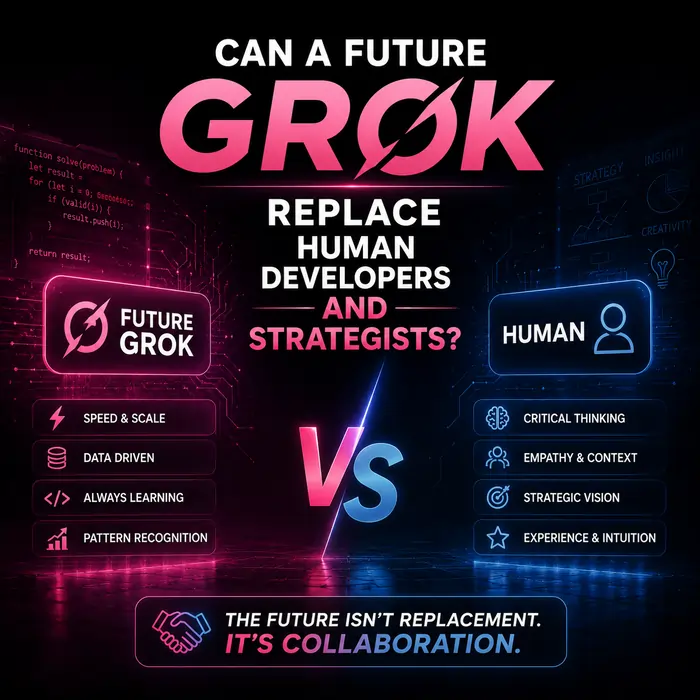
Can a Future Grok Replace Human Developers and Strategists?
The Amplification Effect
This question comes up in almost every conversation about advanced AI models, and it deserves a nuanced answer rather than the utopian or apocalyptic extremes that dominate social media discourse.
The short and honest answer is: probably not completely, and certainly not in the near term. But the more important answer is that this may be asking the wrong question entirely. The relevant question isn’t whether AI will replace human professionals, but how dramatically it will amplify the productivity and capability of those who learn to work with it effectively.
How AI Amplifies Professional Capabilities
Models like the predicted Grok V9-Medium are best understood as true “developer amplifiers” or “strategist amplifiers.” They help professionals:
Code faster by handling boilerplate and letting humans focus on architecture
Debug quicker by analyzing error patterns across vast codebases in seconds
Brainstorm solutions by bringing knowledge from adjacent domains
Automate repetitive tasks that consume time without adding proportionate value
Prototype rapidly at speeds previously impossible
Research efficiently across massive information spaces
The Growing Gap
The same dynamic applies to SEO and digital marketing. AI won’t replace the most experienced strategists who understand the subtle interplay of brand, audience, market dynamics, and business objectives. But AI-assisted SEOs—those who integrate these tools deeply into their workflows—will soon operate on an entirely different playing field.
The gap isn’t just going to widen. It’s going to become a chasm.
Why a Future Grok Will Feel Genuinely Different to Use
The Personality Factor in AI Assistants
This is perhaps the most difficult quality to articulate until you’ve experienced it firsthand, but it’s also one of the most important differentiators in a market where technical capabilities are constantly being matched and exceeded.
The subjective experience of interacting with an AI—its personality, its conversational rhythm, its willingness to engage with ideas rather than just dispense information—matters enormously for sustained, creative work.
The Grok Difference
Already in Grok 4.3 Beta, you get a palpable sense of a more conversational and willing-to-experiment personality. There’s a spark that’s hard to quantify but easy to recognize. The model doesn’t feel like it’s reading from a carefully vetted corporate script. It feels like it’s thinking alongside you, sometimes challenging your assumptions, sometimes proposing approaches you hadn’t considered.
A V9-Medium could take this quality to entirely new levels. The prediction is for an AI that:
Solves problems creatively rather than defaulting to safe answers
Adapts communication style dynamically to match the user’s energy
Challenges assumptions when logic doesn’t hold
Proposes boundary-pushing approaches that more conservative models avoid
Feels like collaborating with a brilliant engineer rather than talking to a sanitized assistant
Why Personality Matters for Professional Work
That personality difference is a significant, often underappreciated advantage, especially for creative and strategic work. When you’re developing an innovative SEO strategy, debugging a complex system, or brainstorming content approaches for a competitive niche, you need a partner who will push your thinking, not just validate your existing ideas. You need friction and creative tension, not just compliance.
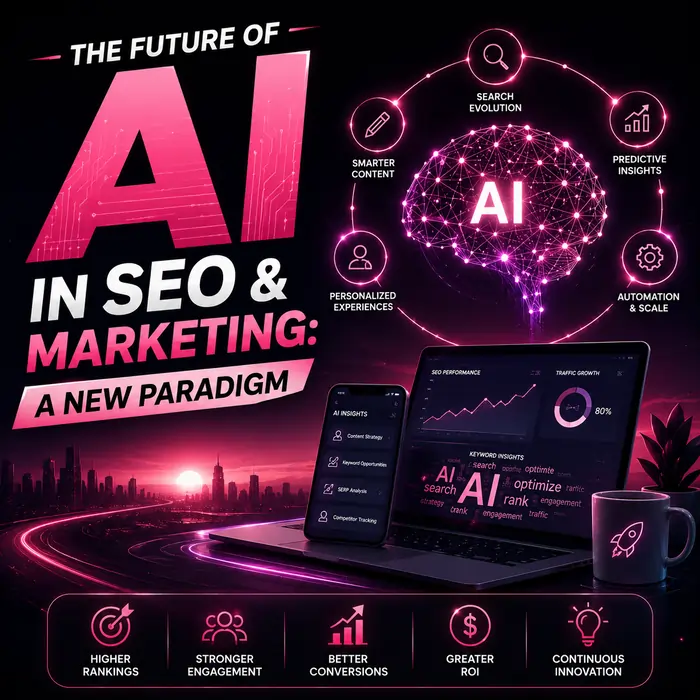
The Future of AI in SEO and Marketing: A New Paradigm
The Shift from Search Engines to Answer Engines
We are entering a phase of digital marketing that will make the previous decades look almost quaint in retrospect. The shift is as fundamental as the transition from print to digital, or from desktop to mobile.
AI-generated answers are rapidly coming to dominate search results pages, pushing traditional organic listings further down and capturing an ever-increasing share of user attention. Search engines are completing their transformation into answer engines, where users expect immediate, comprehensive responses rather than a list of links.
Key Trends Shaping the Future
Conversational Search Behavior: Users are asking complex questions in natural language and expecting nuanced, contextual responses. This fundamentally changes how we must approach content optimization.
Real-Time Context Criticality: Information that’s even a few months old can be dangerously outdated in fast-moving industries. AI models with real-time data access have a decisive advantage.
AI Visibility as a Ranking Factor: If you’re not appearing in ChatGPT, Google AI Overviews, Gemini, Perplexity, and Claude responses, you’re effectively invisible to a growing segment of searchers.
Entity Optimization: Search engines increasingly understand the world through entities—people, places, things, concepts—rather than just keywords. AI entity optimization becomes critical.
What the Future Demands
This transformation fundamentally alters content strategy at every level. The old playbook is being replaced by a more sophisticated approach requiring:
Deep understanding of semantic search architecture
Mastery of AI entity optimization for knowledge graph representation
Answer engine optimization strategies still being invented
Structured knowledge delivery for both human readers and AI systems
Multi-platform AI visibility across ChatGPT, Gemini, Claude, Perplexity, and Copilot
Final Thoughts: The Real Leap Might Be Just Around the Corner
Why Grok V9-Medium Matters
Based on the clear trajectory visible from Grok 4.3 Beta, the strategic moves xAI is making, and persistent industry rumors, it’s entirely reasonable to predict that xAI is building something designed not just to compete in the AI race, but to lead it.
The company’s willingness to integrate deeply with the X platform gives it a data advantage that competitors can’t easily replicate. Its apparent comfort with a more dynamic, less filtered AI personality appeals to technical users who find overly cautious models frustrating. And its focus on real-time awareness and coding capability targets the two areas where current AI assistantsstill show the most room for improvement.
The Convergence of Capabilities
The combination of an estimated 1.5 trillion parameters providing raw cognitive capacity, Blackwell GPU optimization ensuring that capacity can be deployed with minimal latency, deep Cursor code data training embedding genuine software engineering patterns, and real-time capabilitieskeeping the model grounded in current reality, could make a V9-Medium one of the most transformative AI models we’ve seen since the initial release of ChatGPT reset everyone’s expectations.
Preparing for the Future
In nearly two decades of SEO work, I’ve witnessed many technological shifts that were supposed to change everything. Some did. Many didn’t. But the AI-driven transformation we’re living through now feels categorically different. It’s changing what search engines are, how people seek information, and what it means to be visible in a world where answers are generated, not just retrieved.
The most exciting part is this: the real leap might be just around the corner. We’re at the very beginning, watching foundations being laid for capabilities we can barely imagine. The professionals who lean into this now, who learn to work with AI tools while they’re still evolving, who develop intuition for AI collaboration that can’t be taught in a course—those are the professionals who will define the next era of digital marketing.
The future isn’t coming. It’s already here, distributed unevenly across the early adopters and the skeptics. The only question that matters is which group you’ll belong to when Grok V9-Medium or something like it inevitably arrives and resets the playing field once again.
Frequently Asked Questions
What is the predicted Grok V9-Medium?
An advanced future AI model from xAI, Elon Musk’s artificial intelligence company, likely focused intensely on coding, multi-step reasoning, and real-time data processing capabilities that set it apart from current-generation large language models like ChatGPT, Claude, and Gemini.
How many parameters might it have?
Industry speculation centers on an estimated 1.5 trillion parameters, representing a roughly 3x increase over previous Grok versions and placing it among the largest publicly known language models.
What would make it fundamentally different from ChatGPT?
Beyond raw scale, key differentiators would likely include strong emphasis on real-time internet awareness through X platform integration, developer-focused coding workflows trained on authentic programming data, and a more dynamic, less filtered conversational personality.
Could it genuinely be better for professional coding tasks?
Predictions suggest it could excel in coding scenarios due to deep Cursor code data training, exposure to real-world engineering workflows, and optimization specifically for developer productivity—potentially surpassing ChatGPT, Copilot, and other AI coding assistants.
What exactly is Cursor code data?
Cursor code data refers to programming workflow datasets captured from the Cursor AI-powered development environment, encompassing real debugging sessions, multi-file project structures, and authentic engineering problem-solving patterns.
What is NVIDIA Blackwell architecture?
Blackwell is NVIDIA’s next-generation GPU architecture designed specifically for advanced AI workloads, offering significant improvements in processing speed, inference time, and energy efficiency compared to previous Hopper and Ampere architectures.
Would it have genuine real-time internet access?
Yes, the expectation is deep integration with the X platform, giving Grok V9-Medium real-time awareness of current discussions, breaking news, and emerging trends that models reliant solely on static training data cannot match.
Would it be genuinely useful for SEO work?
The prediction is that it would be exceptionally useful for AI SEO, advanced keyword clustering, comprehensive technical audits, predictive trend analysis, and content strategy developmentrequiring understanding of current search behavior.
What is AI SEO and why is it becoming essential?
AI SEO (also called Answer Engine Optimization or Generative Engine Optimization) is the practice of optimizing digital content for visibility within AI-generated answers, conversational search interfaces, and answer engines like ChatGPT, Google AI Overviews, Gemini, Perplexity, and Claude.
Could it generate genuinely complex production-grade code?
The strong prediction, based on anticipated training and architecture, is yes—highly optimized for complex code generation, sophisticated debugging, and understanding entire project architectures rather than just isolated functions.
When might a V9-Medium actually become available?
Availability would depend on xAI’s specific rollout strategy, testing requirements, and platform access policies, but industry observers don’t expect public availability before 2026 at the earliest.
What industries stand to benefit most?
SEO and digital marketing, software development and DevOps, marketing automation and content strategy, academic and market research, quantitative finance and analysis, and any technology-driven industry depending on current information and complex problem-solving.
Will it utilize advanced reinforcement learning techniques?
The prediction is that it will almost certainly utilize sophisticated reinforcement learning from human feedback (RLHF) and other advanced alignment and capability-enhancement techniques.
Could it surpass Claude for specific professional use cases?
The answer depends on the task. Grok would likely excel in real-time applications and coding workflows, while Claude would maintain advantages in long-form reasoning, extended context processing, and applications requiring particularly cautious safety considerations.
Can AI ultimately replace experienced SEO experts?
AI will continue to automate tactical tasks, but experienced strategists who understand business context, brand nuance, audience psychology, and complex market forces will continue to provide essential human judgment.
Why is this model already generating significant buzz?
The predicted combination of real-time capabilities through X integration, sophisticated coding intelligence trained on authentic development data, and a more open, less restricted conversational style is highly anticipated by developers and marketers.
What does the future of AI-driven SEO actually look like?
A deep focus on conversational search optimization, AI Overview and answer engine visibility, semantic entity understanding, predictive trend analysis, and the fundamental restructuring of content strategy around AI-mediated information discovery across platforms including ChatGPT, Gemini, Claude, Perplexity, Copilot, and Grok.