

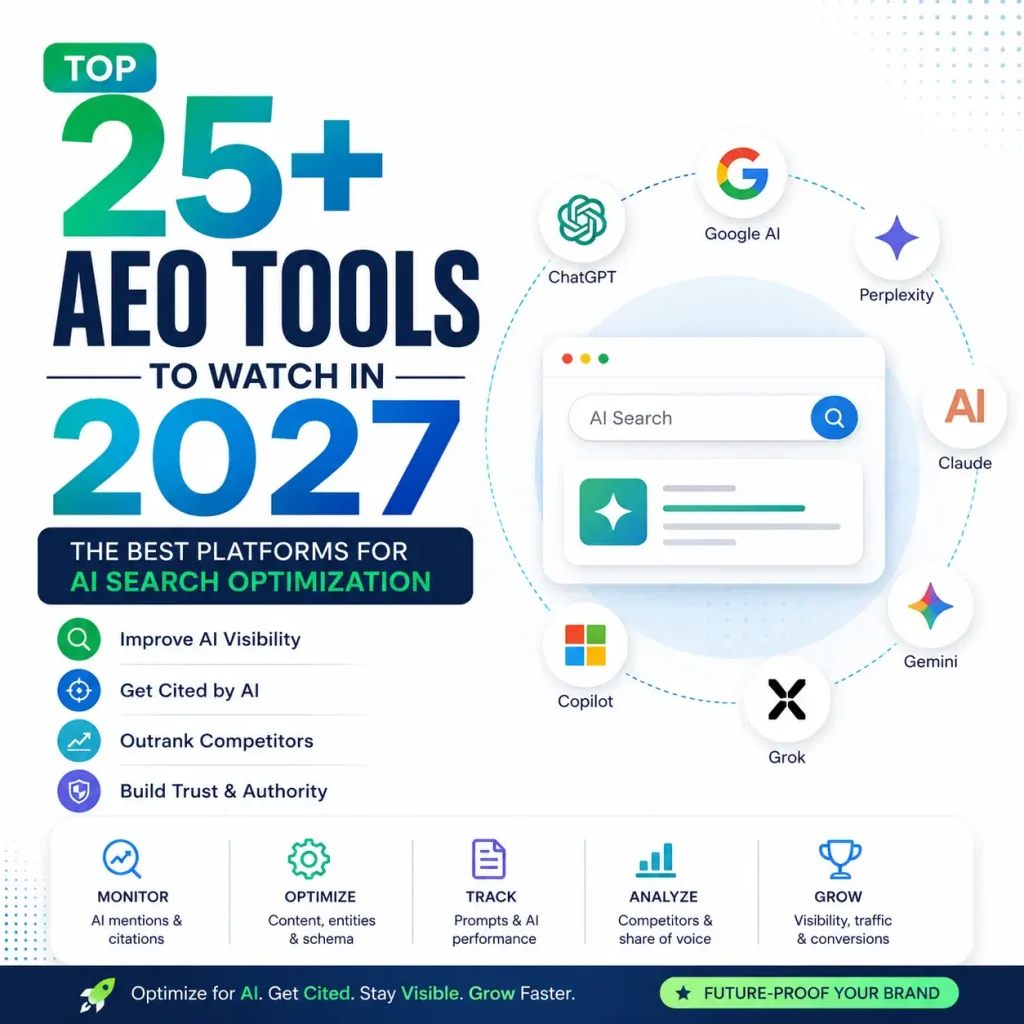
Best AEO Tools 2027 are essential platforms for optimizing content visibility across AI-powered search engines like ChatGPT, Google AI Overviews, Perplexity, Claude, and Gemini. These Answer Engine Optimization tools help businesses track AI citations, monitor brand mentions in generative responses, optimize entity recognition, and measure AI search performance. The top AEO tools for 2027 include RankGid (AI Search Operating System), Profound (enterprise AI visibility), Scrunch AI (AI search monitoring), Otterly AI (brand mention tracking), and Semrush AI Toolkit (integrated AI visibility). These platforms enable marketers to adapt from traditional SEO to AI-first strategies by providing AI citation tracking, knowledge graph optimization, structured data automation, and competitive AI share-of-voice analysis. As AI search continues to reshape digital discovery, investing in the right AEO tools ensures your brand remains visible, authoritative, and consistently cited when AI assistants answer user queries. For comprehensive AI search optimization, prioritize tools that support multi-platform monitoring across ChatGPT Search, Google AI Mode, Perplexity AI, Microsoft Copilot, and emerging LLMs while offering actionable insights for content optimization, entity management, and technical AI readiness.
Introduction: The New Frontier of Search
If there is one truth I have learned in my 18+ years of building technical growth systems and strategic roadmaps, it is this: search is not static; it is evolutionary.
For two decades, we optimized for ten blue links. We chased algorithms, built backlinks, and tweaked meta tags. But as we move deeper into 2027, the paradigm has fundamentally shifted. We are no longer just optimizing for traditional search engines; we are optimizing for answers.
Welcome to the era of Answer Engine Optimization (AEO) and Generative Engine Optimization (GEO).
Today’s users are not just typing queries into a search bar; they are asking conversational questions to OpenAI ChatGPT, Google AI Overviews, Google AI Mode, Perplexity AI, Microsoft Copilot, Anthropic Claude, Google Gemini, Grok AI, DeepSeek AI, and Qwen AI. These large language models (LLMs) do not just return links—they synthesize information, cite sources, and generate direct answers. If your brand is not the source being cited, you are invisible.
This is Everything You Need to Know About the Best AEO Tools in 2027.
In this comprehensive, premium guide, I will walk you through the Top 25+ AEO tools to watch in 2027.
Whether you are an SEO professional, AI SEO specialist, digital marketer, content strategist, SaaS founder, startup team member, enterprise marketing leader, business owner, technical SEO expert, web developer, agency owner, publisher, product marketer, automation specialist, AI engineer, growth marketer, researcher, or technology enthusiast, this guide is for you.
My philosophy has always been strategy first. Tools are only as powerful as the strategy behind them. That is why I provide direct access to my expertise—no junior staff, just 18+ years of distilled knowledge and 50+ eBooks designed for your self-paced mastery.
Let us dive into the best AI SEO software and AI optimization platforms that will define your AI search strategy this year.
Part 1: Understanding the AEO and GEO Landscape in 2027
Before we evaluate the tools, we must align on the terminology and the mechanics of AI search engine optimization. The shift from traditional SEO to AI-driven search requires a fundamental rewiring of how we approach digital marketing and content marketing.
What is Answer Engine Optimization (AEO)?
Answer Engine Optimization tools focus on structuring your content so that AI systems can easily extract, understand, and cite your information as the definitive answer to a user’s query. Unlike traditional SEO, which aims for a click, AEO aims for a citation. It is about becoming the trusted source that AI search engines rely on when formulating responses.
What is Generative Engine Optimization (GEO)?
Generative Engine Optimization tools (or GEO tools) take AEO a step further. They focus on influencing the generative output of LLMs. This involves LLM optimization, RAG optimization (Retrieval-Augmented Generation), and ensuring your brand’s topical authority is recognized by vector search databases and semantic search algorithms. GEO is about shaping the narrative that the AI generates about your brand.
The Core Pillars of AI Search Optimization
To succeed in 2027, your AI content strategy must rest on four unshakeable pillars:
- AI Discoverability & Indexing: Utilizing AI indexing tools and AI indexing automation to ensure AI crawlers can parse your content. This goes beyond traditional technical SEO; it requires AI crawler optimization, ensuring your site architecture is transparent to the bots powering retrieval-augmented generation.
- Entity & Semantic Optimization: Leveraging entity SEO tools, structured data tools, and schema markup tools for knowledge graph optimization. AI entity extraction relies on clear, machine-readable relationships between your brand, your products, and your industry.
- AI Content Optimization: Using AI content briefs, content clustering tools, and AI content generation to build comprehensive, authoritative resources that LLMs trust. This is the heart of AI content optimization and AI answer optimization.
- AI Search Analytics & Monitoring: Deploying AI visibility tools, AI citation tools, and AI search monitoring platforms to track AI brand mentions, AI citations, and overall AI search performance. You cannot improve what you do not measure, making AI search insights critical for AI reputation management.
Part 2: Top 25+ Best AEO Tools 2027 to Watch
I have evaluated dozens of platforms based on their ability to deliver actionable AI search analytics, streamline AI workflow automation, and provide robust AI search monitoring. Here are the best AEO tools and AI search optimization tools you need to know to stay ahead of the curve.
1. RankGid — AI Search Operating System
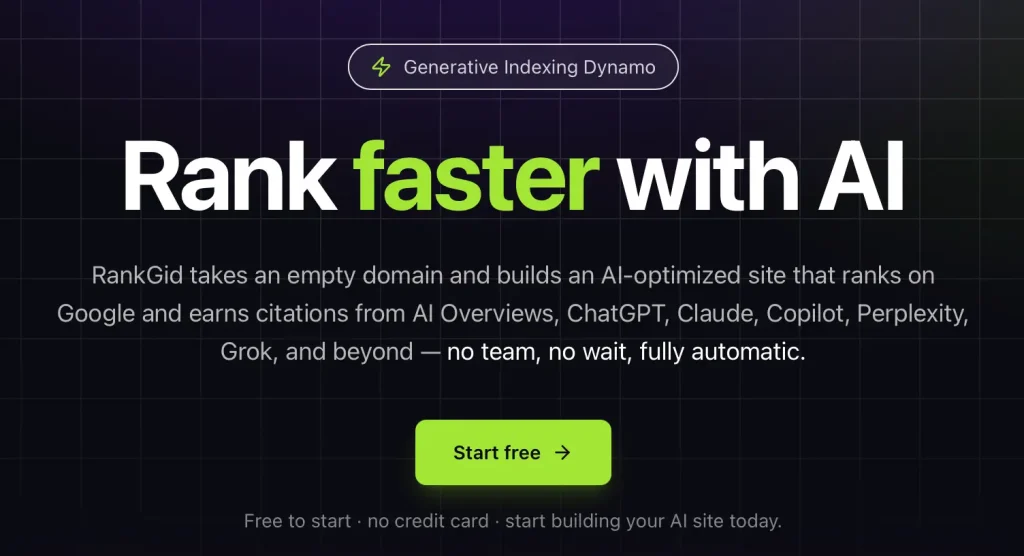
Best for: End-to-end AI search optimization and workflow automation.
Why it matters: RankGid is not just another tool; it is a comprehensive AI Search Operating System (AI Search OS). In my strategic roadmaps, I recommend platforms that consolidate fragmented workflows. RankGid does exactly this. It combines AI keyword research, AI entity extraction, topical map generation, AI content briefs, AI-powered article creation, schema markup tools, internal linking, image generation, WordPress publishing, IndexNow submission, AI citation tracking, prompt monitoring, competitor AI share of voice, and visibility reporting.
2027 Outlook: RankGid stands out for its unified dashboard covering ChatGPT Search optimization, Google AI Overviews optimization, Perplexity optimization, Claude optimization, Gemini optimization, Copilot optimization, Grok optimization, DeepSeek optimization, and Qwen optimization. It is the ultimate AI optimization software for brands serious about AI-first SEO.
2. Profound
Best for: Enterprise AI visibility and citation analytics.
Why it matters: Enterprise AEO requires enterprise-grade data. Profound helps large organizations understand exactly how AI platforms reference their content versus their competitors. It excels in measuring AI visibility, tracking AI citations, and monitoring brand presence across multiple answer engines.
2027 Outlook: As AI search ranking factors become more complex, Profound’s ability to provide granular AI search insights makes it a cornerstone for enterprise AI SEO teams managing AI reputation management.
3. Scrunch AI
Best for: Enterprise AI search monitoring.
Why it matters: Scrunch AI enables organizations to continuously monitor how their brands appear in AI-generated responses. It identifies gaps in AI answer optimization and analyzes overall AI search performance across fragmented AI ecosystems.
2027 Outlook: With its robust AI search monitoring capabilities, Scrunch AI is essential for ensuring your brand maintains AI discoverability at scale.
4. Otterly AI
Best for: AI mention tracking for SMBs and mid-market companies.
Why it matters: Otterly AI specializes in tracking AI brand mentions across emerging AI search engines. It simplifies the complex world of AEO platforms into an accessible dashboard for marketers who need to know when and how AI assistants reference their websites.
2027 Outlook: A highly effective AI citation tool for businesses transitioning from traditional digital marketing to AI marketing.
5. Peec AI
Best for: Brand visibility across AI platforms.
Why it matters: Peec AI provides deep AI search analytics, citation monitoring, and competitive insights. It helps businesses reverse-engineer why certain brands are cited in AI Overviews while others are ignored, providing a clear path to AI search strategy refinement.
2027 Outlook: Peec AI is rapidly becoming a favorite among growth marketers looking for actionable AI search insights to refine their AI content strategy.
6. Goodie AI
Best for: AI-driven content auditing and optimization.
Why it matters: Goodie AI focuses on AI content auditing, scanning existing content libraries to identify gaps in semantic SEO and entity optimization. It provides actionable recommendations to align legacy content with modern LLM optimization standards.
2027 Outlook: An invaluable AI content optimization tool for publishers and SaaS companies with large, aging content repositories needing a AI-first SEO overhaul.
7. Waikay
Best for: AI workflow automation and publishing.
Why it matters: Waikay streamlines the bridge between AI content generation and AI publishing tools. It ensures that AI-generated or AI-assisted content is automatically formatted with the correct structured data tools and published with optimal AI indexing automation.
2027 Outlook: A key player in SEO automation and AI automation, reducing the manual overhead of AI-first SEO for lean teams.
8. AthenaHQ
Best for: GEO and AEO optimization.
Why it matters: AthenaHQ is built specifically for the nuances of Generative Engine Optimization tools. It focuses on knowledge graph optimization and ensuring your brand’s entities are correctly mapped in the databases that power retrieval-augmented generation (RAG).
2027 Outlook: As vector search becomes more prevalent, AthenaHQ’s focus on semantic search alignment will make it a critical AI optimization platform.
9. HubSpot AI Search Grader
Best for: Marketing teams already in the HubSpot ecosystem.
Why it matters: HubSpot has integrated AI search analytics directly into its CRM and content marketing platform. The AI Search Grader evaluates your content’s readiness for AI Overviews and ChatGPT Search, aligning AEO software with inbound content marketing.
2027 Outlook: Perfect for teams wanting to unify AI content marketing and AI analytics without leaving their existing tech stack.
10. Semrush AI Toolkit
Best for: Existing Semrush users expanding into AI search.
Why it matters: Semrush has extended its legendary SEO platform with dedicated AI visibility tools. The Semrush AI Toolkit helps marketers monitor AI search performance alongside traditional organic rankings, providing a unified view of search experience optimization.
2027 Outlook: A reliable, all-in-one solution for agencies and SaaS SEO professionals who need AI search monitoring integrated with classic technical SEO.
11. Ahrefs Brand Radar
Best for: Brand monitoring and AI citation tracking.
Why it matters: While traditionally a backlink tool, Ahrefs Brand Radar now tracks AI brand mentions, authority signals, and AI citations. It complements its established SEO toolkit by showing how your brand is referenced in generative AI outputs.
2027 Outlook: An essential AI citation tool for understanding the correlation between traditional backlinks and emerging AI search ranking factors.
12. Mangools AI Search Grader
Best for: Free AI readiness audits and SMBs.
Why it matters: Mangools offers an accessible entry point into Answer Engine Optimization tools. The AI Search Grader provides a quick, actionable audit of how well your site is structured for AI crawler optimization and AI discoverability.
2027 Outlook: A fantastic starting point for startups and small businesses dipping their toes into AI-first SEO.
13. Authoritas
Best for: Enterprise-level programmatic SEO and AI visibility.
Why it matters: Authoritas handles massive datasets, making it ideal for enterprise SEO and enterprise AEO. It tracks thousands of keywords and entities across multiple AI platforms, providing deep AI search insights and AI search analytics.
2027 Outlook: The go-to AI optimization software for large publishers and global brands managing complex AI content strategy at scale.
14. RankScale.ai
Best for: AI search ranking tools and predictive analytics.
Why it matters: RankScale.ai uses machine learning to predict how changes in your AI content strategy will impact your visibility in large language models. It is a forward-looking AI search ranking tool.
2027 Outlook: As AI search trends 2027 favor predictive modeling, RankScale.ai helps teams stay ahead of algorithmic shifts in OpenAI ChatGPT and Google Gemini.
15. Nightwatch
Best for: Comprehensive AI and traditional SEO rank tracking.
Why it matters: Nightwatch has evolved to include AI search monitoring, allowing users to track rankings not just on Google, but in AI Overviews and other generative interfaces. It offers beautiful, client-ready AI search analytics reports.
2027 Outlook: A top choice for agencies needing to report on both traditional digital marketing KPIs and emerging AEO platforms metrics.
16. Rankshift
Best for: Tracking the shift from traditional clicks to AI citations.
Why it matters: Rankshift specializes in measuring the “cannibalization” or “augmentation” effect of AI search. It helps you understand if AI Overviews are stealing your traffic or if your AI answer optimization is driving new, high-intent AI traffic attribution.
2027 Outlook: Crucial for AI search strategy planning and justifying AI marketing budgets to stakeholders.
17. ZipTie.dev
Best for: Developers and technical SEO experts.
Why it matters: ZipTie.dev is an AI developer tool focused on AI APIs and AI indexing automation. It helps web developers implement advanced schema markup tools, server-side rendering for AI crawlers, and optimized AI technical SEO architectures.
2027 Outlook: As AI automation requires deeper technical integration, ZipTie.dev bridges the gap between AI engineer workflows and SEO automation.
18. Knowatoa
Best for: Knowledge graph and entity management.
Why it matters: Knowatoa focuses heavily on knowledge graph optimization and entity SEO tools. It helps brands build, verify, and expand their digital entities, ensuring AI entity extraction processes correctly identify and associate your brand with its core topics.
2027 Outlook: A foundational semantic SEO tool for any serious AI-first SEO initiative.
19. Writesonic GEO
Best for: AI content generation optimized for generative engines.
Why it matters: Writesonic has pivoted beyond generic copywriting to offer Writesonic GEO, a suite specifically designed for Generative Engine Optimization tools. It creates content with built-in AI content briefs, content clustering, and schema markup ready for RAG optimization.
2027 Outlook: A powerful AI publishing tool for teams that need high-volume, high-quality AI content generation tailored for LLM optimization.
20. Surfer SEO
Best for: Data-driven AI content optimization.
Why it matters: Surfer SEO remains a titan in AI content optimization. Its NLP-based recommendations ensure your content covers the exact entities and semantic variations that AI search engines look for when synthesizing answers.
2027 Outlook: Continues to be a staple AI optimization platform for content strategists and technical SEO experts alike.
21. Clearscope
Best for: Topical authority and content grading.
Why it matters: Clearscope excels as one of the premier topical authority tools. By grading content against the top-performing resources on a topic, it ensures your content is comprehensive enough to be selected by retrieval-augmented generation systems.
2027 Outlook: Essential for AI content auditing and maintaining high standards in AI content marketing.
22. Frase
Best for: AI content briefs and rapid content creation.
Why it matters: Frase combines AI keyword research, AI content briefs, and AI content generation into a seamless workflow. It is particularly strong at analyzing SERPs and AI overview sources to tell you exactly what subtopics to cover.
2027 Outlook: A highly efficient AI workflow automation tool for lean digital marketing teams.
23. MarketMuse
Best for: Enterprise AI content strategy and inventory analysis.
Why it matters: MarketMuse uses advanced AI to analyze your entire content inventory, identifying gaps in topical authority and recommending content clustering tools strategies. It is the brain behind many enterprise AI SEO operations.
2027 Outlook: Unmatched for AI content strategy planning at the enterprise level, ensuring every piece of content serves a strategic AI search engine optimization purpose.
24. InLinks
Best for: Automated internal linking and entity injection.
Why it matters: InLinks automatically identifies entities in your content and suggests (or automates) internal links and schema markup tools implementation. This is pure AI technical SEO gold, directly feeding knowledge graph optimization.
2027 Outlook: A must-have AI automation tool for web developers and technical SEO experts managing large sites.
25. Schema App
Best for: Enterprise structured data management.
Why it matters: Schema App is the industry leader in structured data tools. In the age of AEO, schema markup tools are not optional; they are the primary language AI crawlers use to understand your content. Schema App automates this at scale.
2027 Outlook: Critical for AI crawler optimization and ensuring your content is perfectly parsed for AI citations.
26. WordLift
Best for: Semantic SEO and knowledge graph construction.
Why it matters: WordLift transforms traditional content into a structured knowledge graph. It acts as one of the most powerful semantic SEO tools, using AI entity extraction to link your content internally and externally, boosting AI discoverability.
2027 Outlook: A visionary AI optimization platform for publishers and SaaS SEO teams focused on long-term topical authority.
27. Conductor AI
Best for: Enterprise content optimization and organic growth.
Why it matters: Conductor AI combines enterprise SEO with AI-driven content intelligence. It helps large organizations improve AI discoverability across both traditional search engines and AI assistants, with a strong focus on AI search performance.
2027 Outlook: A robust enterprise AEO solution for brands that need to align organic search with broader AI marketing goals.
28. BrightEdge AI Catalyst
Best for: Enterprise AI search intelligence and reporting.
Why it matters: BrightEdge AI Catalyst offers deep AI search insights, content recommendations, and enterprise-grade reporting. It is designed for large organizations that need to track AI brand mentions and AI search ranking factors across global markets.
2027 Outlook: A heavyweight AI optimization software for Fortune 500 digital marketing teams.
29. SE Ranking AI Visibility
Best for: Small and medium businesses entering AEO.
Why it matters: SE Ranking has added AI visibility tracking to its affordable, user-friendly platform. It allows SMBs to monitor how often their brand appears in AI Overviews without the enterprise price tag.
2027 Outlook: The best budget-friendly AEO platform for startup teams and small agencies.
30. Hall
Best for: Emerging enterprise AI visibility and predictive modeling.
Why it matters: Hall is an emerging player focusing on predictive AI search analytics. It helps enterprise marketing leaders forecast how changes in AI content strategy will impact future AI citations and AI search performance.
2027 Outlook: A cutting-edge AI optimization platform to watch as AI search trends 2027 continue to favor predictive, data-driven decision-making.
Part 3: The Foundational Stack (Do Not Ignore These)
While the specialized AEO tools above are revolutionary, I always remind my clients: do not abandon the foundations. Your AI search strategy must be built on a bedrock of solid technical SEO and classic analytics.
- Google Search Console (GSC): Still the ultimate source of truth for how Google crawls and indexes your site. Monitor for AI crawler optimization issues, new user-agent patterns, and leverage it alongside AI indexing automation strategies.
- Google Analytics 4 (GA4): Essential for tracking user behavior. As AI traffic attribution becomes complex, GA4’s custom dimensions and exploration reports will help you isolate traffic originating from ChatGPT Search, Perplexity AI, and other AI search engines.
- Bing Webmaster Tools: Do not sleep on Bing. Microsoft is aggressively integrating Microsoft Copilot and Grok AI capabilities into its search ecosystem. Bing Webmaster Tools provides unique insights into how Microsoft’s large language models view and index your site.
Part 4: How to Choose the Right AEO Platform for Your Business
With so many AI search optimization tools available, how do you choose? In my 18+ years of consulting, I have found that the “best” tool depends entirely on your organizational maturity, technical resources, and strategic goals. Here is my framework for selection:
1. Define Your Primary Objective
- For AI Citation Tracking: If your main goal is to know when and where you are mentioned, prioritize AI citation tools like Profound, Otterly AI, or Ahrefs Brand Radar.
- For Content Creation & Optimization: If you need to produce content that ranks in AI Overviews, invest in AI content optimization suites like Surfer SEO, Clearscope, MarketMuse, or Writesonic GEO.
- For End-to-End Workflow: If you want a unified system, RankGid is the premier AI Search Operating System that handles everything from AI keyword research to AI publishing tools.
2. Evaluate Enterprise vs. SMB Needs
- Enterprise AEO: Large organizations need enterprise AI SEO platforms like BrightEdge AI Catalyst, Conductor AI, or Authoritas that offer AI APIs, robust AI automation, and deep AI search analytics at scale.
- SMB AEO: Smaller teams should look at SE Ranking AI Visibility, Mangools AI Search Grader, or Frase for cost-effective, high-impact AI optimization software.
3. Assess Technical Capabilities
If you have a strong team of web developers and AI engineers, tools like ZipTie.dev, InLinks, and Schema App will allow you to leverage AI developer tools for deep AI technical SEO and knowledge graph optimization. If your team is more marketing-focused, lean toward no-code AI workflow automation platforms like Waikay or HubSpot AI Search Grader.
4. Check for Multi-Engine Support
The future of SEO is multi-polar. Ensure your chosen AEO platforms support Google AI Overviews optimization, ChatGPT Search optimization, Perplexity optimization, Claude optimization, Gemini optimization, Copilot optimization, Grok optimization, DeepSeek optimization, and Qwen optimization. A tool that only tracks Google is already obsolete.
Part 5: Actionable AI Search Strategy for 2027
Knowing the tools is only half the battle. As I emphasize in my 50+ eBooks, strategy first. Here is my step-by-step framework for implementing an AI-first SEO strategy using these best AI SEO software solutions.
Step 1: Conduct Advanced AI Keyword Research
Move beyond traditional search volume. Use AI keyword research tools to identify conversational, long-tail queries that trigger AI Overviews and ChatGPT Search. Look for “how,” “why,” and “what is” queries that LLMs are likely to synthesize. Focus on intent, not just volume.
Step 2: Map Entities and Build Topical Authority
Use entity SEO tools and topical authority tools like Knowatoa or WordLift. Map out the core entities related to your brand. Ensure your content covers these entities comprehensively using content clustering tools. This feeds directly into RAG optimization, making your site a preferred source for vector search databases.
Step 3: Optimize for AI Crawlers and Indexing
Implement AI technical SEO best practices. Use structured data tools and schema markup tools (like Schema App) to explicitly tell large language models what your content is about. Ensure your site is easily parsable for AI entity extraction. Leverage AI indexing automation to push new content to search engines instantly.
Step 4: Generate and Optimize AI-Ready Content
Utilize AI content briefs from tools like Frase or MarketMuse. Guide your AI content generation to be factual, well-sourced, and structured with clear headings. This is crucial for AI answer optimization. Remember, LLMs favor content that is authoritative, concise, and well-formatted.
Step 5: Automate Publishing and Internal Linking
Use AI publishing tools and AI workflow automation (like Waikay or InLinks) to ensure every published piece is internally linked contextually and enriched with schema markup tools. This strengthens your knowledge graph optimization and creates a dense web of semantic relevance.
Step 6: Monitor, Measure, and Iterate
Deploy AI search monitoring and AI visibility tools like RankGid, Profound, or Scrunch AI. Track your AI citations, AI brand mentions, and overall AI search performance. Use these AI search insights to refine your AI content strategy continuously. This is the core of AI reputation management and search experience optimization.
Part 6: The Future of SEO and AI Search Trends 2027
As we look toward the future of SEO, several AI search trends 2027 are becoming undeniable. Adapting to these trends is not optional; it is a business imperative.
- The Rise of Zero-Click AI Answers: Traditional organic clicks will continue to decline for informational queries. Success will be measured by AI citations and AI brand mentions, not just CTR. AI answer optimization is the new CTR.
- RAG Optimization as a Core Discipline: As retrieval-augmented generation becomes the standard for OpenAI ChatGPT, Anthropic Claude, and Perplexity AI, optimizing your content to be the most relevant retrieved document will be a primary AI search ranking factor.
- Multimodal AI Search: AI engines will increasingly process and cite images, video, and audio. AI discoverability will require optimizing all media types with advanced schema markup tools and descriptive metadata.
- Proprietary LLMs and Walled Gardens: Brands like Google Gemini, Microsoft Copilot, and Qwen AI will increasingly favor their own ecosystems. AI search engine optimization will require platform-specific strategies, making versatile AEO platforms indispensable.
- AI Automation and Developer Convergence: The line between SEO automation and AI automation will blur. AI developer tools and AI APIs will be used to build custom AI optimization software tailored to specific enterprise needs, bridging the gap between marketing and engineering.
Final Thoughts
The future of search is no longer limited to ranking on Google’s traditional search results. Success in 2027 will increasingly depend on whether AI platforms recognize, trust, and cite your brand when answering users’ questions.
The shift from traditional SEO to Answer Engine Optimization (AEO) and Generative Engine Optimization (GEO) is not a temporary trend; it is a fundamental rewiring of how information is discovered, synthesized, and consumed.
While enterprise solutions like Profound, BrightEdge, and Conductor lead the AI visibility space, newer, more holistic platforms such as RankGid are expanding the category by combining SEO, AEO, GEO, AI content generation, and citation monitoring into a single, powerful AI Search Operating System.
As answer engines continue to evolve, investing in the right AEO tools today can help your business remain visible, authoritative, and competitive in the AI-first search landscape.
Remember my core philosophy: Strategy first. Do not just buy a tool and hope for the best. Build a robust AI content strategy, implement flawless AI technical SEO, and use these best AI SEO software solutions to execute with precision.
If you are ready to build a technical growth system that dominates the AI search era, you know where to find me. Direct access, no junior staff, and the strategic roadmap you need to win.
Stay ahead. Optimize for the answer, not just the link.
About the Author: Jin Grey is a Senior SEO Consultant & Author with 18+ years of experience building technical growth systems and strategic roadmaps. He provides direct access to his expertise (no junior staff) and has authored 50+ eBooks for self-paced mastery. His philosophy is simple: Strategy first.