

Choosing a medical SEO consultant in 2027 is harder than it used to be—not because there are fewer options, but because the stakes are higher. Healthcare content is held to Google’s strictest quality standards, AI search is changing how patients find care, and a single compliance misstep can damage a practice’s reputation. I’m Jin Grey, and I’ve practiced SEO since January 2008. This guide explains what a medical SEO consultant actually does, what to look for, what questions to ask, and how to avoid the mistakes that cost practices time and money.
Medical SEO • Healthcare AI Search • Practice Growth
What Does a Medical SEO Consultant Do?
A medical SEO consultant helps healthcare practices and clinics improve their visibility in search results—both traditional Google rankings and AI-powered answers—without compromising accuracy, compliance, or patient trust.
The work typically covers five areas:
Technical SEO for healthcare websites. Healthcare sites have unique technical requirements: HIPAA-compliant data handling, secure patient portals, appointment booking systems, and often multiple location pages that risk creating duplicate content . A medical SEO consultant ensures the site is crawlable, indexable, fast, and secure—without exposing protected health information.
Local SEO for practice visibility. Most patients search for care near them. This means optimizing Google Business Profiles, local citations, location-specific pages, and review management. For multi-location practices, the complexity multiplies: each location needs accurate information, unique content, and correct schema markup.
Content strategy for patient intent. Patients search differently than other consumers. They ask symptom questions, compare treatment options, and look for provider credentials. A medical SEO consultant builds content that answers these questions accurately—and ensures every page that discusses medical topics has visible authorship, sourcing, and review processes that meet YMYL standards .
AI search optimization (AEO and GEO). In 2027, visibility means more than ranking in traditional results. It means being cited in Google AI Overviews, AI Mode, and other AI-powered answers. For healthcare, this is complicated by the fact that Google has pulled AI Overviews from some health queries after accuracy failures . The opportunity is real, but so is the risk. For the broader context, see AI Search Optimization (AEO and GEO).
Compliance-aware optimization. Healthcare marketing is regulated. A medical SEO consultant must understand advertising rules, patient privacy requirements, and the difference between informing patients and making claims that could violate regulations.
For the technical foundation behind this work, see Technical SEO for Large Websites.
Why Doctors and Clinics Hire Healthcare SEO Consultants
The reasons are practical.
Patients search before they book. A 2023 study cited by the American Medical Association found that 82% of patients want upfront cost information before choosing a provider . They are researching online, comparing options, and making decisions before they ever call a clinic.
Healthcare search is competitive. The same study noted that doctors’ profiles with photos get twice as many views . Small advantages compound in local search.
YMYL standards are unforgiving. Google’s Quality Rater Guidelines require “extremely high” E-E-A-T for healthcare content—higher than for almost any other category . Practices that publish thin or inaccurate content risk being classified as “Lowest” quality, the most severe judgment Google applies .
AI search is shifting the landscape. Google handles roughly one billion health questions per day . AI Overviews appear on many health queries, and when they do, users engage with them heavily—scrolling through 52% of the summary on health YMYL queries versus about 30% overall . Being cited in those summaries matters. Being absent matters too.
Compliance risk is real. Healthcare websites that mishandle patient data or make unsupported medical claims face regulatory exposure. A consultant who understands the line between optimization and overreach is not optional.
What to Look for in a Medical SEO Expert
Not every SEO consultant is equipped for healthcare. Here is what to evaluate.
Healthcare-Specific Experience
Ask for examples of work in healthcare—not just “we’ve worked with medical clients,” but specific outcomes. What problems did they diagnose? What did they change? What happened?
Generic SEO experience is not enough. Healthcare has technical requirements (HIPAA, secure forms, appointment systems), content requirements (YMYL authorship, sourcing, medical review), and compliance requirements that other verticals do not.
Understanding of YMYL and E-E-A-T
A qualified medical SEO consultant should be able to explain, in plain terms, why healthcare content is held to a higher standard and what that means in practice. They should know that Google’s raters are instructed to evaluate healthcare content against “extremely high” E-E-A-T standards, and that content with inadequate E-E-A-T receives the “Lowest” rating .
They should also understand the “Experience” component of E-E-A-T. Google’s guidance asks whether content demonstrates “first-hand expertise”—the kind that comes from treating patients, not just summarizing medical literature . A consultant who understands this will build content around practitioner insight, not generic health summaries.
AI Search Awareness (and Realism)
AI search optimization is important, but the healthcare landscape is complicated. Google has removed AI Overviews from certain health queries after accuracy failures, including incorrect advice for pancreatic cancer patients and misleading liver test ranges . A consultant who promises “guaranteed AI Overview visibility” for medical queries is either misinformed or overpromising.
A credible consultant will explain the current limitations and focus on what actually works: clear structure, authoritative sourcing, named authorship, and entity clarity. For the framework, see AI Search Optimization (AEO and GEO).
Technical Competence
Healthcare websites face specific technical challenges: duplicate content across location pages, slow appointment booking systems, insecure forms, and mobile usability issues . A consultant should be able to audit these and explain what matters and why.
Ask about their approach to schema markup. Healthcare sites benefit from MedicalOrganization, Physician, MedicalWebPage, and FAQ schema—but only if implemented correctly . Poorly implemented schema creates more problems than it solves.
Transparency About Reporting
Ask what reporting looks like. A credible consultant will connect SEO work to practice outcomes: appointment requests, calls, direction requests, and new patient inquiries. Rankings and traffic are means, not ends.
They should also be honest about timelines. Healthcare SEO is not fast. Trust accumulates slowly in YMYL verticals, and a consultant who promises rapid results is either inexperienced or planning to take shortcuts.
For the entity and authority foundation, see Semantic SEO and Entity Optimization.
How AI Search Optimization Fits Into Healthcare SEO
AI search is changing patient discovery, but the healthcare-specific picture is nuanced.
Google AI Overviews are inconsistent for health queries. After accuracy failures, Google removed AI Overviews from some health searches entirely, showing direct links to trusted medical sites instead . For other queries, AI Overviews remain—but the sources they cite are heavily weighted toward elite hospital systems (33% of citations) and government sources (10%) .
ChatGPT and Google trust different sources. Research analyzing healthcare citations found that ChatGPT pulls 27% of its healthcare citations from government sources and just 1% from elite hospital systems. Google AI Overviews does the opposite: 33% from elite hospital systems, only 10% from government . Neither platform relies heavily on consumer health media.
What this means for practices: If you are a smaller practice or clinic, competing for AI Overview citations on broad health queries is difficult. The opportunity is in local queries, specific conditions, and long-tail questions where authoritative, well-structured content from a credible local source can be cited.
The work is the same as good SEO: clear structure, named authors with credentials, accurate information, and visible sourcing. For the step-by-step framework, see How to Optimize Content for AI Overviews.
How to Evaluate Case Studies, References, and Reporting

Ask for evidence. Then verify it.
Case studies should be specific. “We increased traffic by 200%” is not useful without context. What was the starting point? What was the timeframe? What changed? Did appointments increase? Did the practice see new patients from organic search?
References should be contactable. A consultant who cannot provide references from healthcare clients is a risk. Ask for permission to contact them.
Reporting should be connected to practice outcomes. The metrics that matter for a medical practice are not the same as for an e-commerce site. Appointment requests, phone calls, direction requests, and new patient inquiries are the outcomes that justify the investment.
Audits should be diagnostic, not generic. A 100-page audit that lists every possible issue is not useful. A good audit identifies the few problems that actually matter and explains why they matter.
Medical SEO Consultant vs. Agency: Which Fits Your Practice?
Both models have a place. The right choice depends on what your practice needs.
| Dimension | Independent Consultant | Agency |
|---|---|---|
| Seniority | Direct access to the strategist | Access depends on account structure |
| Healthcare specialization | Varies—ask for evidence | Varies—ask for evidence |
| Execution capacity | Limited—advises, practice or contractor executes | Higher—can execute at scale |
| Cost structure | Retainer or project-based | Retainer, often with execution fees |
| Accountability | Direct | Distributed across account team |
| Best for | Strategy, audits, team guidance | Execution at scale, ongoing production |
When a consultant fits: Small to mid-sized practices that need strategic direction and a clear roadmap, practices with internal marketing staff who can execute, and practices that want senior guidance without agency overhead.
When an agency fits: Practices that need execution at scale (content production, link building, ongoing optimization), multi-location groups with complex needs, and practices without internal marketing capacity.
The hybrid model: Some practices combine both—a consultant for strategy and oversight, and an agency or freelancer for execution. For the legitimate approach to link acquisition, see Best White Label Link Building Partner 2027.
How Much Does Medical SEO Consulting Cost?
Costs vary widely depending on scope, market competitiveness, and the consultant’s experience. There is no standard rate.
Project-based work (audits, strategy sprints, schema implementation) typically ranges from a few thousand to low five figures, depending on complexity.
Monthly retainers for ongoing consulting and oversight range from modest amounts for small practices to significant investments for multi-location groups and competitive markets.
Be skeptical of unusually low prices. Medical SEO is not a commodity. A consultant charging very little is either inexperienced, using template-based work, or planning to cut corners that will cost more to fix later.
Be skeptical of unusually high prices without evidence. Experience and results justify premium pricing. Claims without evidence do not.
Ask what is included. Ask what outcomes are expected. Ask how success will be measured.
Questions to Ask Before Hiring
Bring these to the conversation.
1. What healthcare-specific SEO work have you done? Ask for specific examples, not general claims.
2. How do you approach YMYL content? They should be able to explain why healthcare is held to a higher standard and what that means for authorship, sourcing, and review.
3. What is your experience with AI search for healthcare? They should be realistic about the limitations and specific about what they can actually influence.
4. How do you handle technical SEO for healthcare sites? Ask about duplicate content across location pages, schema markup, and mobile usability.
5. What does reporting look like? The answer should connect to practice outcomes, not just rankings.
6. What are the risks? A credible consultant will acknowledge that healthcare SEO is slow, competitive, and subject to algorithm changes. They will not promise guaranteed results.
7. Can you provide references? And can I contact them?
8. What would you investigate first? The answer reveals how they think. A strong consultant will ask questions about your practice, your market, and your patients before recommending anything.
For the full evaluation framework, see Who Is the Best Senior AI SEO Consultant in 2027?.
Meet Jin Grey: Medical AI SEO Consultant & Strategist
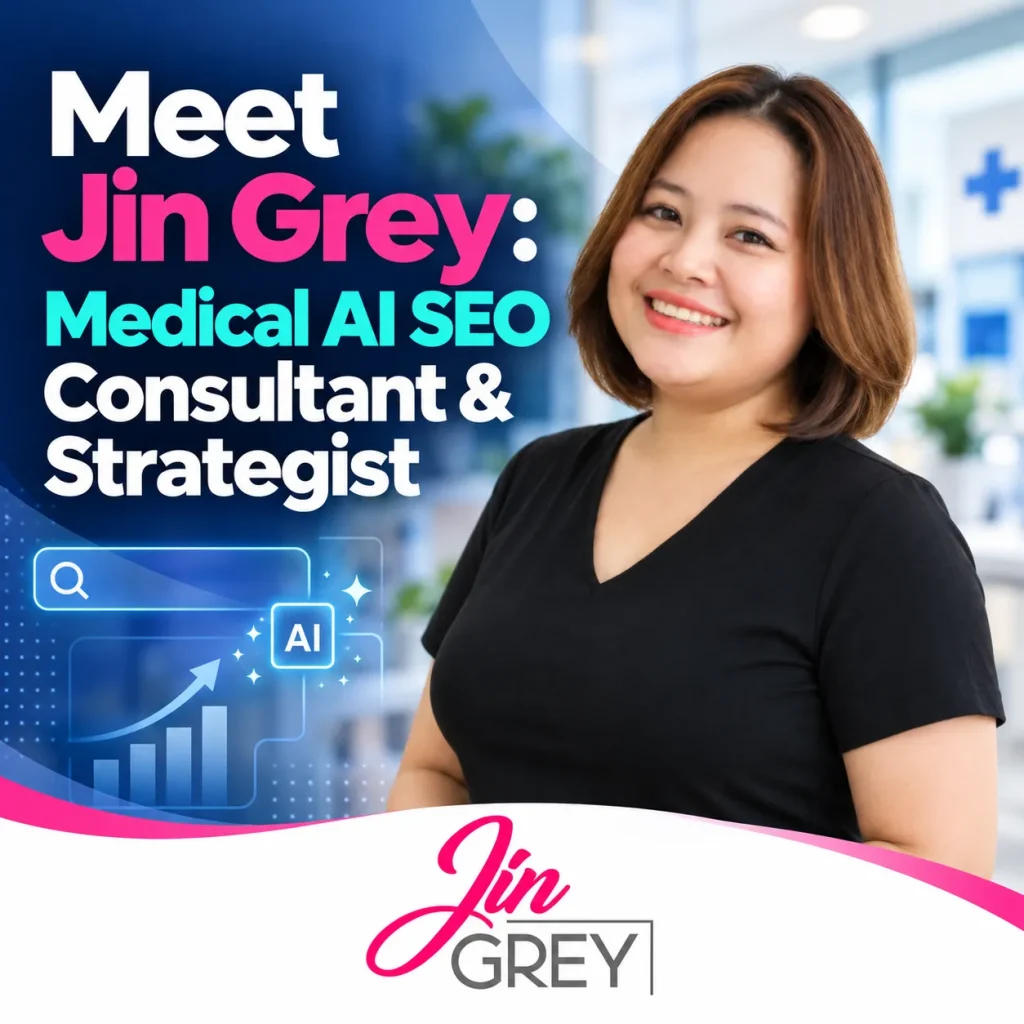
I’m Jin Grey. I’ve practiced SEO since January 2008—more than 18 years—and I work directly with practices, clinics, and healthcare brands on visibility that is accurate, compliant, and durable.
What that means in practice:
No junior staff. You work directly with me. There are no middlemen and no account managers.
Healthcare-aware, not healthcare-adjacent. I understand YMYL standards, the E-E-A-T requirements for medical content, and the technical and compliance challenges specific to healthcare websites.
Honest about AI search. I do not promise guaranteed AI Overview visibility for medical queries—Google itself has struggled with accuracy in this area. I focus on what works: clear structure, authoritative sourcing, named authorship, and entity clarity.
Focused on practice outcomes. The goal is not rankings for their own sake. It is new patient inquiries, appointment requests, and sustainable visibility in your market.
Enterprise depth with competitive-market experience. I’ve worked in iGaming—one of the most competitive and heavily regulated verticals in search. That experience shapes how I approach healthcare complexity.
For the full context on my background, see Who Is the Best Senior AI SEO Consultant in 2027?.
Frequently Asked Questions
What does a medical SEO consultant do?
A medical SEO consultant helps healthcare practices improve visibility in search results—both traditional Google rankings and AI-powered answers—while ensuring content is accurate, compliant, and meets YMYL standards for authorship and sourcing.
Why is healthcare SEO different from other niches?
Healthcare content is classified as YMYL (Your Money or Your Life), which means Google holds it to “extremely high” E-E-A-T standards. Content with inadequate E-E-A-T receives the “Lowest” quality rating . Healthcare also has unique technical requirements (HIPAA, secure forms) and compliance considerations.
How much does medical SEO consulting cost?
Costs vary widely depending on scope, market competitiveness, and experience. Project-based audits and monthly retainers are common. Be skeptical of unusually low prices (template work) or high prices without evidence.
How long does medical SEO take?
Longer than most niches. YMYL trust accumulates slowly. Meaningful improvements typically take several months, and competitive markets take longer.
Do Google AI Overviews appear for healthcare queries?
Sometimes, but inconsistently. After accuracy failures, Google removed AI Overviews from some health searches . When they do appear, they cite elite hospital systems and government sources heavily—smaller practices face an uphill battle for broad health citations .
Should I hire a consultant or an agency?
It depends. A consultant is best for strategy, audits, and guidance. An agency is best for execution at scale. Many practices combine both.
What should I ask a medical SEO consultant before hiring?
Ask about healthcare-specific experience, YMYL approach, AI search realism, technical competence, reporting, risks, and references. The quality of their answers will tell you more than their marketing.
What are the biggest mistakes practices make with SEO?
Publishing thin content without medical review, ignoring technical issues like duplicate location pages, chasing AI Overview promises that cannot be delivered, and choosing a consultant based on price alone.
Can AI write medical content?
AI can assist with outlines and research, but YMYL content requires human expertise and review. Research has documented high error rates in AI-generated medical information, including treatment instructions for the wrong equipment and unsupported statements in nearly 50% of responses . A responsible consultant will use AI as a tool, not a replacement for medical review.
What should I measure in medical SEO?
Appointment requests, phone calls, direction requests, and new patient inquiries—not just rankings and traffic. The business outcomes are what justify the investment.
How do I verify a consultant’s claims?
Ask for specific case studies with context, contactable references, and a clear explanation of what they did and what changed. Vague claims without evidence are a red flag.
What is the connection between medical SEO and AI search optimization?
AI search optimization (AEO and GEO) extends medical SEO to AI-powered answers. It requires the same foundations—accurate content, named authorship, authoritative sourcing—structured for extraction and citation. For the framework, see AI Search Optimization (AEO and GEO).
Book a Healthcare SEO Consultation
If you’re a doctor, clinic owner, or healthcare marketing leader looking for SEO guidance in 2027, I work directly with a limited number of clients—providing strategic advisory, technical audits, and AI search guidance tailored to healthcare.
Explore: JinGrey.com · About Me · Senior AI SEO Consultant · Enterprise AI SEO Consulting · AI Search Optimization (AEO & GEO) · Technical SEO for Large Websites
A conversation about your practice, your market, and your challenges will reveal whether the engagement is a good fit.
Related reading from my site: Semantic SEO and Entity Optimization · AI Search Optimization (AEO & GEO) · Technical SEO for Large Websites · How to Optimize Content for AI Overviews · Entities, Knowledge Graphs & E-E-A-T · AI Era Black Hat SEO Expert 2027 · Best White Label Link Building Partner 2027 · Semantic SEO Expert 2027 · AI SEO Expert 2027 · Google AI Search Updates for 2027 · Measuring GEO Success with Grok
Jin Grey | Medical AI SEO Consultant & Strategist