





Rank Math Pillar Content and Topic Clusters for Topical Authority in 2026.
If you want stronger rankings in 2026, you cannot rely on random blog posts anymore. You need pillar content and topic clusters that show clear topical depth, supported by smart internal links powered by Rank Math SEO.
In this guide, you will learn how to use the Pillar Content feature in Rank Math, how to design topic clusters, and how this structure helps with SEO, AEO, GEO, and knowledge‑graph style authority.
This article is part of my Rank Math series, together with Rank Math SEO: The Ultimate Guide to Optimizing Your WordPress Site and Advanced Rank Math Features: Schema, Redirections, and Content AI Explained.
What Is Pillar Content in Rank Math?
Pillar content (or cornerstone content) is a long, evergreen page that covers a broad topic in depth and links to all related subtopics. In Rank Math, you can mark a post or page as Pillar Content so the plugin knows this is a key asset you want to prioritize.
Rank Math uses this flag to:
- Put pillar posts at the top of its link suggestions panel.
- Make it easier to build contextual internal links from newer posts to your most important content.
You can learn more in Rank Math’s own guide: How to Use Pillar Content to Build Internal Links.
Why Topic Clusters Matter for Topical Authority
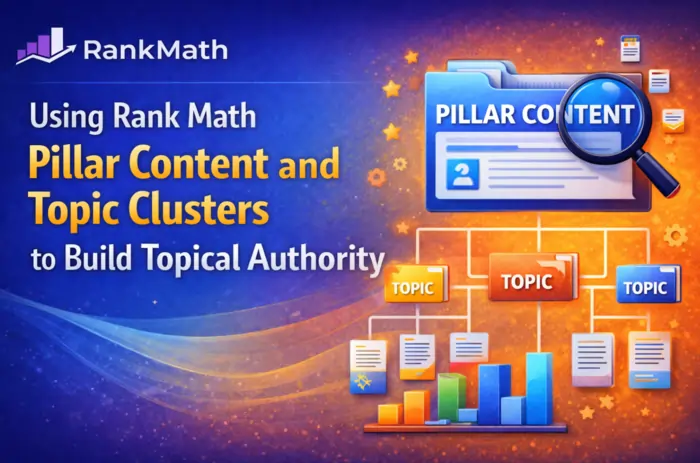
A topic cluster is a group of content where one pillar page covers a main topic and multiple cluster pages go deep into subtopics. All pages in the cluster connect through internal links, which helps both users and search engines understand the hierarchy and depth of your content.
In 2026, search and AI systems reward sites that show:
- Clear topic scope (one pillar that frames the main idea).
- Strong coverage (clusters for definitions, how‑tos, comparisons, FAQs, mistakes, tools, etc.).
- Clean internal links between all these pieces.
Good clusters are not just for Google—they also act as a roadmap for readers, which boosts engagement and trust.
How Rank Math’s Pillar Content Feature Works

Rank Math makes working with pillar content very simple.
Mark a Post or Page as Pillar Content
- Open any post or page in the WordPress editor.
- Scroll to the Rank Math SEO panel.
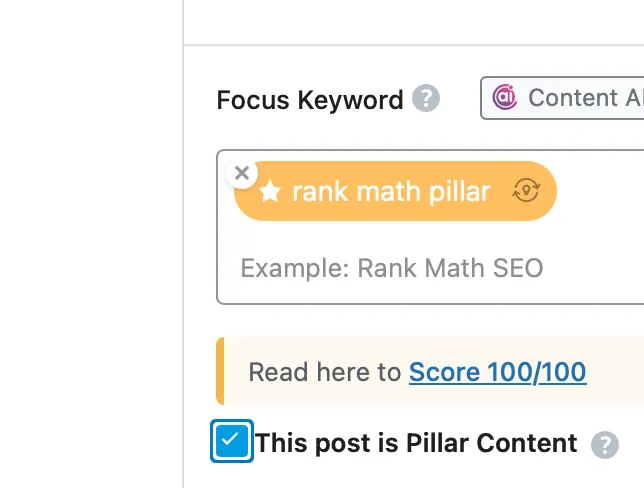
- In the Advanced tab (or General settings, depending on your version), find the Pillar Content toggle.
- Turn it On for your main, evergreen guides.
You can only mark posts, pages, or custom post types as pillar content (not categories or tags), because archives usually have thin content.
See Pillars in Link Suggestions
When you write a new article, Rank Math can show internal link suggestions based on your pillar content and taxonomy. In the editor:
- Open the Link Suggestions section in the Rank Math panel.
- You will see pillar/cornerstone posts at the top of the list.
- You can copy link or insert link directly into your content.
This saves you time and ensures that new cluster articles always link back to your main pillar pages.
Designing a Rank Math Topic Cluster (Example)
On your site, Rank Math SEO is a perfect topic for a cluster. You already have:
- Pillar: Rank Math SEO: The Ultimate Guide to Optimizing Your WordPress Site
- Beginner setup: How to Configure Rank Math SEO Step by Step (For Beginners)
- Advanced features: Advanced Rank Math Features: Schema, Redirections, and Content AI Explained
- This guide: Using Rank Math Pillar Content and Topic Clusters to Build Topical Authority
- Comparison: Rank Math vs Yoast vs All in One SEO: Which WordPress SEO Plugin Should You Use in 2026?
- AEO/GEO: How to Optimize Rank Math for AI Overviews and Answer Engines (AEO Mindset)
This is exactly what many 2026 cluster playbooks recommend: one broad pillar plus multiple focused cluster pages around it.
Internal Linking Rules for Pillar and Cluster Pages
A strong internal linking pattern is what turns separate posts into a real cluster.
Most experts now follow a simple rule:
- Pillar page → links to all cluster pages.
- Every cluster page → links back to the pillar.
- Related cluster pages → link to each other where it makes sense.
This creates a dense network that:
- Concentrates link equity on your pillar page.
- Shows Google and AI that you cover the topic with depth and breadth.
- Helps users move from big picture to specific answers.
You can see this described in more detail here: Powerful Internal Links Strategy to Boost Rankings in 2026. For general internal linking tips, see Rank Math’s Internal Linking for SEO: A Comprehensive Guide.
Using Rank Math to Build Your Rank Math Cluster
Let’s apply this structure directly to your Rank Math content.
Make the Pillar Page the Hub
On https://jingrey.com/seo/rank-math-seo:
- Mark the page as Pillar Content in the Rank Math panel.
- Add contextual links to each cluster article in sections about setup, advanced features, comparisons, and AI/AEO/GEO.
Example anchors:
- “step‑by‑step tutorial” → How to Configure Rank Math SEO Step by Step (For Beginners)
- “advanced Rank Math features” → Advanced Rank Math Features: Schema, Redirections, and Content AI Explained
- “plugin comparison” → Rank Math vs Yoast vs All in One SEO
- “Rank Math for AI Overviews and AEO mindset” → How to Optimize Rank Math for AI Overviews and Answer Engines (AEO Mindset)
Make Cluster Pages Link Back to the Pillar
In each cluster article (beginner, advanced, comparison, AEO/GEO):
- Mark as not pillar (only the main guide should be pillar for this topic).
- Add a clear link back to your main Rank Math pillar in the introduction or conclusion.
Example sentence:
“For a complete overview of Rank Math SEO, see my main guide Rank Math SEO: The Ultimate Guide to Optimizing Your WordPress Site.”
This pattern follows the “hub and spokes” model used in 2026 topic‑cluster strategies.
How Pillar Clusters Support AEO, GEO, and Entity SEO
A strong pillar‑cluster structure helps not just classic SEO, but also AEO (Answer Engine Optimization) and GEO (Generative Engine Optimization).
Key benefits:
- Clear entities and topics: Pillars act as “entity hub pages” that define who you are and what you know.
- Topical authority: Clusters show that you cover every angle—definitions, how‑tos, comparisons, FAQs, mistakes.
- Machine‑readable structure: Internal links and schema help AI engines map your content and trust it.
You can read more about entity‑driven GEO here: Entity SEO for GEO: Build Topical Authority AI Engines Can Trust. For an AI SEO checklist that includes pillar and cluster content, see: AI SEO Checklist: Ultimate 2026 Guide to AEO & GEO Optimization.
Practical Steps: Building a Rank Math Cluster with Rank Math
Here is a simple workflow you can follow inside WordPress with Rank Math:
- Choose the pillar topic
- Example: “Rank Math SEO” as your main topic.
- Plan for 3,000–5,000 words of coverage as a pillar.
- Define cluster topics
- Setup for beginners.
- Advanced features (schema, redirects, Content AI).
- Pillar content and topic clusters (this article).
- Plugin comparison.
- Rank Math for AI/AEO/GEO.
- Write and publish the pillar first
- Mark it as Pillar Content in Rank Math.
- Add internal links out to placeholder URLs for cluster pages or update links as they go live.
- Create and optimize each cluster article
- Use Rank Math SEO for titles, meta, schema, and internal links.
- In each article, link back to the pillar and 1–2 related clusters.
- Use Rank Math’s link suggestions to fill gaps
- As you publish more content, open older posts and use the Link Suggestions panel to add missing links to the pillar.
This simple system follows the patterns that guides on topic clusters and pillar pages recommend for 2026.
Frequently Asked Questions: Pillar Content and Clusters in Rank Math
Can I mark my homepage as pillar content in Rank Math?
You should usually mark long, evergreen posts or pages (not the homepage) as pillar content, because the feature is designed for in‑depth resources, not thin or generic pages.
How many pillar pages should I have on my site?
Most sites only need a small number of pillars—one per major topic or service area; too many pillars can dilute focus and make your internal linking messy.
Do all cluster pages need to link to each other?
Not every cluster must link to every other one, but related clusters should link together where it is natural; all clusters should link back to the pillar.
Does marking content as pillar improve rankings by itself?
The toggle alone does not boost rankings, but it helps Rank Math suggest better internal links, which can strengthen your internal structure and support better rankings over time.
How often should I update my pillar pages?
Update your pillars regularly when tools, best practices, or examples change; fresh, accurate pillar content is a key part of topical authority for SEO, AEO, and GEO.